
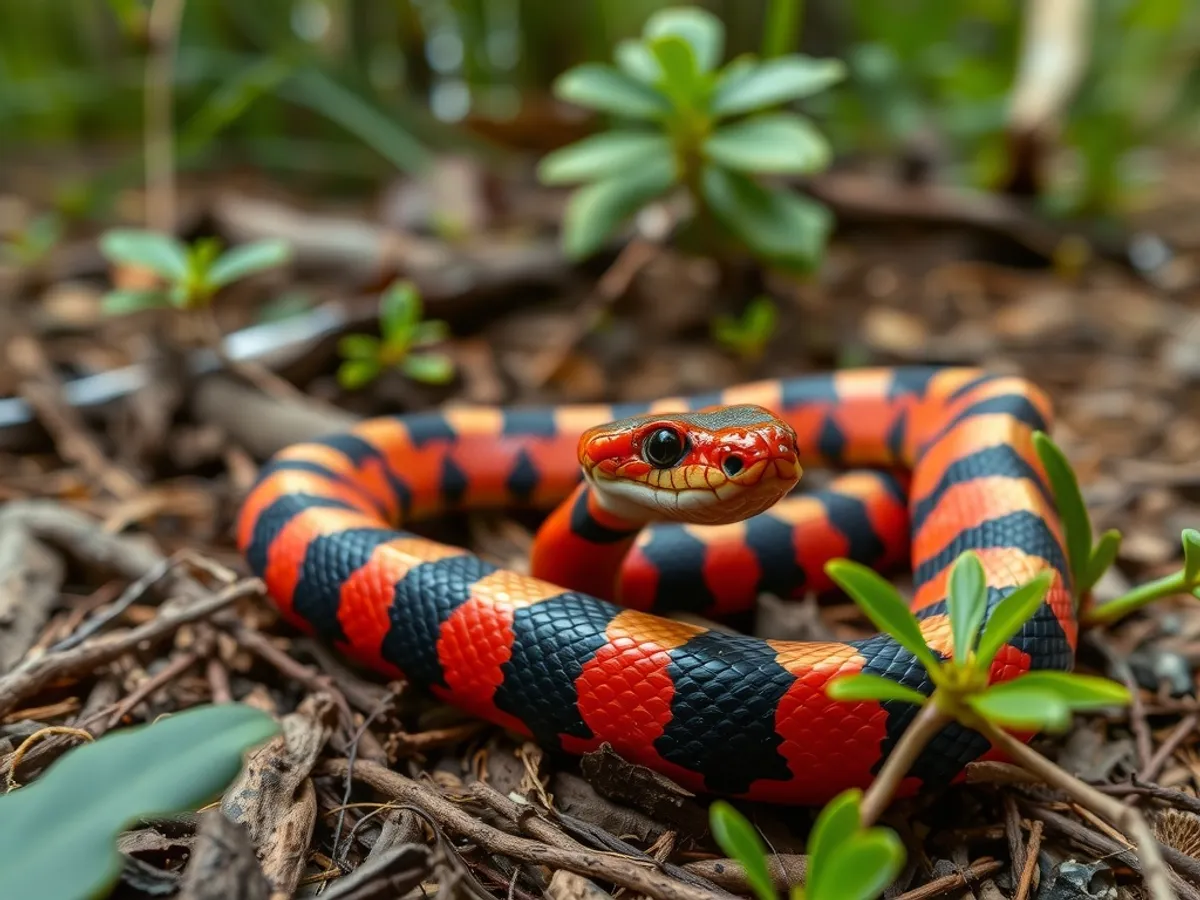
About the Eastern Coral Snake
Micrurus fulvius is North America's most famous elapid and one of its least-encountered snakes. It spends most of its life under leaf litter, logs and sand in the southeastern United States, hunting other snakes and lizards, which it grips and works into its mouth with small, fixed fangs at the front of the jaw. Those fangs are short and cannot be swung like a viper's, so the snake has to hold on and chew, and bites to humans are correspondingly rare — the great majority occur when someone picks one up. The venom is a potent neurotoxin that blocks transmission at the nerve-muscle junction, and its most dangerous property is delay: there may be very little pain or swelling and almost no local damage, and symptoms of paralysis can take up to twelve hours to appear, by which point the victim may believe they escaped. Untreated, death comes from respiratory failure. The old rhyme "red touches yellow, kills a fellow; red touches black, venom lack" genuinely does distinguish it from the harmless scarlet kingsnake and scarlet snake — but only in the United States, and it is useless in Latin America, where coral snakes break the pattern freely. Antivenom supply in the US has been a chronic problem since the sole manufacturer ceased production in the early 2000s.
Fascinating facts
Bright Warning Colors
The Eastern Coral Snake's bands of red, yellow, and black serve as a warning to potential predators that it is venomous.
Potent Neurotoxic Venom
Its venom affects the nervous system and can cause respiratory failure if not treated, though bites are exceptionally rare.
Secretive Lifestyle
This snake spends most of its life hidden under debris or underground, making sightings uncommon even within its range.
Detailed description
The Eastern Coral Snake (Micrurus fulvius) is a slender, medium-sized elapid snake, typically measuring 60–80 cm (24–31 in) in total length, though some individuals may reach up to 122 cm (48 in). Its body is encircled by a distinctive tri-color banding pattern: broad red and black rings separated by narrow yellow rings, with the red and yellow bands always touching—a key feature distinguishing it from non-venomous mimics such as the scarlet kingsnake. The head is blunt and black, often with a yellow band just behind the eyes, and the tail is short with alternating black and yellow rings. The scales are smooth, contributing to its glossy appearance. M. fulvius possesses fixed, proteroglyphous fangs at the front of the upper jaw, delivering a potent neurotoxic venom. This species is highly secretive and fossorial, spending much of its life underground or beneath debris, leaf litter, and logs in sandy pine forests, hardwood hammocks, and scrublands. It is primarily active during the warmer months and exhibits crepuscular or nocturnal activity patterns. The Eastern Coral Snake is solitary, except during the breeding season, and is generally non-aggressive, relying on its cryptic habits and aposematic coloration for defense. Its diet consists mainly of other reptiles, especially small snakes and lizards, as well as amphibians. Despite its potent venom, human fatalities are exceedingly rare due to the snake’s reclusive nature and the availability of antivenom.
Did you know?
The Eastern Coral Snake's venom is among the most potent of any North American snake, but antivenom shortages have made treatment of bites more challenging in recent years.
Research & sources
Wikipedia summary
Micrurus fulvius, commonly known as the eastern coral snake, common coral snake, American cobra, and more, is a species of highly venomous coral snake in the family Elapidae that is endemic to the southeastern United States. The family also contains the cobras and sea snakes.
Behaviour & social structure
Eastern Coral Snakes are predominantly fossorial, spending much of their time hidden beneath leaf litter, logs, or within burrows. They are most active from March to October, with peak activity in spring and fall. Their movements are generally slow and deliberate, and when threatened, they may engage in defensive behaviors such as hiding their head under their coils, elevating and curling the tail, or releasing a musky cloacal discharge. Unlike many snakes, they rarely strike unless persistently provoked. Feeding primarily on other small snakes (including conspecifics), lizards, and occasionally amphibians, they use their venom to quickly immobilize prey, often holding on until paralysis occurs. Hunting is typically done by actively searching through substrate rather than ambushing. Eastern Coral Snakes are solitary, showing no evidence of social structure outside of mating interactions. They are diurnal or crepuscular in cooler months but shift to more nocturnal activity during hot weather.
Reproduction & life cycle
Micrurus fulvius is oviparous, with breeding occurring in late spring (April to June). Females lay clutches of 3–12 elongated, leathery eggs in concealed, moist locations such as under logs or within rotting vegetation. Incubation lasts approximately 60–80 days, with hatching typically occurring in late summer (July to September). Hatchlings measure about 18–23 cm (7–9 in) in length and are fully independent at birth, displaying the same aposematic coloration as adults. There is no parental care post-oviposition. Sexual maturity is reached at approximately 2–3 years of age. Mating behavior is not well documented due to the species’ secretive nature, but males are believed to locate females through pheromone trails.
Adaptations & survival
The Eastern Coral Snake exhibits several notable adaptations for its fossorial and predatory lifestyle. Its smooth, glossy scales reduce friction, aiding in movement through loose soil and leaf litter. The vivid aposematic coloration serves as a warning to potential predators of its potent neurotoxic venom, a classic example of Batesian mimicry in the region. Its small, fixed fangs are highly efficient for delivering venom to small, elongate prey such as other snakes. The venom itself is a complex mixture of neurotoxins, primarily alpha-neurotoxins, which rapidly disrupt synaptic transmission and cause paralysis. The snake’s cryptic habits and reluctance to bite unless provoked are behavioral adaptations that reduce risk of predation and unnecessary energy expenditure. Additionally, its ability to consume other venomous snakes (ophiophagy) is facilitated by physiological resistance to certain snake venoms.
Cultural significance
The Eastern Coral Snake has a prominent place in North American folklore and is often referenced in the rhyme, 'Red touch yellow, kill a fellow; red touch black, friend of Jack,' which helps distinguish it from non-venomous mimics. Its striking coloration has made it a symbol of danger and caution in popular culture. While there are no known traditional medicinal or utilitarian uses, its venom has been the subject of biomedical research for potential applications in pain management and neurobiology. The snake’s reputation as highly venomous has led to both fear and fascination, influencing local attitudes and sometimes resulting in unnecessary killing. Educational outreach efforts have focused on dispelling myths and promoting conservation.
Recent research
Recent research has focused on the molecular composition of Micrurus fulvius venom, revealing a complex array of neurotoxins that target nicotinic acetylcholine receptors. Studies have explored the evolutionary relationships within the genus Micrurus, clarifying species boundaries and genetic diversity using mitochondrial DNA analysis. Ongoing research includes the development of more effective antivenoms and investigation into the ecological impacts of coral snake population declines. Behavioral studies remain limited due to the species' secretive habits, but advances in radio telemetry and environmental DNA (eDNA) techniques are beginning to yield new insights into habitat use and population dynamics.
Videos
Habitat
Sandy pine forests, hardwood forests, and scrublands


Conservation
The Eastern Coral Snake is currently classified as Least Concern on the IUCN Red List.
Threats & challenges
Currently classified as Least Concern by the IUCN, the Eastern Coral Snake faces localized threats primarily from habitat loss due to urbanization, agriculture, and forestry practices that reduce suitable sandy or forested habitats. Road mortality is a significant threat in some areas, as the snakes may cross roads during dispersal or seasonal movements. The decline in populations of small snakes and amphibians, their primary prey, could also impact local populations. Human persecution, often due to mistaken identity or fear, occasionally results in direct mortality. Climate change may alter the distribution and availability of suitable habitats in the future. Despite these challenges, the species remains relatively widespread and stable across much of its range, though local declines have been noted in parts of the southeastern United States.
Taxonomy
Scientific name
Micrurus fulvius
- Kingdom
- Animalia
- Phylum
- Chordata
- Class
- Reptilia
- Order
- Squamata
- Family
- Elapidae
- Genus
- Micrurus
- Species
- fulvius
Community notes
Share your observations about the Eastern Coral Snake.
No community notes yet. Be the first!
Discover more wildlife
More fascinating animals from the encyclopedia.