
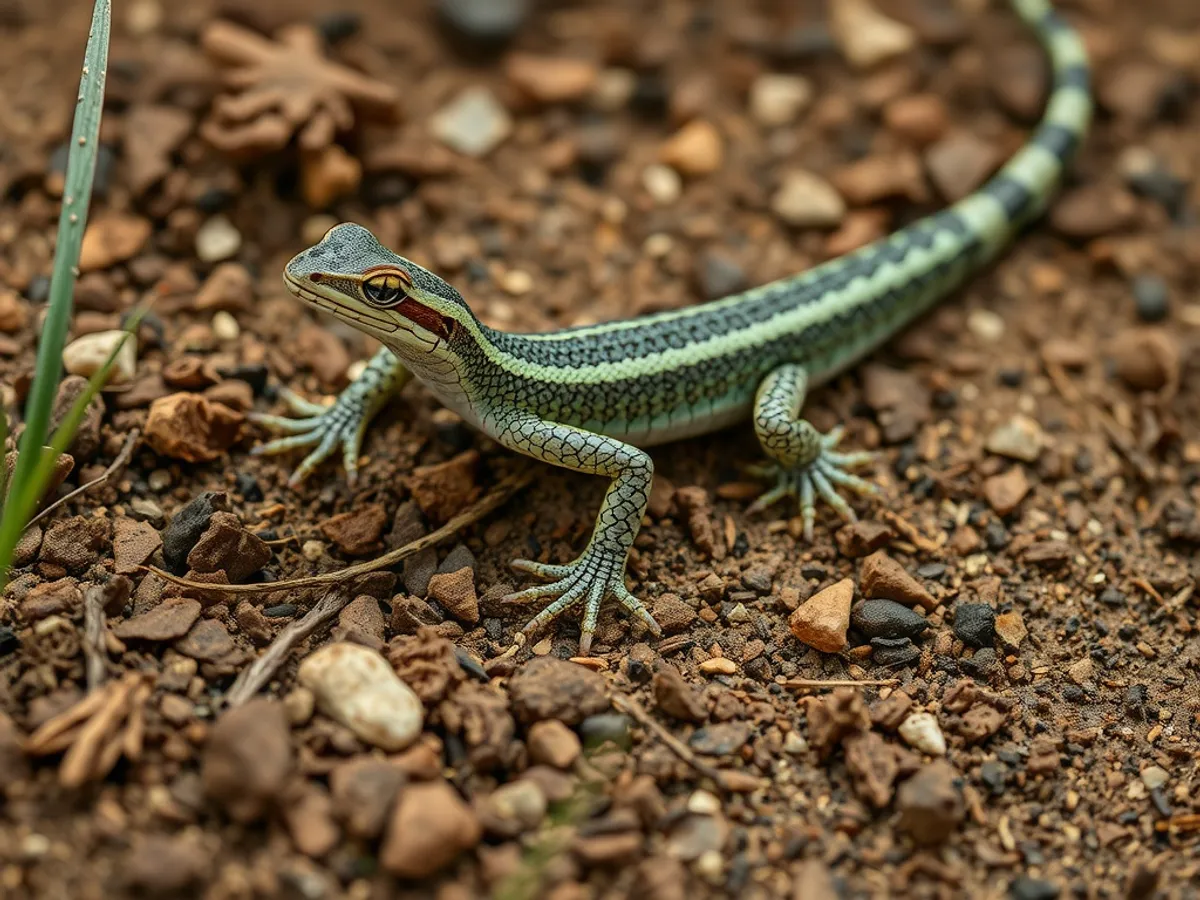
About the Eastern Glass Lizard
The Eastern Glass Lizard is a legless lizard native to the southeastern United States, often mistaken for a snake due to its elongated, slender body. Unlike snakes, it has movable eyelids and external ear openings, distinguishing it as a true lizard. Its name comes from its remarkable ability to autotomize, or break off, its tail to escape predators, with the detached tail often shattering like glass. This species is primarily terrestrial, active during the day, and is known for its secretive, burrowing lifestyle in loose soil or dense vegetation.
Fascinating facts
Not a Snake
Eastern Glass Lizards are often mistaken for snakes, but they are true lizards with eyelids and external ear openings.
Breakaway Tail
Their tails break off easily as a defense mechanism, sometimes shattering into multiple pieces to distract predators.
Habitat Preference
They prefer habitats with sandy soils and dense ground cover, often found in grasslands, pine flatwoods, and wetlands.
Detailed description
The Eastern Glass Lizard (Ophisaurus ventralis) is a robust, legless lizard measuring 60–108 cm (24–43 in) in total length, with the tail comprising nearly two-thirds of its body length. Its body is elongated and laterally compressed, covered in smooth, shiny scales that range from olive to brownish-green dorsally, with a pale yellow or cream ventral surface. A distinguishing feature is the presence of a lateral groove along each side, which aids in flexibility during locomotion. Unlike snakes, it possesses external ear openings and movable eyelids, both adaptations for terrestrial life. The species exhibits sexual dimorphism, with males generally having broader heads and more vivid coloration during the breeding season. Eastern Glass Lizards are primarily diurnal but are highly secretive, spending much of their time hidden under debris, leaf litter, or within burrows. They are capable of remarkable tail autotomy; the tail can break off in multiple pieces when grasped by a predator, often writhing to distract the attacker while the lizard escapes. The tail regrows over time, though the regenerated section is typically shorter and differently pigmented. This species is an adept burrower, using its pointed snout to push through sandy soils, and is well-adapted to habitats prone to periodic flooding.
Did you know?
The Eastern Glass Lizard can regenerate its tail after shedding it, but the new tail is usually shorter and differently colored than the original.
Research & sources
Wikipedia summary
The eastern glass lizard is a species of legless lizard in the family Anguidae and the longest and heaviest species of glass lizards in the genus Ophisaurus, endemic to the Southeastern United States. The streamlined, legless species is often confused with snakes. Glass lizards differ from snakes as they possess a moveable eyelid and an external ear opening as well as a lateral groove that separates the different types of scales on the animal, all three of these features are absent in snakes. Snakes also have flexible jaws while lizards do not. Ventralis comes from the Latin "venter" meaning belly; this is in reference to the snake-like movement.
Behaviour & social structure
Eastern Glass Lizards are solitary and territorial, with individuals maintaining overlapping home ranges but rarely interacting outside the breeding season. They are active foragers, preying on a variety of invertebrates such as insects, spiders, and snails, as well as small vertebrates like frogs and other lizards. Hunting is primarily visual; they use rapid tongue flicks to sample chemical cues and locate prey. When threatened, they rely on their speed and agility to flee, or employ tail autotomy as a last resort. Activity peaks during warm, humid conditions, typically from late spring through early fall. During the hottest part of the day or in dry periods, they retreat underground or beneath cover to avoid desiccation. There is little evidence of social hierarchy or group behavior; encounters between adults may result in displays of aggression, especially between males.
Reproduction & life cycle
Breeding occurs in late spring to early summer (May–June), with males seeking out females through pheromone trails. Courtship involves tactile stimulation and gentle biting. Females lay a single clutch of 5–15 leathery eggs in moist, protected sites such as under logs or within rotting vegetation. Incubation lasts 50–60 days, depending on temperature and humidity. Females exhibit limited parental care, remaining with the eggs and guarding them from predators and fungal infection until hatching. Hatchlings measure 10–13 cm (4–5 in) and are independent from birth, dispersing quickly to establish their own territories. Sexual maturity is typically reached at 2–3 years of age.
Adaptations & survival
Ophisaurus ventralis exhibits several remarkable adaptations for a fossorial (burrowing) and semi-fossorial lifestyle. The absence of limbs reduces resistance when moving through dense vegetation or loose substrate. The lateral groove along the body enhances flexibility, allowing the lizard to maneuver efficiently in confined spaces. Its smooth, glossy scales minimize abrasion and water loss. The ability to autotomize the tail is a key anti-predator adaptation, with the tail containing fracture planes that facilitate clean breaks. The regenerated tail, while functional, lacks the original vertebrae and is supported by a cartilaginous rod. The species’ coloration provides camouflage in grassy and sandy environments. Additionally, the presence of external ear openings and movable eyelids distinguishes it from snakes and aids in environmental awareness and protection from debris.
Cultural significance
The Eastern Glass Lizard is often featured in local folklore and is sometimes mistakenly feared as a venomous snake due to its appearance. In some southeastern U.S. cultures, it is associated with myths about 'glass snakes' shattering into pieces and reassembling, a misinterpretation of its tail autotomy. The species has no known traditional medicinal or economic uses but plays an important ecological role as a predator of pest insects and as prey for larger animals. Educational outreach often uses this species to illustrate reptile diversity and the differences between lizards and snakes.
Recent research
Recent research has focused on the genetic diversity and phylogeography of Ophisaurus ventralis, revealing significant population structure across its range, likely due to historical barriers such as rivers and habitat fragmentation. Studies on tail regeneration have provided insights into vertebrate tissue regeneration, with potential biomedical applications. Ongoing ecological research examines the species’ response to habitat management practices, such as prescribed burning and wetland restoration, to inform conservation strategies. There is also interest in the species’ sensory biology, particularly its reliance on chemoreception for prey detection.
Videos
Habitat
Sandy soils in grasslands, pine flatwoods, wetlands, and coastal areas


Conservation
The Eastern Glass Lizard is currently classified as Least Concern on the IUCN Red List.
Threats & challenges
Currently listed as Least Concern by the IUCN, the Eastern Glass Lizard faces localized threats primarily from habitat loss due to urbanization, agriculture, and drainage of wetlands. Road mortality and predation by domestic cats and dogs also contribute to population declines in fragmented habitats. Fire suppression in pine flatwoods can lead to habitat degradation, as these lizards depend on open, grassy areas maintained by periodic burns. Pesticide use may reduce prey availability and cause direct toxicity. Despite these challenges, the species remains widespread and relatively common in suitable habitats, with stable overall population trends.
Taxonomy
Scientific name
Ophisaurus ventralis
- Kingdom
- Animalia
- Phylum
- Chordata
- Class
- Reptilia
- Order
- Squamata
- Family
- Anguidae
- Genus
- Ophisaurus
- Species
- ventralis
Community notes
Share your observations about the Eastern Glass Lizard.
No community notes yet. Be the first!
Discover more wildlife
More fascinating animals from the encyclopedia.