
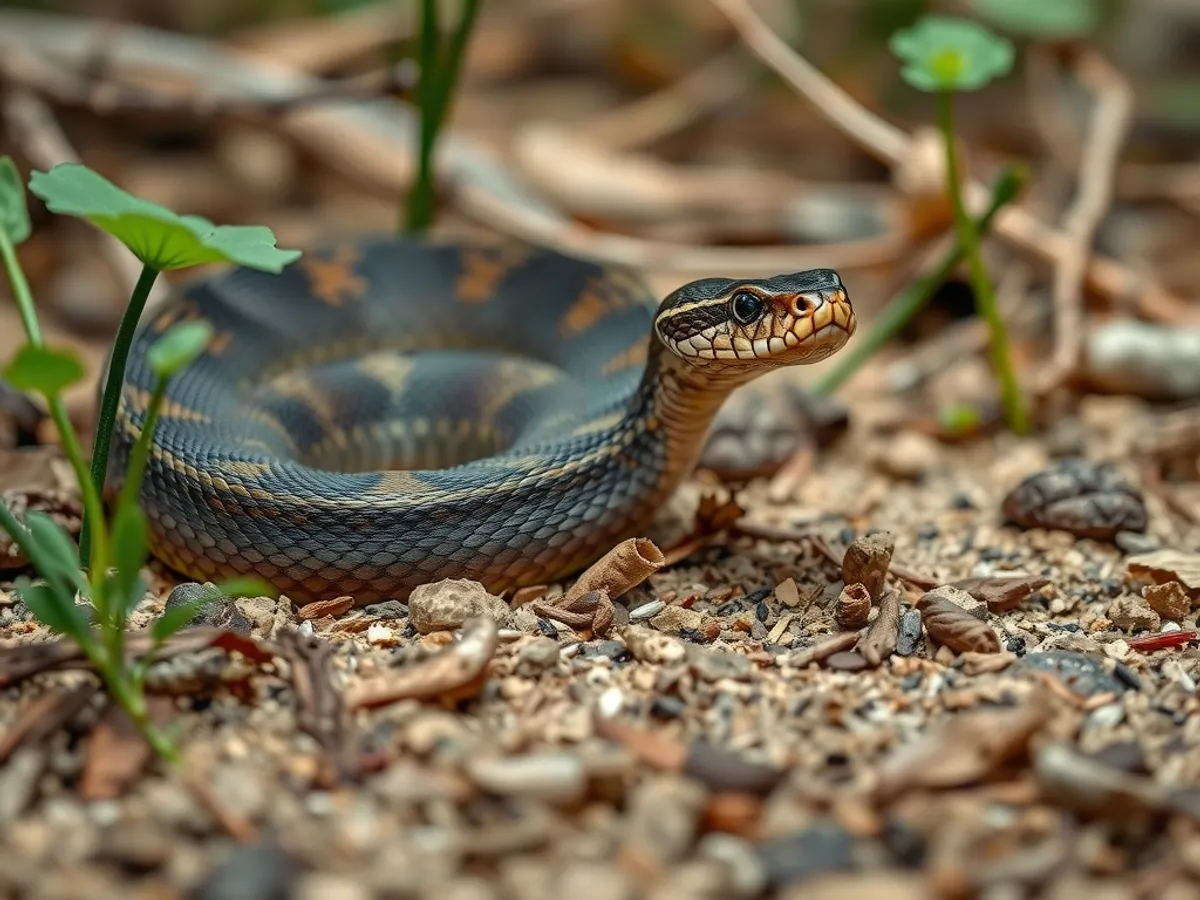
About the Eastern Hognose Snake
Heterodon platirhinos is a harmless North American snake with the most elaborate bluff in the reptile world, and it runs it in a fixed sequence. Confronted, it first flattens its neck into a wide hood, hisses loudly and lunges with the mouth firmly closed — an entirely fake strike that almost never makes contact. If that fails, it switches strategies completely: it writhes as if in agony, rolls onto its back, gapes its mouth with the tongue lolling out, smears itself in foul musk and faeces, and goes limp. The performance is undermined by one detail — a hognose playing dead will immediately flip back onto its back if you turn it upright, which gives the whole game away. Its actual life is quiet and specialised. The upturned, keeled snout scale is a shovel for rooting toads out of sandy soil, and toads are the bulk of its diet. Toads inflate themselves to become unswallowable and secrete bufotoxins from their skin, so the hognose evolved two counters: enlarged teeth at the back of the jaw that puncture the inflated toad like a pin in a balloon, and greatly enlarged adrenal glands thought to help it handle the toad's cardiac toxins. It is technically rear-fanged with a mild saliva that is harmless to humans.
Fascinating facts
Master of Drama
When threatened, the hognose snake flattens its neck like a cobra, hisses, and may even play dead to deter predators.
Toad Specialist
Unlike many snakes, the Eastern Hognose specializes in eating toads and is immune to the toxins produced by them.
Upturned Snout
Its distinctive, pig-like upturned snout helps it dig through loose soil to find prey or create burrows.
Detailed description
The Eastern Hognose Snake (Heterodon platirhinos) is a medium-sized colubrid, typically measuring 50–115 cm (20–45 in) in total length, with females generally larger than males. Its most distinctive feature is the upturned rostral scale, forming a shovel-like snout adapted for burrowing in loose, sandy soils. The body is robust and the head is broad and flattened, often accentuated during defensive displays. Coloration is highly variable, ranging from yellow, olive, brown, gray, orange, to solid black, with or without dark dorsal blotches; melanistic (all-black) and patternless morphs are not uncommon. The ventral surface is usually lighter, often with irregular dark patches. Scales are keeled, providing a rough texture. The eyes are medium-sized with round pupils. Eastern Hognose Snakes are diurnal and primarily terrestrial, though they may climb low vegetation. They are solitary outside of the breeding season and are most active in warm months. Their dramatic anti-predator displays include hooding, hissing, mock strikes, and thanatosis (playing dead), making them one of North America's most theatrical snakes. Despite possessing enlarged rear fangs and mild venom specialized for subduing amphibian prey, they pose no significant danger to humans.
Did you know?
The hognose snake's upturned snout is an adaptation that helps it dig for its favorite prey, especially burrowing amphibians like toads.
Research & sources
Wikipedia summary
The eastern hog-nosed snake, is a species of mildly venomous rear-fanged snake in the family Colubridae. The venom is specifically adapted to amphibian prey and is harmless to humans. However, some people may have an allergic reaction, and experience local swelling and other symptoms. The species is endemic to North America. There are no subspecies that are recognized as being valid. This species prefers habitats with sandy soils and a combination of grass fields and forest edges. They come in many different colorations and have the identifiable upturned "snout". They can be found in captivity but are a relatively difficult species to keep due to a specialized diet of toads. As with other Heterodon species, they have a distinctive threat reaction of first bluffing by striking with a closed mouth and then pretending to die if this fails to deter the threat.
Behaviour & social structure
Eastern Hognose Snakes are renowned for their complex defensive behaviors. When threatened, they first flatten their necks and bodies, hiss loudly, and may perform repeated mock strikes with a closed mouth. If these tactics fail, they may roll onto their backs, emit foul-smelling musk, gape their mouths, and feign death, remaining motionless until the threat passes. Their primary diet consists of amphibians, especially toads (genus Anaxyrus), which they locate using chemosensory cues. Specialized rear fangs and mild venom help overcome the toads' chemical defenses. They also consume frogs, salamanders, and occasionally small mammals, lizards, or reptile eggs. Eastern Hognose Snakes are mostly solitary, except during the breeding season. They are crepuscular to diurnal, with peak activity in the morning and late afternoon, especially in spring and early summer. They spend much time burrowed or hidden under debris, emerging to bask or forage. They rarely climb but may be found on low shrubs or logs.
Reproduction & life cycle
Breeding occurs in spring, typically from April to May, following emergence from winter brumation. Males actively seek out females, sometimes engaging in brief courtship rituals involving tongue flicking and body alignment. Females are oviparous, laying clutches of 8–40 eggs (average 15–25) in early summer, usually in sandy, well-drained soils under logs, leaf litter, or in abandoned burrows. Incubation lasts 39–65 days, depending on temperature and humidity. Hatchlings emerge in late summer (July–September), measuring 15–20 cm (6–8 in) and are independent from birth, receiving no parental care. Sexual maturity is typically reached at 2–3 years of age. Reproductive output can vary with female size, age, and environmental conditions.
Adaptations & survival
The upturned snout is a key adaptation for digging and excavating prey, especially burrowing toads. Enlarged rear maxillary teeth (rear fangs) and Duvernoy's glands produce a mild venom that is highly effective against amphibians, overcoming their toxic skin secretions. The snake's resistance to bufotoxins (toad toxins) is a unique physiological adaptation. Its variable coloration provides camouflage in diverse habitats, from leaf litter to sandy soils. The dramatic anti-predator displays, including hooding and thanatosis, are behavioral adaptations that deter predators by mimicking venomous snakes (e.g., cobras) or by appearing unpalatable. Seasonal brumation in underground retreats allows survival in colder climates. The ability to consume large, toxic prey items gives it a unique ecological niche.
Cultural significance
The Eastern Hognose Snake has a prominent place in North American folklore, often referred to as 'puff adder,' 'spreadhead,' or 'blow snake' due to its dramatic threat displays. Its habit of playing dead has fascinated naturalists and laypeople alike, leading to myths about its supposed danger or magical powers. In some indigenous cultures, snakes with unusual behaviors were regarded with curiosity or superstition, though there is little evidence of direct ritual use. The species is sometimes kept by advanced reptile enthusiasts, but its specialized diet and stress-prone nature make it challenging in captivity. Public education efforts increasingly highlight its ecological role and harmlessness to humans.
Recent research
Recent research has focused on the Eastern Hognose Snake's resistance to amphibian toxins, revealing unique physiological mechanisms that allow it to consume otherwise poisonous prey. Studies on its defensive behaviors have provided insights into the evolution of mimicry and anti-predator strategies among colubrids. Genetic analyses confirm the lack of recognized subspecies, though regional color morphs exist. Ongoing research examines the impact of habitat fragmentation and road mortality on population dynamics. Conservation genetics and landscape ecology studies are helping to identify critical habitats and inform management strategies. Citizen science initiatives, such as herpetofaunal atlases, are improving knowledge of its distribution and status.
Videos
Habitat
Sandy woodlands, fields, and forest edges
 Arid Regions
Desert
Arid lands with minimal rainfall, extreme temperatures, and specialized wildlife adapted to harsh conditions.
 Various Continental Regions
Grassland
Open areas dominated by grasses rather than trees, supporting numerous herbivores and their predators.
 Global
Forest
Wooded areas with significant tree cover and diverse plant and animal communities.
Conservation
The Eastern Hognose Snake is currently classified as Least Concern on the IUCN Red List.
Threats & challenges
While the Eastern Hognose Snake is currently listed as Least Concern by the IUCN, it faces localized threats. Habitat loss and fragmentation due to urbanization, agriculture, and fire suppression reduce suitable sandy habitats. Road mortality is significant in some areas, especially during spring migrations. The species is often killed by humans due to mistaken identity with venomous snakes or fear of its defensive displays. Pesticide use and declines in amphibian populations (especially toads, their primary prey) may also impact local populations. Despite these challenges, the species remains widespread and relatively stable across much of its range, though declines are noted in the northern and western parts of its distribution.
Taxonomy
Scientific name
Heterodon platirhinos
- Kingdom
- Animalia
- Phylum
- Chordata
- Class
- Reptilia
- Order
- Squamata
- Family
- Colubridae
- Genus
- Heterodon
- Species
- platirhinos
Where to see an eastern hognose snake
1 zoo and aquarium in 1 country are recorded as keeping this species.
Community notes
Share your observations about the Eastern Hognose Snake.
No community notes yet. Be the first!
Discover more wildlife
More fascinating animals from the encyclopedia.