
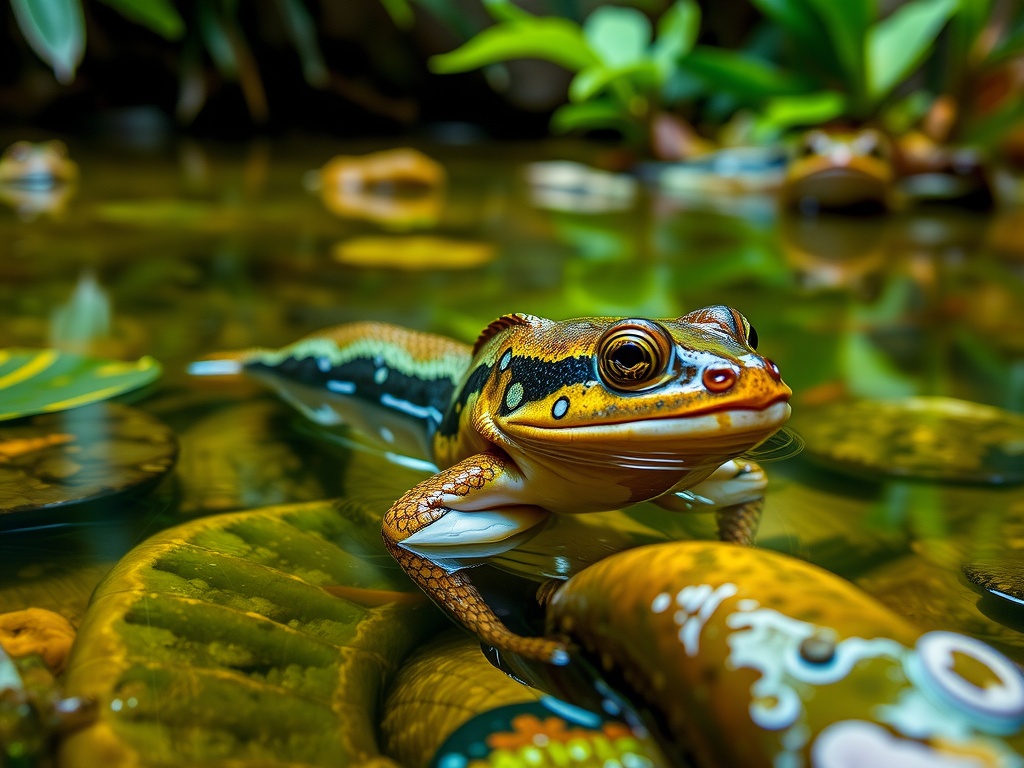
About the Eastern Long-fingered Batrachian
The Eastern Long-fingered Batrachian, scientifically known as Trichobatrachus robustus, is a remarkable amphibian renowned for its unusually elongated fingers. This species is native to fast-flowing streams and rivers in the eastern regions of Central Africa, where its unique adaptations aid in gripping slippery rocks. It is distinguished by its robust body, warty skin, and strikingly long third fingers, which assist in both locomotion and foraging. This batrachian displays fascinating defensive behaviors, making it a subject of interest among herpetologists.
Fascinating facts
Bone Claws
When threatened, this frog can break the bones in its toes, which then pierce through the skin to form sharp claws.
Aquatic Adaptations
Its long fingers and webbed feet help it navigate swiftly in fast-moving streams and cling to slippery rocks.
Hairy Males
Males develop hair-like dermal papillae along their flanks and thighs during the breeding season, which are thought to aid in oxygen absorption.
Detailed description
The Eastern Long-fingered Batrachian (Trichobatrachus robustus), commonly referred to as the 'hairy frog,' is a robust amphibian notable for its muscular build and distinctive morphological features. Adult individuals typically measure between 10 and 13 centimeters in snout-vent length, with females generally larger than males. The skin is granular and warty, providing camouflage among riverine substrates, and during the breeding season, males develop keratinized hair-like dermal papillae along their flanks and thighs, which increase surface area for cutaneous respiration. The most striking anatomical feature is the exceptionally elongated third finger, equipped with sharp, retractable bony claws that can puncture through the skin for defense. The head is broad with a short, rounded snout, and the eyes are positioned dorsolaterally, granting a wide field of vision. This species is primarily nocturnal, emerging at dusk to forage along the banks and in shallow waters. Its powerful hind limbs and webbed feet enable agile swimming and effective anchoring against strong currents. The Eastern Long-fingered Batrachian is solitary outside of the breeding season, exhibiting territoriality in males. Its unique defensive behaviors, including the ability to break its own toe bones to produce claws, have made it a subject of considerable scientific interest.
Did you know?
The Eastern Long-fingered Batrachian is one of the few vertebrates known to intentionally break bones as a defense mechanism.
Research & sources
Behaviour & social structure
Trichobatrachus robustus is predominantly nocturnal, spending daylight hours concealed under rocks or submerged vegetation to avoid predation. It is an ambush predator, remaining motionless until prey—typically insects, spiders, crustaceans, and small aquatic vertebrates—comes within striking distance. The elongated third finger is used to probe crevices and dislodge prey. When threatened, the frog exhibits a remarkable defensive behavior: it forcibly fractures the distal phalanges of its toes, projecting sharp bony claws through the skin to deter predators. Social interactions are minimal outside the breeding season, with individuals maintaining exclusive territories. Vocalizations are rare, but males may produce low-frequency calls during courtship. Daily activity peaks at dusk and during periods of high humidity, coinciding with increased prey availability.
Reproduction & life cycle
Breeding occurs during the rainy season, typically from March to July, when water levels in streams and rivers rise. Males establish territories in shallow, fast-flowing water and attract females through tactile and chemical cues rather than vocalizations. Amplexus is axillary, with the male grasping the female behind her forelimbs. Females lay clutches of 100–300 eggs, attaching them to submerged vegetation or rocks. The eggs hatch after 9–12 days, and the aquatic larvae (tadpoles) possess specialized mouthparts for grazing on algae and detritus. Metamorphosis occurs after 2–3 months, depending on environmental conditions. Parental care is absent post-oviposition, and larval survival is highly dependent on water quality and predation pressure.
Adaptations & survival
The Eastern Long-fingered Batrachian exhibits several remarkable adaptations. The keratinized 'hairs' on breeding males facilitate increased oxygen uptake in hypoxic aquatic environments. The elongated, retractable third finger and associated bony claw serve both for prey capture and as a unique anti-predator mechanism. Its cryptic coloration and warty skin provide effective camouflage among river rocks and debris. The powerful hind limbs and extensive webbing enable strong swimming and the ability to anchor against swift currents. Additionally, the species' ability to tolerate a range of water temperatures and oxygen levels allows it to inhabit diverse riverine habitats.
Cultural significance
In parts of Cameroon and the Democratic Republic of Congo, the Eastern Long-fingered Batrachian is known in local folklore as the 'hairy frog' and is sometimes associated with supernatural powers due to its unusual appearance and defensive claws. It is occasionally used in traditional medicine, believed to confer strength or healing. However, it does not have widespread symbolic significance and is not a major focus of local mythology compared to other amphibians.
Recent research
Recent research has focused on the biomechanics of the frog's retractable claws, revealing a unique adaptation among vertebrates involving the intentional fracturing of phalanges. Studies on the keratinized dermal papillae have provided insights into amphibian respiratory adaptations. Ongoing ecological research is examining the species' role in freshwater ecosystems as both predator and prey, as well as its responses to environmental change. Genetic studies are underway to clarify population structure and evolutionary relationships within the Arthroleptidae family.
Sources
The extraordinary defensive mechanism of the 'hairy frog' (Trichobatrachus robustus): Bone claws and their evolutionary significance
David C. Blackburn, et al. (2008)
scientificTrichobatrachus robustus: The IUCN Red List of Threatened Species 2016
IUCN SSC Amphibian Specialist Group
conservationVideos
Habitat
Tropical freshwater rivers and streams
 Elevated Terrain
Mountain
High-altitude environments with varying climates and specialized wildlife adapted to rugged terrain and thin air.
 Global
Forest
Wooded areas with significant tree cover and diverse plant and animal communities.
 Global
Freshwater
Lakes, rivers, and wetlands with diverse aquatic ecosystems.
Conservation
The Eastern Long-fingered Batrachian is currently classified as Least Concern on the IUCN Red List.
Threats & challenges
Although currently listed as Least Concern by the IUCN, Trichobatrachus robustus faces localized threats from habitat degradation, particularly due to deforestation, agricultural runoff, and pollution of freshwater systems. Overharvesting for the pet trade and local consumption has been reported in some regions. Climate change poses a long-term threat by altering rainfall patterns and stream hydrology, potentially impacting breeding success. Despite these challenges, the species remains widespread and relatively resilient, but ongoing habitat monitoring is recommended to detect population declines.
Taxonomy
Scientific name
Trichobatrachus robustus
- Kingdom
- Animalia
- Phylum
- Chordata
- Class
- Amphibia
- Order
- Anura
- Family
- Arthroleptidae
- Genus
- Trichobatrachus
- Species
- robustus
Community notes
Share your observations about the Eastern Long-fingered Batrachian.
No community notes yet. Be the first!
Discover more wildlife
More fascinating animals from the encyclopedia.