
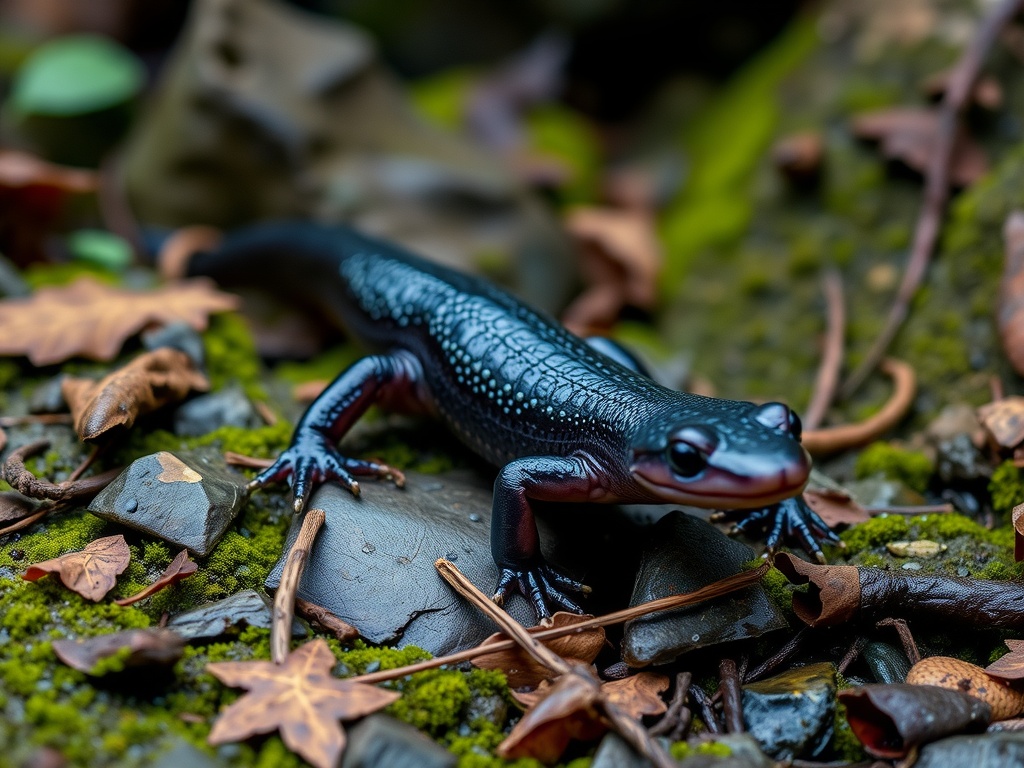
About the Eastern Long-toed Salamander
The Eastern Long-toed Salamander is a slender amphibian recognized by its dark body adorned with a yellow or greenish stripe running from head to tail, and notably long outer toes on its hind feet. It inhabits moist woodlands, montane forests, and areas near freshwater bodies, thriving in cool, damp environments. This subspecies is primarily nocturnal and secretive, often hiding under logs or leaf litter during the day. It plays a vital role in controlling insect populations and serves as an indicator of healthy ecosystems.
Fascinating facts
Long Toes
The species is named for its exceptionally long outer toes, which are much longer than those of other salamanders in the same genus.
Forest Dweller
They are most commonly found in moist coniferous and mixed forests, often at elevations between 400 and 2,100 meters.
Secretive Habits
Eastern Long-toed Salamanders spend most of their lives hidden under rocks, logs, or debris, emerging mainly at night or during rainy weather.
Detailed description
The Eastern Long-toed Salamander (Ambystoma macrodactylum columbianum) is a medium-sized, slender amphibian typically measuring 9–13 cm in total length, with the tail comprising nearly half of its body length. Its most distinguishing feature is the elongated fourth toe on each hind foot, an adaptation that aids in maneuvering through its moist, uneven habitat. The dorsal coloration is generally dark brown to black, accentuated by a continuous, irregular yellow or olive-green stripe that runs from the snout to the tip of the tail, sometimes bordered by small white or bluish flecks. The ventral surface is lighter, often grayish, with scattered pale spots. The skin is smooth and moist, facilitating cutaneous respiration, which is critical in the cool, damp environments it inhabits. This subspecies is primarily nocturnal, emerging at dusk to forage and retreating to shelter under logs, rocks, or leaf litter during the day. It is a secretive species, rarely seen except during the breeding season or after heavy rains. Eastern Long-toed Salamanders are solitary outside of the breeding period, exhibiting minimal social interaction. Their diet consists mainly of small invertebrates such as insects, spiders, worms, and mollusks, which they capture with quick, darting movements. As a key predator of soil invertebrates, they play an important ecological role in nutrient cycling and pest control.
Did you know?
When threatened, the Eastern Long-toed Salamander secretes a sticky, mildly toxic substance from its tail to deter predators.
Research & sources
Behaviour & social structure
Eastern Long-toed Salamanders are crepuscular to nocturnal, with peak activity occurring during damp, mild nights, especially in spring and autumn. They are highly secretive, spending most of their lives hidden under debris or underground in rodent burrows to avoid desiccation and predation. Foraging is typically solitary; individuals use chemosensory cues to locate prey, employing a sit-and-wait or slow active search strategy. When threatened, they may exhibit defensive behaviors such as arching the body, secreting a mildly toxic, sticky substance from their skin glands, or autotomizing (shedding) their tail to distract predators. Social interactions are limited, mostly occurring during the breeding season when adults congregate at temporary ponds. Outside of breeding, they maintain small, overlapping home ranges and show little territoriality.
Reproduction & life cycle
Breeding occurs in early spring, often immediately following snowmelt, when adults migrate en masse to ephemeral or semi-permanent ponds. Males arrive first and perform courtship displays, including tail undulations and pheromone release, to attract females. Fertilization is internal but indirect: males deposit spermatophores (sperm packets) on submerged substrates, which females then pick up with their cloaca. Females lay clusters of 50–200 eggs, attaching them to submerged vegetation or debris. Embryonic development is temperature-dependent, typically lasting 2–6 weeks. Larvae are aquatic, with external gills and a finned tail, and undergo metamorphosis after 2–4 months, depending on environmental conditions. There is no parental care after egg deposition. Juveniles disperse into terrestrial habitats soon after metamorphosis, where they remain until sexual maturity at 2–4 years.
Adaptations & survival
The elongated fourth toe on the hind feet enhances locomotion in muddy or aquatic environments, providing greater surface area for propulsion. Their permeable skin allows for efficient cutaneous respiration, essential in the low-oxygen microhabitats they frequent. The skin also secretes toxins that deter many predators, and the salamander’s cryptic coloration provides camouflage against the forest floor. Behavioral adaptations include nocturnality and burrowing to maintain moisture balance and avoid predation. The ability to autotomize the tail is a notable anti-predator adaptation, allowing escape from grasping predators. Their breeding strategy, utilizing ephemeral ponds, reduces competition and predation on eggs and larvae from fish.
Cultural significance
The Eastern Long-toed Salamander holds limited direct cultural significance, but salamanders in general have featured in Indigenous folklore and local mythology throughout the Pacific Northwest, often symbolizing transformation and resilience. Their presence is sometimes used as an indicator of environmental health in conservation education programs. In scientific and educational contexts, they are valued as model organisms for studies of amphibian ecology, development, and environmental monitoring.
Recent research
Recent research has focused on the effects of climate change and habitat fragmentation on breeding phenology and larval development. Genetic studies have clarified the phylogeographic relationships within the Ambystoma macrodactylum complex, revealing significant genetic diversity among subspecies. Ongoing ecological monitoring is assessing the impacts of introduced fish and pollutants on larval survival. Studies on skin secretions have identified antimicrobial peptides with potential biomedical applications. Additionally, the species is used in research on amphibian disease dynamics, particularly chytridiomycosis, due to its sensitivity to environmental changes.
Sources
Ambystoma macrodactylum (Long-toed Salamander) Species Account
AmphibiaWeb, University of California, Berkeley (2023)
scientificIUCN Red List of Threatened Species: Ambystoma macrodactylum
IUCN SSC Amphibian Specialist Group
conservationVideos
Habitat
Moist coniferous forests and mountainous regions near freshwater bodies
 Elevated Terrain
Mountain
High-altitude environments with varying climates and specialized wildlife adapted to rugged terrain and thin air.
 Global
Forest
Wooded areas with significant tree cover and diverse plant and animal communities.
 Global
Freshwater
Lakes, rivers, and wetlands with diverse aquatic ecosystems.
Conservation
The Eastern Long-toed Salamander is currently classified as Least Concern on the IUCN Red List.
Threats & challenges
Although currently listed as Least Concern, the Eastern Long-toed Salamander faces localized threats from habitat loss due to logging, urban development, and wetland drainage. Road mortality during breeding migrations and the introduction of predatory fish to breeding ponds pose additional risks. Climate change, resulting in altered precipitation patterns and increased frequency of drought, threatens the availability of suitable breeding sites. Pollution, particularly from pesticides and herbicides, can negatively impact both adults and larvae. Despite these challenges, populations remain stable in undisturbed habitats, but ongoing monitoring is necessary to detect potential declines.
Taxonomy
Scientific name
Ambystoma macrodactylum columbianum
- Kingdom
- Animalia
- Phylum
- Chordata
- Class
- Amphibia
- Order
- Caudata
- Family
- Ambystomatidae
- Genus
- Ambystoma
- Species
- macrodactylum columbianum
Community notes
Share your observations about the Eastern Long-toed Salamander.
No community notes yet. Be the first!
Discover more wildlife
More fascinating animals from the encyclopedia.