
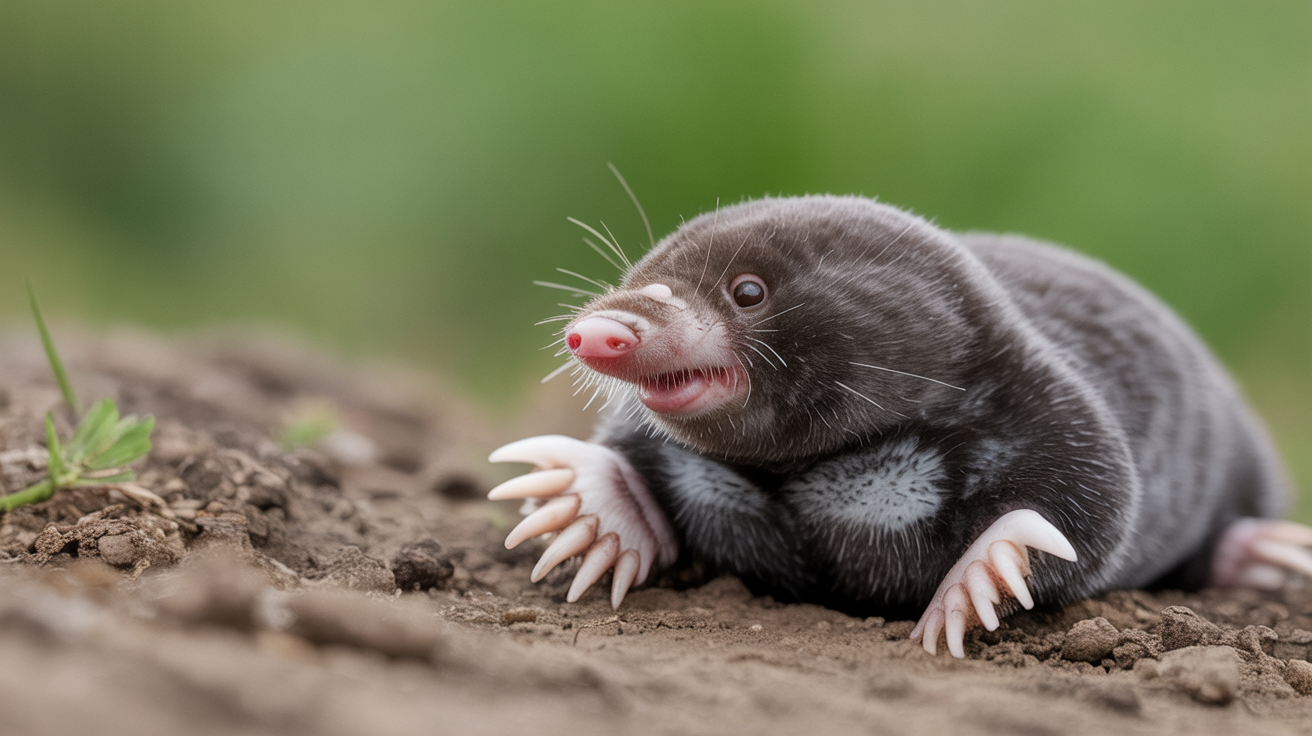
About the Eastern Mole
The Eastern Mole is a small, burrowing mammal native to eastern and central North America. It is easily recognized by its velvety gray fur, cylindrical body, and large, spade-shaped forelimbs specialized for digging. This species spends most of its life underground, creating extensive tunnel systems in moist soils of grasslands, forests, and suburban lawns. Eastern Moles are solitary and highly adapted to their subterranean lifestyle, rarely emerging to the surface except occasionally at night or after heavy rain.
Fascinating facts
Powerful Diggers
Eastern Moles have broad, outward-facing forepaws with large claws, which allow them to move soil efficiently and create elaborate tunnel systems.
Sensitive Snout
They rely heavily on their sensitive snouts and tactile whiskers to locate prey underground, as their eyesight is extremely poor.
Soil Aerators
Their tunneling activities help aerate soil, improve drainage, and control insect populations, indirectly benefiting plant growth.
Detailed description
The Eastern mole (Scalopus aquaticus) is a robust, medium-sized mammal, typically measuring 12–18 cm (4.7–7.1 in) in length and weighing 60–130 grams (2.1–4.6 oz). Its body is highly specialized for a subterranean lifestyle, featuring velvety, slate-gray fur that minimizes friction against tunnel walls and a cylindrical shape that allows for efficient movement underground. The forelimbs are greatly enlarged, paddle-shaped, and rotated outward, equipped with strong claws for digging through soil. The eyes are tiny and functionally blind, covered by skin and fur, while external ears are absent, reducing the risk of soil intrusion. Eastern moles possess a short, nearly hairless tail used for tactile navigation in dark tunnels. Their dental formula and sharp teeth are adapted for an insectivorous diet. Primarily solitary, they construct extensive networks of shallow surface runways and deeper permanent tunnels, which can span several hundred meters. Eastern moles are most active during moist conditions and can move up to 4 meters per hour while tunneling. Their metabolic rate is high, necessitating frequent feeding. The species is found in a variety of habitats with loose, moist soils, including forests, grasslands, agricultural fields, and suburban lawns, but avoids rocky or overly dry substrates.
Did you know?
Despite their species name 'aquaticus', Eastern Moles are not aquatic but are named for their preference for moist, loose soils.
Research & sources
Wikipedia summary
The eastern mole or common mole is a medium-sized North American mole. It is the only species in the genus Scalopus. It is found in forested and open areas with moist sandy soils in northern Mexico, the eastern United States and the southwestern corner of Ontario in Canada.
Behaviour & social structure
Eastern moles are solitary and territorial, aggressively defending their tunnel systems from intruders. They are primarily crepuscular, with peak activity during dawn and dusk, although they may be active at any time of day depending on soil moisture and temperature. Their foraging behavior involves creating shallow surface tunnels to intercept earthworms, insect larvae, and other soil invertebrates, which constitute the bulk of their diet. Moles use their sensitive snouts and vibrissae to detect prey, and their saliva contains toxins that can paralyze earthworms, allowing for storage in underground larders. Surface tunnels are often visible as raised ridges in lawns and fields. Eastern moles rarely emerge above ground, except during dispersal events or after heavy rains that flood their burrows. Communication is primarily through scent marking and tactile cues, with limited vocalizations. Home ranges are exclusive except during the breeding season, when temporary overlaps may occur.
Reproduction & life cycle
Breeding in Eastern moles typically occurs from late winter to early spring (January to March in southern ranges, March to April in northern areas). Males expand their tunnel systems in search of receptive females, and copulation occurs underground. After a gestation period of 4–6 weeks (approximately 42 days), females give birth to a single annual litter of 2–5 young, usually in a deep, grass-lined nest chamber. The altricial young are born hairless and blind, weighing about 3 grams each. They develop rapidly, with fur appearing by two weeks and eyes opening at three to four weeks. Weaning occurs at about one month, after which juveniles disperse to establish their own territories. Parental care is provided solely by the female, with no involvement from the male after mating. Sexual maturity is reached within the first year of life.
Adaptations & survival
Eastern moles exhibit several remarkable adaptations for fossorial (burrowing) life. Their powerful, outwardly rotated forelimbs and large, spade-like claws enable rapid excavation of soil. The velvety fur lies in any direction, reducing drag and allowing easy backward and forward movement. Their skeletal structure, including a shortened humerus and robust pectoral girdle, provides leverage for digging. The reduction or absence of external eyes and ears minimizes injury and soil entry. Their Eimer’s organs—specialized tactile receptors on the snout—enhance sensitivity to vibrations and prey movement underground. Physiologically, they have a high hemoglobin affinity for oxygen, allowing survival in low-oxygen, high-carbon dioxide environments typical of burrows. Their metabolic rate is high to support constant digging and foraging.
Cultural significance
Eastern moles have a mixed reputation in human culture. While often regarded as pests due to their burrowing activities in gardens and lawns, they also provide valuable ecosystem services by aerating soil and controlling insect populations. In some Native American traditions, moles are symbolic of earth and underground wisdom, though the Eastern mole itself is not a prominent figure in folklore. There are no known traditional medicinal or utilitarian uses for this species in North America. Their presence is sometimes used as an indicator of healthy, invertebrate-rich soils.
Recent research
Recent research on Eastern moles has focused on their sensory biology, particularly the function of Eimer’s organs and their ability to detect seismic vibrations. Studies have investigated the ecological impact of mole tunneling on soil health and invertebrate communities. Genetic analyses have clarified the species’ phylogenetic relationships within Talpidae, confirming Scalopus as a monotypic genus. Ongoing research explores the effects of urbanization and pesticide exposure on mole populations. There is also interest in the species’ role as a bioindicator for soil quality and ecosystem health.
Sources
Videos
Habitat
Moist soils in grasslands, forests, and gardens


Conservation
The Eastern Mole is currently classified as Least Concern on the IUCN Red List.
Threats & challenges
Currently, the Eastern mole is classified as Least Concern by the IUCN due to its wide distribution and presumed large, stable population. However, localized threats include habitat loss from urbanization, intensive agriculture, and soil compaction. Pesticide use can reduce prey availability and may cause secondary poisoning. In suburban and agricultural areas, moles are often persecuted as pests due to their tunneling, which can damage lawns and crops. Road mortality and predation by domestic cats, dogs, and wild predators (e.g., owls, snakes, foxes) also pose risks. Despite these pressures, the species remains adaptable and resilient in many environments.
Taxonomy
Scientific name
Scalopus aquaticus
- Kingdom
- Animalia
- Phylum
- Chordata
- Class
- Mammalia
- Order
- Eulipotyphla
- Family
- Talpidae
- Genus
- Scalopus
- Species
- aquaticus
Community notes
Share your observations about the Eastern Mole.
No community notes yet. Be the first!
Discover more wildlife
More fascinating animals from the encyclopedia.