
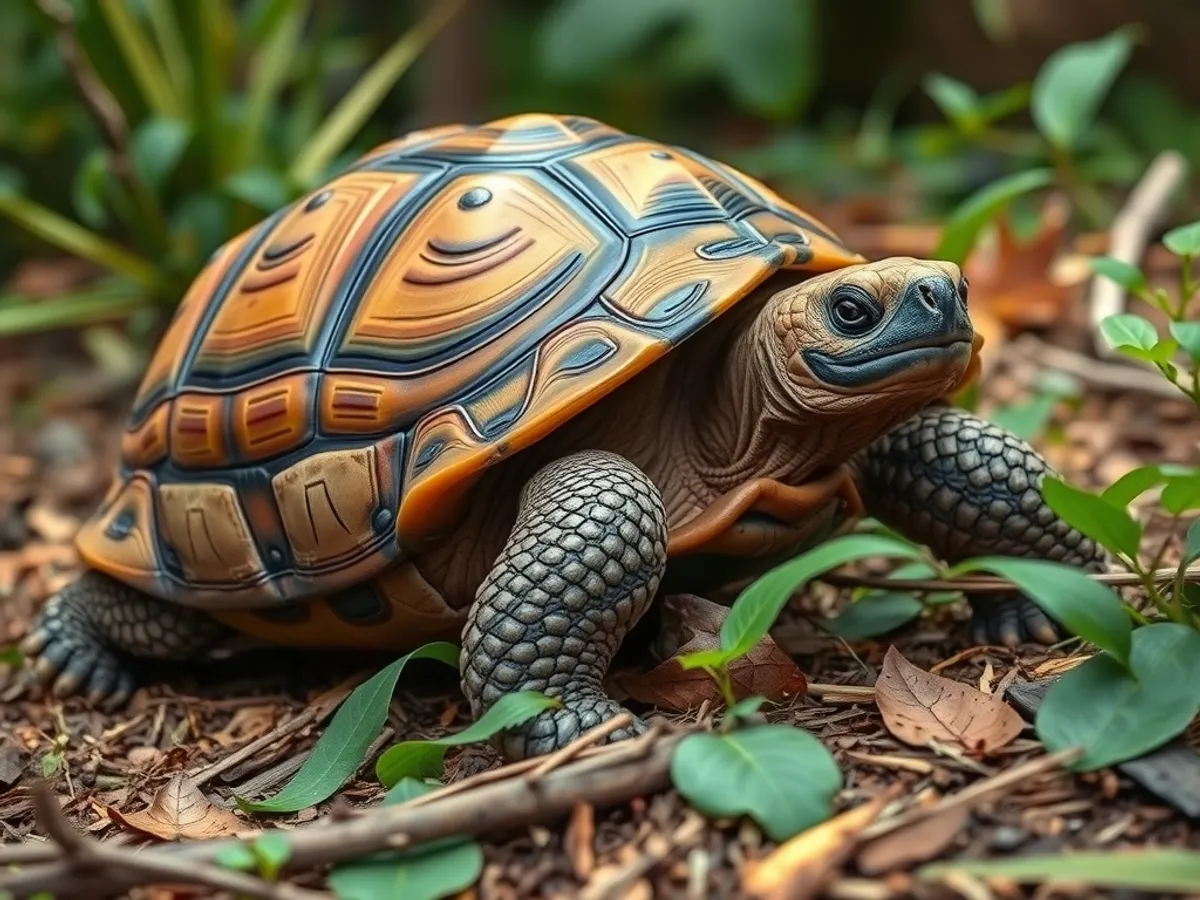
About the Elongated tortoise
The elongated tortoise is a medium-sized land tortoise known for its distinctly long, narrow, and slightly flattened golden-brown carapace. Native to Southeast Asia, it inhabits deciduous forests and forest edges, where it spends much of its time foraging among leaf litter. This species is mostly terrestrial, but can tolerate moist and humid environments, and is often found in areas with abundant ground cover. Unfortunately, the elongated tortoise faces heavy pressure from habitat loss and illegal collection for the pet trade and consumption.
Fascinating facts
Forest Foragers
Elongated tortoises primarily eat fallen fruits, leaves, and mushrooms, but will occasionally consume invertebrates and carrion.
Protective Shell
Their carapace is not only elongated but also domed, providing extra protection from predators and falling debris.
Threatened Existence
The elongated tortoise is critically endangered due to habitat loss and illegal wildlife trade, with wild populations declining sharply.
Detailed description
The elongated tortoise (Indotestudo elongata) is a medium-sized terrestrial chelonian, with adults typically measuring 30–35 cm in straight carapace length, though some individuals may reach up to 40 cm. Its carapace is notably elongated and slightly flattened, with a pale yellow to golden-brown coloration and prominent dark blotches or streaks on each scute. The plastron is lighter, often yellowish with dark markings. The head is relatively small, with a pointed snout and a distinctively hooked upper jaw, while the limbs are robust and covered in large, overlapping scales. Sexual dimorphism is present: males generally have longer tails and a more concave plastron compared to females. Indotestudo elongata is primarily crepuscular, being most active during the cooler hours of early morning and late afternoon. It is a solitary species, except during the breeding season, and spends much of its time hidden under leaf litter or in burrows to avoid extreme heat and predators. The species is adapted to a variety of habitats, including dry deciduous forests, evergreen forests, and secondary growth, but always favors areas with dense ground cover and high humidity. Its diet is predominantly herbivorous, consisting of fallen fruits, leaves, grasses, fungi, and occasionally invertebrates such as snails or worms. The elongated tortoise plays a significant ecological role as a seed disperser within its native range.
Did you know?
Despite being tortoises, elongated tortoises are surprisingly good climbers and can traverse rough, uneven terrain with ease.
Research & sources
Wikipedia summary
The elongated tortoise is a species of tortoise found in Southeast Asia and parts of South Asia.
Behaviour & social structure
Elongated tortoises are generally solitary and display minimal social interaction outside of the breeding season. They are primarily terrestrial and exhibit a slow, deliberate gait, spending much of their time foraging among leaf litter for edible plant material. Their activity peaks during the wet season and in the early morning or late afternoon, when temperatures are moderate. During the hottest parts of the day or in dry conditions, they seek shelter under dense vegetation, fallen logs, or in self-excavated burrows to maintain hydration and avoid overheating. When threatened, they retreat into their shells, relying on their cryptic coloration and the flattened shape of their carapace for camouflage. Feeding behavior is opportunistic; they consume a wide variety of plant matter, including fruits, flowers, grasses, and occasionally carrion or invertebrates. Elongated tortoises are known to exhibit homing behavior, returning to favored resting or nesting sites.
Reproduction & life cycle
Breeding in Indotestudo elongata typically coincides with the onset of the rainy season (May to October, depending on locality). Courtship involves the male circling the female, head bobbing, and gentle biting of the female's limbs or shell. Copulation is often accompanied by vocalizations from the male. Females lay 2–6 eggs per clutch, with up to three clutches per year. Eggs are oval, measuring approximately 40–50 mm in length, and are deposited in shallow nests dug in soft soil or leaf litter. Incubation lasts 80–150 days, depending on temperature and humidity. Hatchlings emerge with a carapace length of 40–50 mm and are highly vulnerable to predation. There is no parental care post-oviposition; hatchlings are independent from birth and rely on camouflage and cryptic behavior for survival.
Adaptations & survival
The elongated tortoise exhibits several adaptations for survival in variable forest environments. Its elongated, flattened carapace allows it to move efficiently through dense undergrowth and leaf litter. The cryptic coloration provides effective camouflage against predators. The species is tolerant of a range of humidity levels and can withstand periods of drought by reducing activity and seeking shelter. Behavioral thermoregulation, such as burrowing and basking, helps maintain optimal body temperature. The hooked upper jaw is adapted for cropping tough vegetation and fruits. Its ability to consume a wide variety of plant and fungal material, as well as occasional animal matter, reflects dietary flexibility. The tortoise's strong homing instinct aids in navigation and resource localization within its home range.
Cultural significance
The elongated tortoise has cultural significance in several Asian societies. In parts of Southeast Asia, tortoises are traditionally associated with longevity, wisdom, and stability, and are sometimes kept as symbols of good fortune. However, these beliefs have also contributed to overexploitation, as tortoises are sought for traditional medicine, ritual release, and as status symbols. In some regions, they are consumed as food or used in folk remedies, further exacerbating population pressures. Conservation efforts increasingly focus on community education and engagement to shift perceptions and reduce demand.
Recent research
Recent research has focused on the population genetics of Indotestudo elongata, revealing significant genetic structuring across its range, which has implications for conservation management. Studies on its ecology have highlighted the species' role in seed dispersal and forest regeneration. Ongoing telemetry and mark-recapture studies are improving understanding of home range size, movement patterns, and habitat use. Conservation programs are investigating captive breeding and head-starting as potential tools for population recovery. There is also active research into the impacts of the illegal wildlife trade, with molecular forensics being used to trace the origins of confiscated individuals.
Videos
Habitat
Tropical and subtropical forests


Conservation
The Elongated tortoise is currently classified as Critically Endangered on the IUCN Red List.
Threats & challenges
Indotestudo elongata faces severe threats from habitat destruction due to deforestation, agricultural expansion, and urbanization across its range. Illegal collection for the international pet trade and for human consumption (particularly in China and Southeast Asia) has led to dramatic population declines. The species is also impacted by road mortality and predation on eggs and juveniles by feral animals. Fragmentation of habitats has resulted in isolated populations, reducing genetic diversity and increasing vulnerability to stochastic events. Despite legal protections in many range countries, enforcement is often weak, and illicit trade persists. The IUCN Red List classifies the elongated tortoise as Critically Endangered, with ongoing declines in population size and distribution.
Taxonomy
Scientific name
Indotestudo elongata
- Kingdom
- Animalia
- Phylum
- Chordata
- Class
- Reptilia
- Order
- Testudines
- Family
- Testudinidae
- Genus
- Indotestudo
- Species
- elongata
Community notes
Share your observations about the Elongated tortoise.
No community notes yet. Be the first!
Discover more wildlife
More fascinating animals from the encyclopedia.