
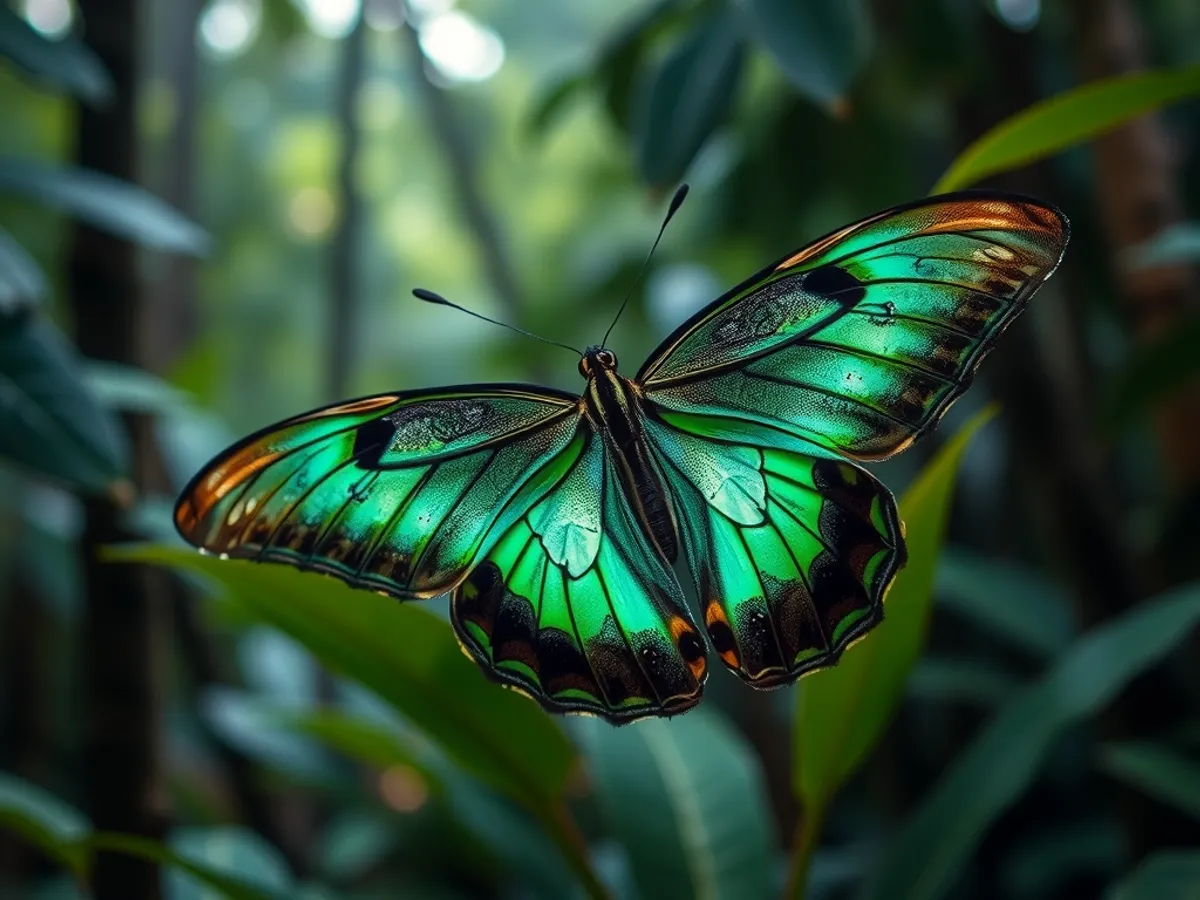
About the Emerald Swallowtail
The Emerald Swallowtail is a striking butterfly renowned for its iridescent green bands and shimmering blue-green scales that adorn its wings. Native to Southeast Asia, this butterfly inhabits lush rainforests where it flits among the undergrowth and canopy. Its vibrant coloration is not due to pigments but rather microscopic scales that refract light, creating a mesmerizing metallic sheen. The Emerald Swallowtail is highly prized by collectors and nature enthusiasts for its dazzling appearance and graceful flight.
Fascinating facts
Structural Coloration
The Emerald Swallowtail's wings appear green due to microscopic structures that bend and reflect light, producing vibrant, iridescent colors.
Caterpillar Diet
The caterpillars of the Emerald Swallowtail feed primarily on plants in the citrus family, which provide essential nutrients for their development.
Rainforest Resident
This butterfly prefers the humid, dense rainforests of Southeast Asia, where it finds shelter, mates, and food sources.
Detailed description
The Emerald Swallowtail (Papilio palinurus) is a medium-sized butterfly with a wingspan ranging from 80 to 100 millimeters (3.1–3.9 inches). Its most distinctive feature is the vivid, iridescent green band that traverses the forewings and hindwings, produced not by pigments but by microscopic, multi-layered scales that refract and scatter light—a phenomenon known as structural coloration. The dorsal (upper) wing surfaces are a velvety black-green, while the ventral (under) sides are dark brown to black, adorned with orange, blue, and white spots, and the hindwings possess elongated tails characteristic of swallowtails. The body is robust, covered in fine scales, and the antennae are clubbed, aiding in navigation. Emerald Swallowtails are strong, agile fliers, often seen gliding or darting through the lower and mid-canopy of tropical rainforests. Their compound eyes provide a wide field of vision, crucial for detecting predators and mates. The proboscis is long and coiled, adapted for sipping nectar from a variety of forest flowers. Larvae are cryptically colored and mimic bird droppings in early instars, providing camouflage against predators. Adults exhibit sexual dimorphism, with females generally being slightly larger and paler than males. The species is known for its solitary habits but may aggregate at mud puddles or mineral-rich substrates, a behavior called 'puddling,' to obtain essential nutrients.
Did you know?
Despite their showy appearance, Emerald Swallowtails are masters of camouflage, blending in seamlessly among dappled rainforest foliage.
Research & sources
Wikipedia summary
Papilio palinurus, the emerald swallowtail, emerald peacock, or green-banded peacock, is a butterfly of the genus Papilio of the family Papilionidae. It is native to Southeast Asia, but is regularly kept in butterfly houses around the world.
Behaviour & social structure
Emerald Swallowtails are diurnal, most active during the warmest hours of the day when sunlight enhances their iridescence. Adults primarily feed on nectar from a range of flowering plants, favoring those with tubular blossoms suited to their proboscis. They exhibit rapid, erratic flight patterns to evade predators such as birds and lizards. Males are territorial, often patrolling and defending sunlit clearings or perches within the forest to attract females and deter rivals. Both sexes engage in puddling, where they absorb minerals and salts from moist soil or decaying organic matter, which are vital for reproductive success. Larvae are solitary feeders on host plants, typically from the Rutaceae family, and exhibit defensive behaviors such as rearing up and displaying an osmeterium—a forked, orange gland that emits foul-smelling chemicals to deter predators. Adults are generally solitary but may be seen in loose aggregations at abundant food sources.
Reproduction & life cycle
Papilio palinurus is multivoltine in tropical environments, producing several generations per year. Courtship involves aerial displays, with males pursuing females through intricate flight maneuvers. After mating, females lay single, spherical eggs on the undersides of host plant leaves, primarily species of Citrus and related Rutaceae. The incubation period for eggs is typically 4–7 days, depending on temperature and humidity. Larvae pass through five instars over 2–3 weeks, initially mimicking bird droppings for camouflage, then developing green coloration as they mature. Pupation occurs in a chrysalis attached to a stem or leaf, where the pupa is well-camouflaged and remains for 10–14 days before the adult emerges. There is no parental care beyond egg-laying; all life stages are solitary. Breeding can occur year-round in equatorial regions, but may be more seasonal in areas with pronounced wet and dry periods.
Adaptations & survival
The most remarkable adaptation of the Emerald Swallowtail is its structural coloration: microscopic ridges and lamellae on the wing scales create interference patterns that produce the butterfly’s signature green and blue iridescence, serving both as camouflage among sun-dappled foliage and as a warning or distraction to predators. The tail-like extensions on the hindwings may function as false targets, drawing attacks away from vital body parts. Larval mimicry of bird droppings deters visually hunting predators, while the osmeterium provides chemical defense. Adults’ strong, erratic flight and acute vision help them evade threats. Their ability to utilize a variety of host plants within the Rutaceae family increases their ecological flexibility. Puddling behavior allows males to supplement sodium and amino acids, which are transferred to females during mating, enhancing egg viability.
Cultural significance
The Emerald Swallowtail’s striking appearance has made it a symbol of beauty and transformation in various Southeast Asian cultures. It is a popular subject in art, jewelry, and butterfly collections worldwide, often associated with good fortune and renewal. In some regions, its iridescent wings are used in traditional crafts and as decorative elements. The butterfly’s presence in butterfly gardens and exhibits has educational value, promoting conservation awareness and appreciation for rainforest biodiversity.
Recent research
Recent research has focused on the nanostructures responsible for the butterfly’s iridescence, with implications for biomimetic materials and photonic technologies. Studies using electron microscopy have revealed the precise arrangement of wing scales that produce the emerald coloration, inspiring advances in anti-counterfeiting and optical devices. Ecological research has examined the butterfly’s role as a pollinator and its interactions with native flora. Ongoing genetic studies are clarifying the evolutionary relationships within the Papilio genus and the mechanisms underlying mimicry and adaptation. Conservation genetics projects are monitoring population structure and gene flow across fragmented habitats.
Videos
Habitat
Tropical rainforest


Conservation
The Emerald Swallowtail is currently classified as Least Concern on the IUCN Red List.
Threats & challenges
Currently classified as Least Concern by the IUCN, the Emerald Swallowtail faces localized threats from habitat loss due to deforestation and agricultural expansion in Southeast Asia. Collection for the butterfly trade, while regulated, can impact wild populations if not managed sustainably. Climate change poses a long-term threat by altering the distribution of suitable rainforest habitats and host plants. Pesticide use in agricultural areas may also reduce larval survival. However, the species’ wide distribution and adaptability to disturbed habitats have so far buffered it from major declines. Butterfly farming and captive breeding for display in butterfly houses help reduce pressure on wild populations.
Taxonomy
Scientific name
Papilio palinurus
- Kingdom
- Animalia
- Phylum
- Arthropoda
- Class
- Insecta
- Order
- Lepidoptera
- Family
- Papilionidae
- Genus
- Papilio
- Species
- palinurus
Community notes
Share your observations about the Emerald Swallowtail.
No community notes yet. Be the first!
Discover more wildlife
More fascinating animals from the encyclopedia.