
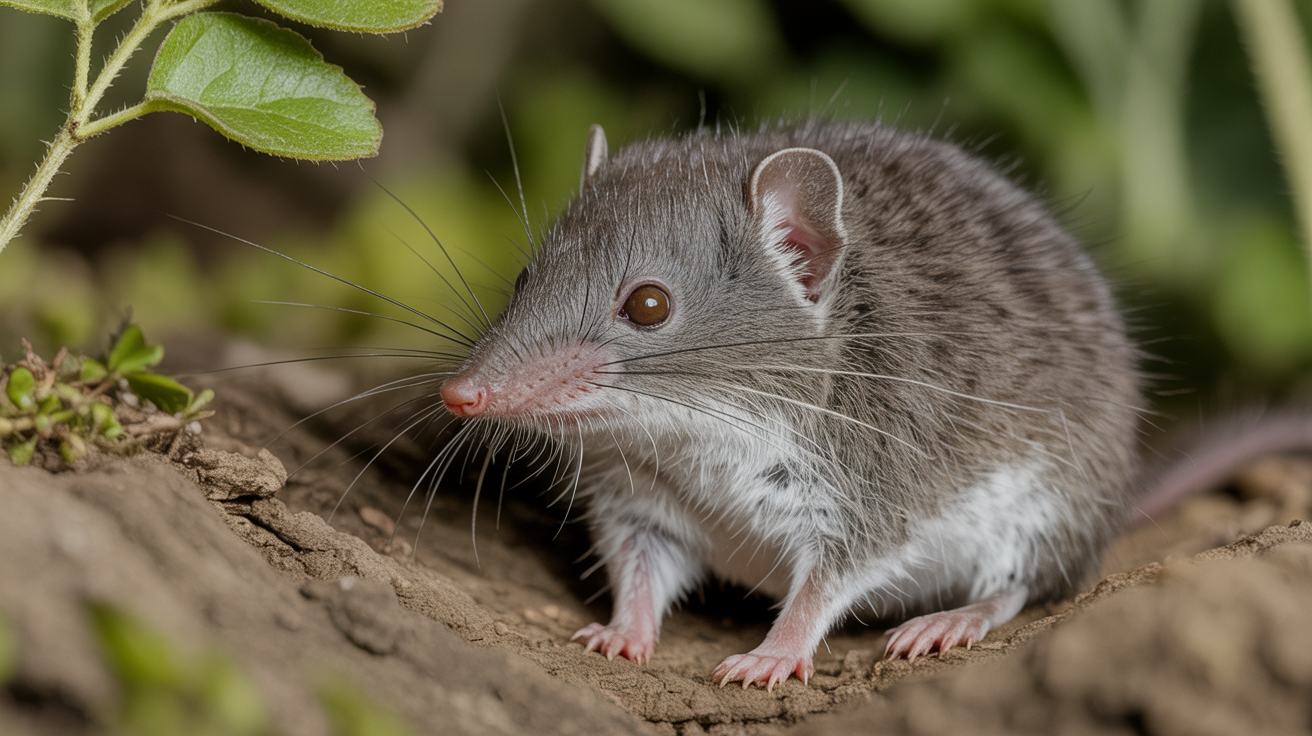
About the Etruscan Shrew
Suncus etruscus weighs about 1.8 g, less than a British penny, and is the smallest mammal on Earth by mass. Being that small pushes mammalian physiology to its limit. Surface area scales badly against volume, so it haemorrhages body heat, and to compensate its heart runs at up to around 1,500 beats a minute — roughly 25 beats every second, so fast that individual beats are hard to resolve — and it breathes several hundred times a minute at rest. To fuel that furnace it must eat one and a half to two times its own body weight in insects every day, and it can starve to death in a matter of hours. There is no time for careful hunting, so it does not use its eyes at all in the dark; it maps prey with its whiskers, sweeping them across a cricket and deciding from the shape of the touch whether to attack, in a strike that can be launched within a few tens of milliseconds of first contact. Neuroscientists study it precisely because that whisker-to-attack loop is one of the fastest sensory-motor decisions known in a mammal. It lives in warm rocky scrub around the Mediterranean and across to Southeast Asia, hunting in crevices and old walls.
Fascinating facts
Rapid Heartbeat
The Etruscan shrew's heart can beat up to 1,511 times per minute, one of the fastest rates among mammals.
Tiny Predator
Despite its size, the shrew is a voracious hunter, preying on insects and even tiny vertebrates.
Wide Range
It is found across southern Europe, North Africa, and Asia, adapting to a variety of warm, sheltered habitats.
Detailed description
The Etruscan shrew (Suncus etruscus) is the smallest extant mammal by mass, typically weighing between 1.2 and 2.7 grams and measuring 35–48 mm in body length, with a tail almost as long as its body (25–30 mm). Its fur is dense, velvety, and grayish-brown, providing camouflage in leaf litter and undergrowth. The shrew's head is elongated with a sharply pointed, flexible snout, large black eyes, and prominent ears relative to its size. Its teeth are white, lacking iron pigmentation, a trait distinguishing it from red-toothed shrews. The Etruscan shrew has a highly specialized musculoskeletal system, enabling rapid, agile movements necessary for capturing prey and evading predators. Its heart is proportionally the largest of any mammal, beating up to 1,500 times per minute at rest and even faster during activity, supporting an extremely high metabolic rate. This species is primarily nocturnal and crepuscular, spending daylight hours concealed in dense vegetation or burrows. It is solitary and territorial, using scent marking and vocalizations to communicate. The Etruscan shrew's lifespan in the wild is short, typically less than 18 months, with high mortality due to predation and environmental hazards. Despite its diminutive size, it plays a significant ecological role as an insectivore in Mediterranean and temperate ecosystems.
Did you know?
The Etruscan shrew is so lightweight that it can run across the surface of dry leaves without making a sound, making it almost invisible to predators.
Research & sources
Wikipedia summary
The Etruscan shrew, also known as the Etruscan pygmy shrew, white-toothed pygmy shrew and Savi's pygmy shrew, is the smallest known extant mammal by mass, weighing only about 1.8 g (0.063 oz) on average.
Behaviour & social structure
Etruscan shrews are hyperactive, spending most of their waking hours foraging for food. They hunt primarily by smell and touch, using their sensitive snout to detect and capture prey such as insects, spiders, and small arthropods. Prey is seized with rapid, precise bites, often immobilized by repeated attacks. The shrew consumes up to 125% of its body weight daily, feeding every 1–2 hours to sustain its metabolism. It is generally solitary, with individuals maintaining exclusive territories marked by scent glands. Social interactions are limited to brief encounters during the breeding season or territorial disputes, which can involve aggressive vocalizations and physical confrontations. The shrew is crepuscular and nocturnal, with peak activity at dusk and dawn. It constructs temporary nests from leaves and grass in sheltered locations and may use abandoned burrows but rarely excavates its own. Rest periods are brief, and the shrew enters torpor during food shortages or cold weather to conserve energy.
Reproduction & life cycle
Breeding occurs mainly in spring and early summer, though in favorable climates, multiple litters may be produced annually. Etruscan shrews are polyestrous, with females capable of entering estrus shortly after giving birth. Courtship is brief, involving scent cues and vocalizations. After mating, gestation lasts approximately 27–28 days. Litters typically consist of 2–6 altricial young, born blind and hairless in a concealed nest. The mother provides intensive care, nursing the young for 20–23 days until weaning. Young shrews develop rapidly, opening their eyes at about 14 days and becoming independent soon after weaning. There is no paternal care, and juveniles quickly disperse to establish their own territories. Sexual maturity is reached at 2–3 months of age, allowing for rapid population turnover.
Adaptations & survival
The Etruscan shrew exhibits several remarkable adaptations for its tiny size and insectivorous lifestyle. Its extremely high metabolic rate is supported by a disproportionately large heart and lungs, facilitating rapid oxygen delivery. The flexible, elongated snout is highly innervated, enabling precise detection and capture of small prey. Its sharp, needle-like teeth are specialized for piercing exoskeletons. The shrew's fur provides insulation and camouflage, while its small size allows it to exploit microhabitats inaccessible to larger predators. Behavioral adaptations include frequent feeding, short sleep cycles, and the ability to enter torpor to survive periods of food scarcity or cold. Acute hearing and olfaction aid in navigation and prey detection in low-light environments.
Cultural significance
The Etruscan shrew has limited direct cultural significance, likely due to its secretive nature and minute size. It is occasionally referenced in scientific literature as a model organism for studies of mammalian physiology, particularly regarding metabolic extremes and cardiac function. In some Mediterranean folklore, shrews in general were believed to bring luck or were associated with fertility due to their prolific breeding, but there are no specific myths or traditional uses documented for Suncus etruscus.
Recent research
Recent research has focused on the Etruscan shrew's neurobiology and sensory adaptations, revealing a highly developed somatosensory cortex for tactile prey detection. Studies of its cardiac physiology have provided insights into mammalian heart rate regulation and metabolic scaling. The species is also used in comparative genomics to understand evolutionary constraints on body size. Ongoing field studies are investigating its population genetics and responses to habitat fragmentation. Notably, the Etruscan shrew's ability to enter torpor is of interest for biomedical research into hypometabolism and organ preservation.
Sources
Videos
Habitat
Dense undergrowth in forests, grasslands, and scrublands


Conservation
The Etruscan Shrew is currently classified as Least Concern on the IUCN Red List.
Threats & challenges
Currently classified as Least Concern by the IUCN, the Etruscan shrew faces localized threats from habitat loss due to agricultural expansion, urbanization, and pesticide use, which reduce prey availability. Its small size and high metabolic needs make it particularly vulnerable to food shortages and environmental fluctuations. Predators include owls, snakes, small carnivorous mammals, and domestic cats. Climate change poses a potential long-term threat by altering habitat structure and prey abundance. Despite these challenges, the species' wide distribution and rapid reproductive rate contribute to its overall population stability. Monitoring is recommended in regions experiencing rapid land-use change.
Taxonomy
Scientific name
Suncus etruscus
- Kingdom
- Animalia
- Phylum
- Chordata
- Class
- Mammalia
- Order
- Eulipotyphla
- Family
- Soricidae
- Genus
- Suncus
- Species
- etruscus
Where to see an etruscan shrew
2 zoos and aquariums in 1 country are recorded as keeping this species.


Community notes
Share your observations about the Etruscan Shrew.
No community notes yet. Be the first!
Discover more wildlife
More fascinating animals from the encyclopedia.