
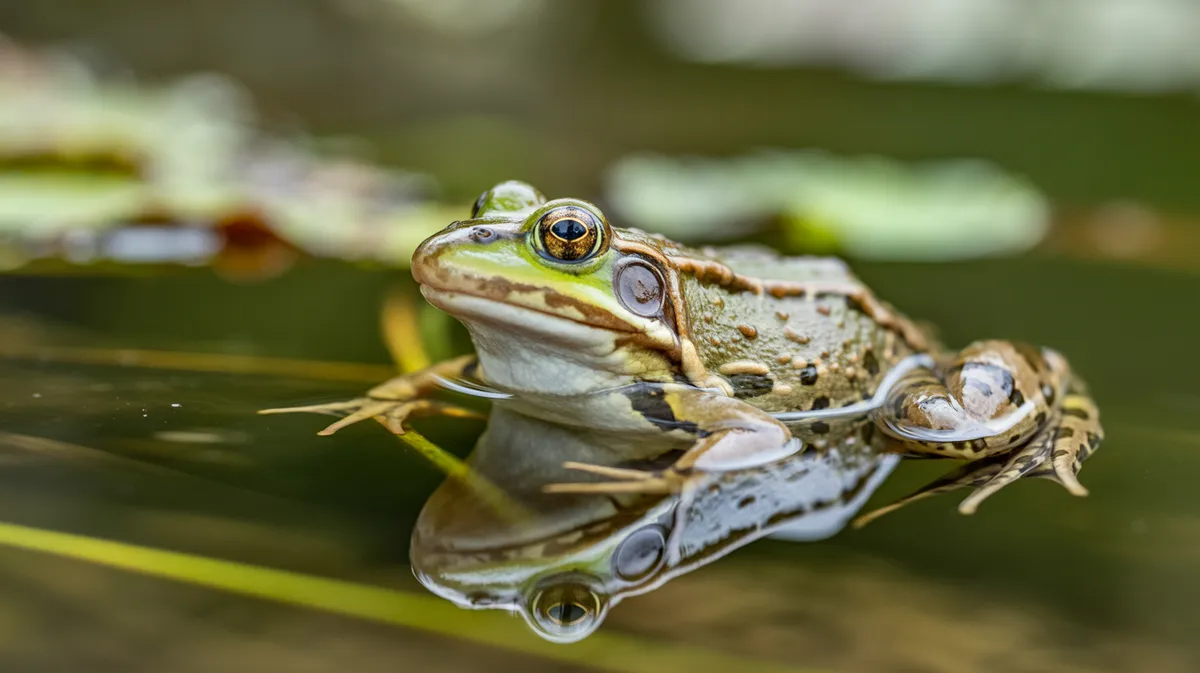
About the European Common Frog
The European Common Frog, also known simply as the Common Frog, is a widespread amphibian native to much of Europe and parts of Asia. It is easily recognized by its smooth skin, which varies in color from olive green to brown or grey, often with dark spots and a distinctive dark patch behind the eyes. This species is highly adaptable, frequenting a variety of moist habitats such as ponds, marshes, grasslands, and woodlands. Breeding occurs in spring, with large numbers of eggs laid in shallow water, and tadpoles metamorphose into froglets by early summer. The European Common Frog plays a crucial role in its ecosystem, both as a predator of invertebrates and as prey for larger animals.
Fascinating facts
Variable Colors
The European Common Frog can range in color from olive green to brown, yellow, or even reddish, often with dark spots and a pale underside.
Mass Breeders
During spring, females can lay up to 4,000 eggs in large jelly-like clumps in shallow waters.
Winter Survival
These frogs can survive freezing temperatures by slowing their metabolism and hiding in mud or under leaf litter until spring.
Detailed description
The European Common Frog (Rana temporaria) is a medium-sized amphibian, typically measuring 6–9 cm in body length, with females generally larger than males. Its skin is smooth and moist, with coloration ranging from olive green, brown, yellow, to grey, often featuring irregular dark spots and a characteristic dark mask-like patch behind each eye. The ventral side is usually pale, sometimes with mottling. This species has long, powerful hind limbs adapted for jumping and swimming, and unwebbed forelimbs. The eyes are large and positioned dorsally, providing a wide field of vision, and the tympanum (external eardrum) is visible behind the eyes. Rana temporaria is primarily crepuscular and nocturnal, spending daylight hours hidden under vegetation or debris to avoid desiccation and predation. It is an ectothermic species, relying on environmental temperatures to regulate its body functions, and exhibits seasonal behaviors such as hibernation in winter, often buried in mud at the bottom of ponds or under leaf litter. The species is highly adaptable, occupying a range of habitats from lowland meadows to subalpine regions up to 2,800 meters in the Alps. During the breeding season, males develop nuptial pads on their thumbs to aid in amplexus (mating embrace). Tadpoles are dark-colored, forming large aggregations in shallow water, and undergo metamorphosis over 8–12 weeks, depending on temperature and food availability. The European Common Frog is a key ecological indicator due to its sensitivity to environmental changes and pollutants.
Did you know?
Despite their name, European Common Frogs can sometimes be found at elevations over 2,500 meters in the Alps.
Research & sources
Behaviour & social structure
European Common Frogs are generally solitary outside the breeding season, exhibiting territoriality especially among males during mating. They are opportunistic carnivores, feeding primarily on invertebrates such as insects, spiders, worms, and slugs, using a sit-and-wait hunting strategy. Prey is captured with a rapid flick of the sticky tongue. Activity peaks at dusk and during humid or rainy conditions, when frogs emerge to forage. They are capable swimmers, using their strong hind legs for propulsion. During dry or hot periods, they seek shelter in moist microhabitats to prevent water loss. Vocalizations are most prominent during the breeding season; males produce a low, purring call to attract females and establish dominance. Outside of breeding, vocalizations are rare. Frogs are known to migrate several hundred meters between terrestrial habitats and breeding sites, often returning to their natal ponds. They exhibit homing behavior and can navigate complex landscapes using olfactory and visual cues.
Reproduction & life cycle
Breeding occurs in early spring (March–April), often triggered by rising temperatures and increased daylight. Males arrive at breeding ponds first and compete for access to females, sometimes forming dense aggregations. Amplexus is axillary (male grasps female behind the forelimbs) and can last several hours. Females lay between 1,000 and 4,000 eggs in large, gelatinous clumps attached to submerged vegetation. Fertilization is external. Embryonic development is temperature-dependent, with hatching occurring after 1–3 weeks. Tadpoles feed on algae and detritus, gradually developing hind legs, then forelegs, and resorbing their tails during metamorphosis. Metamorphosis is usually complete by early summer. There is no parental care post-oviposition. Sexual maturity is reached at 2–3 years, and individuals can live up to 10–12 years in the wild, though most succumb earlier due to predation.
Adaptations & survival
Rana temporaria exhibits several adaptations for survival in temperate climates. Its permeable skin allows for cutaneous respiration and moisture absorption, but also makes it vulnerable to dehydration, hence its preference for moist environments. The ability to hibernate in both aquatic and terrestrial sites enables survival through freezing winters; frogs can tolerate partial freezing of body fluids due to the accumulation of glucose and urea, which act as cryoprotectants. Cryptic coloration provides camouflage from predators. The species’ broad dietary range and flexible habitat use contribute to its resilience. During breeding, explosive aggregation and synchronized spawning increase reproductive success and reduce predation risk on eggs and tadpoles. Tadpoles can accelerate development in response to drying ponds or high predation pressure.
Cultural significance
The European Common Frog holds a prominent place in European folklore and culture, often symbolizing transformation, fertility, and renewal due to its metamorphic life cycle. In some regions, frogs are considered omens of rain or good luck. Traditional medicine in parts of Europe once used frog parts for purported healing properties, though such practices are now rare. The species is a popular subject in educational programs and citizen science projects, serving as an ambassador for wetland conservation. In literature and fairy tales, frogs are frequently depicted as magical creatures, most famously in stories like 'The Frog Prince.'
Recent research
Recent research on Rana temporaria includes studies on the effects of climate change on breeding phenology, with evidence showing earlier spawning dates linked to warmer winters. Genetic studies have revealed significant population structure across Europe, with postglacial recolonization patterns influencing current genetic diversity. Investigations into disease dynamics have highlighted the species' susceptibility to chytrid fungus and ranavirus, prompting monitoring efforts. Ecotoxicological studies have used the species as a bioindicator for environmental contaminants. Ongoing research explores the impacts of habitat fragmentation and road mortality, with mitigation measures such as amphibian tunnels showing promise. The species is also used in developmental biology to study metamorphosis and endocrine disruption.
Videos
Habitat
Freshwater ponds, marshes, meadows, and woodlands
 Various Continental Regions
Grassland
Open areas dominated by grasses rather than trees, supporting numerous herbivores and their predators.
 Elevated Terrain
Mountain
High-altitude environments with varying climates and specialized wildlife adapted to rugged terrain and thin air.
 Global
Forest
Wooded areas with significant tree cover and diverse plant and animal communities.
 Global
Freshwater
Lakes, rivers, and wetlands with diverse aquatic ecosystems.
Conservation
The European Common Frog is currently classified as Least Concern on the IUCN Red List.
Threats & challenges
While classified as Least Concern by the IUCN, European Common Frogs face several threats. Habitat loss and fragmentation due to urbanization, agriculture, and drainage of wetlands are major concerns. Road mortality during seasonal migrations can significantly impact local populations. Pollution, particularly from pesticides, heavy metals, and endocrine-disrupting chemicals, affects larval development and adult health. Emerging infectious diseases, such as chytridiomycosis (caused by Batrachochytrium dendrobatidis) and ranavirus, have caused localized declines. Climate change poses additional risks by altering breeding phenology and increasing the frequency of droughts. Despite these challenges, the species remains widespread and locally abundant, benefiting from its adaptability and use of artificial habitats such as garden ponds.
Taxonomy
Scientific name
Rana temporaria
- Kingdom
- Animalia
- Phylum
- Chordata
- Class
- Amphibia
- Order
- Anura
- Family
- Ranidae
- Genus
- Rana
- Species
- temporaria
Community notes
Share your observations about the European Common Frog.
No community notes yet. Be the first!
Discover more wildlife
More fascinating animals from the encyclopedia.