
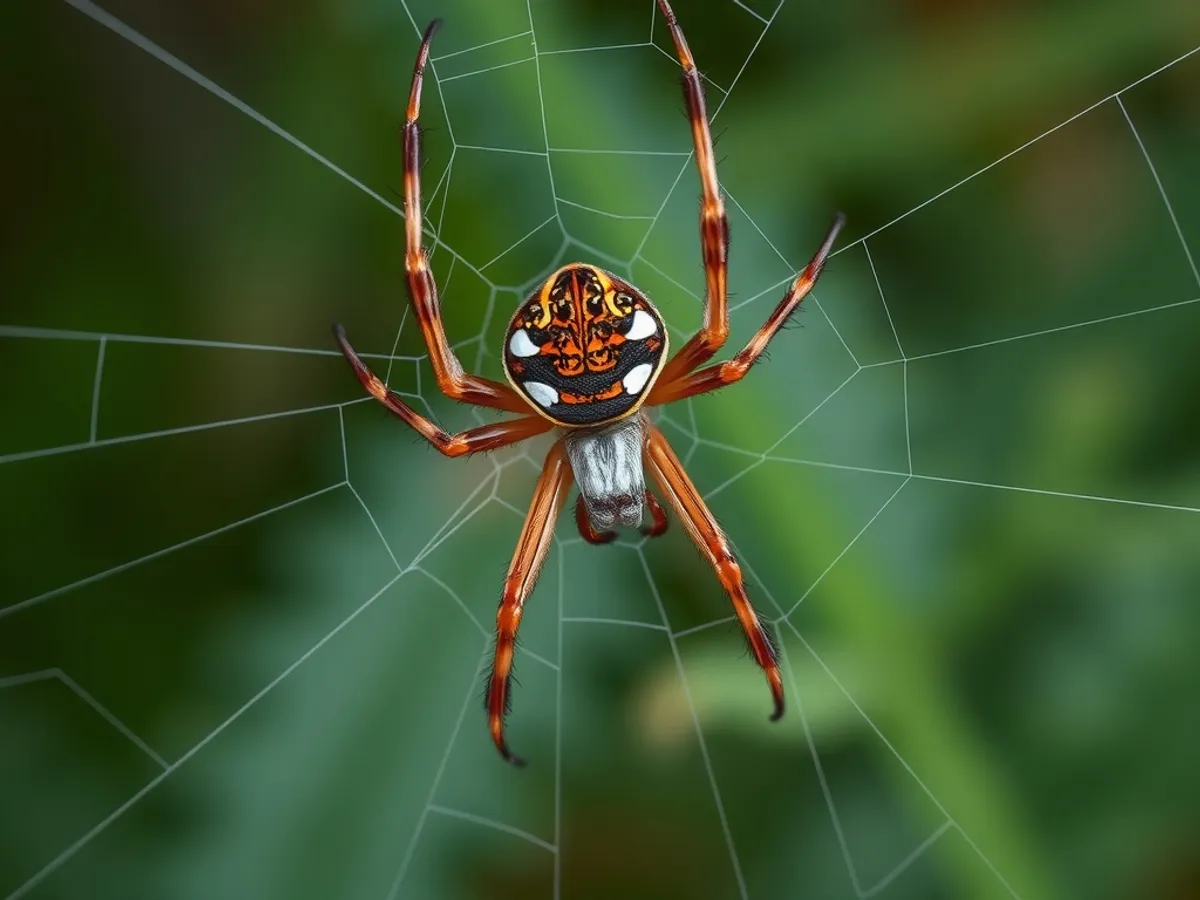
About the European garden spider
Araneus diadematus is the orb-weaver with a cross of white spots on its abdomen, and it rebuilds its web with a frequency that would bankrupt most animals. The capture spiral is a costly protein, and a web loses its stickiness and its tension within a day or so, so the spider takes the old web down, eats it, and recycles the amino acids directly into new silk — the material is back in a fresh web within hours. The animal sits either at the hub or in a curled leaf retreat off to one side, holding a single taut signal thread that runs to the centre, so it feels the vibration of a strike without exposing itself. Prey is bitten and then swathed in bands of silk laid down by the hind legs as the spider rotates it, and digestion is external: enzymes liquefy the insect inside its own cuticle and the spider drinks it out. Males are much smaller than females and approach carefully along a mating thread, plucking it in a specific rhythm, and they are frequently eaten anyway. The spider produces at least half a dozen chemically distinct silks from different glands — dry structural radials, sticky spiral, wrapping silk, dragline, egg-sac silk — each optimised for a different job.
Fascinating facts
Web Builders
European garden spiders are known for creating classic orb-shaped webs, which they use to ensnare flying insects.
Sexual Dimorphism
Females are significantly larger than males and are responsible for producing and guarding egg sacs.
Seasonal Life Cycle
Adults are most commonly seen in late summer and autumn, with spiderlings hatching the following spring.
Detailed description
The European garden spider (Araneus diadematus) is a medium-sized orb-weaving arachnid, with adult females typically measuring 6.5–20 mm in body length and males 5.5–13 mm. Its most distinctive feature is the pale, cross-shaped pattern of spots on the dorsal side of its bulbous abdomen, set against coloration that ranges from pale yellow to dark brown. The cephalothorax is covered in fine hairs and bears eight eyes arranged in two rows. The spider's legs are banded and equipped with specialized setae for web construction and prey handling. Araneus diadematus is primarily solitary, constructing large, vertical orb webs up to 40 cm in diameter, often rebuilt daily. It is a sit-and-wait predator, relying on web vibrations to detect and locate prey, which it immobilizes with silk and venom. The species exhibits sexual dimorphism, with females being larger and more robust. After mating, females produce one or more egg sacs, each containing several hundred eggs, which are guarded or hidden in vegetation. The spider undergoes several molts before reaching maturity, with a typical lifespan of one year. Its ecological role as a predator of flying insects makes it a key species in temperate garden and woodland ecosystems.
Did you know?
Despite their intimidating appearance, the bite of a European garden spider is generally no more harmful to humans than a bee sting.
Research & sources
Wikipedia summary
The spider species Araneus diadematus is commonly called the European garden spider, cross orbweaver, diadem spider, orangie, cross spider, and crowned orb weaver. It is sometimes called the pumpkin spider, although this name is also used for a different species, Araneus marmoreus. It is an orb-weaver spider found in Europe, where it is native, and North America, where it was introduced.
Behaviour & social structure
Araneus diadematus is primarily crepuscular, showing peak activity at dawn and dusk. It spends most of its time motionless at the hub of its web, monitoring for prey via web-borne vibrations. When an insect becomes ensnared, the spider rapidly approaches, bites to inject venom, and wraps the prey in silk for later consumption. Webs are often constructed in sheltered, open spaces such as between branches or garden structures. The spider typically consumes and reconstructs its web daily, recycling silk proteins. Social interactions are limited, with individuals maintaining exclusive territories; encounters between conspecifics, especially males and females outside of mating, can result in aggression. Males may wander in search of mates, often risking predation or cannibalism by females. The species exhibits thanatosis (playing dead) when threatened and may drop from the web on a dragline to escape predators.
Reproduction & life cycle
Breeding occurs in late summer to early autumn. Males mature earlier and seek out females by following pheromone trails. Courtship involves cautious web vibrations to signal intent and avoid being mistaken for prey. After mating, which can last several minutes, the male often dies or is consumed by the female (sexual cannibalism is documented but not obligatory). Females lay eggs in silken sacs, typically attached to vegetation or hidden in crevices. Each sac contains 300–800 eggs. Embryonic development takes several weeks; spiderlings overwinter within the sac and emerge in spring. There is no parental care post-oviposition. The life cycle is annual, with most adults dying after reproduction.
Adaptations & survival
Araneus diadematus has evolved several adaptations for survival. Its orb web is a highly efficient prey-capture device, with radial and spiral threads optimized for strength and elasticity. The spider can sense minute vibrations through specialized slit sensilla on its legs, allowing precise prey localization. Its coloration provides camouflage among foliage, while the cross pattern may serve as disruptive coloration or warning. Silk production is highly specialized, with different glands producing various silk types for web construction, prey wrapping, and egg sac formation. Behavioral adaptations include web recycling to conserve resources and thanatosis to deter predators. The venom is potent against insects but harmless to humans.
Cultural significance
The European garden spider is a familiar figure in European folklore, often associated with good luck and the changing seasons. Its cross-shaped marking has led to religious and mythological associations, sometimes symbolizing protection or the harvest. In literature and art, the species is emblematic of autumn and the intricate beauty of nature. It is also used in educational contexts to illustrate web architecture and arachnid biology. There are no known traditional medicinal or utilitarian uses.
Recent research
Recent studies have focused on the biomechanics of orb web construction, revealing that Araneus diadematus can adjust web geometry in response to prey availability and environmental conditions. Genetic research has explored population structure and gene flow between European and introduced North American populations, indicating limited but ongoing genetic divergence. Investigations into silk properties have highlighted its remarkable tensile strength and potential applications in biomaterials. Behavioral research has examined the effects of light pollution and urbanization on web-building and reproductive success.
Videos
Habitat
Gardens, woodlands, hedgerows, and meadows


Conservation
The European garden spider is currently classified as Least Concern on the IUCN Red List.
Threats & challenges
Currently classified as Least Concern, Araneus diadematus faces few major threats due to its wide distribution and adaptability. However, habitat loss from urbanization, pesticide use, and climate change can impact local populations. Light pollution may disrupt web-building and prey capture. Predators include birds, wasps, and other spiders. The species is resilient, often thriving in gardens and urban green spaces, but long-term monitoring is needed to assess potential declines linked to environmental changes.
Taxonomy
Scientific name
Araneus diadematus
- Kingdom
- Animalia
- Phylum
- Arthropoda
- Class
- Arachnida
- Order
- Araneae
- Family
- Araneidae
- Genus
- Araneus
- Species
- diadematus
Community notes
Share your observations about the European garden spider.
No community notes yet. Be the first!
Discover more wildlife
More fascinating animals from the encyclopedia.