
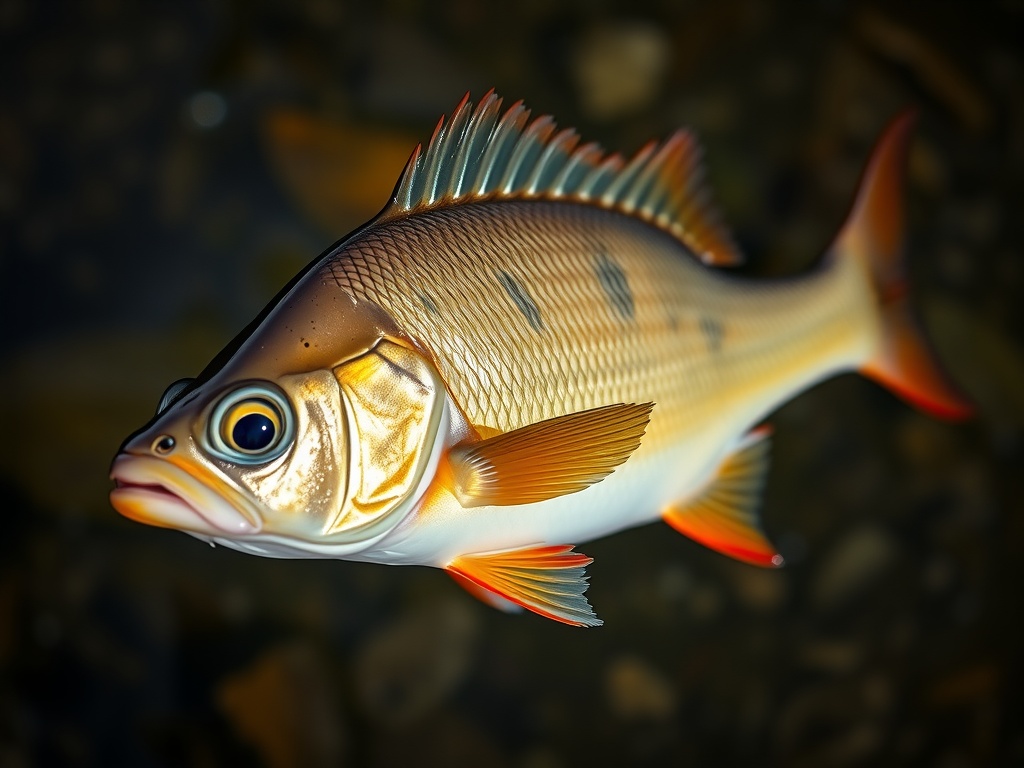
About the European perch
The European perch is a widely distributed freshwater fish found throughout Europe and northern Asia. Characterized by its greenish body marked with dark vertical bars and bright red or orange coloring on its fins, it is a popular species among anglers for its striking appearance and spirited fight. This medium-sized predatory fish prefers slow-moving or still waters such as lakes, rivers, and ponds, where it preys on smaller fish, insects, and aquatic invertebrates. Known for forming large schools, especially when young, the European perch plays an important role in its ecosystem as both predator and prey.
Fascinating facts
Angler's Favorite
European perch are highly prized by recreational fishers for their fighting spirit and delicious white flesh.
Schooling Behavior
Young perch form large schools for protection, but adults often become more solitary as they age.
Spiny Defense
Their sharp, spiny dorsal fins provide a defense mechanism against predators and make them tricky for larger fish to swallow.
Detailed description
The European perch (Perca fluviatilis) is a robust, laterally compressed freshwater fish, typically reaching 20–35 cm in length, though specimens over 50 cm and weighing up to 4.8 kg have been recorded in optimal conditions. Its body is olive-green with 5–9 distinct dark vertical bars along the flanks, and the pelvic, anal, and caudal fins are strikingly red or orange. The dorsal fin is divided into two parts: the first is spiny and the second soft-rayed, a feature aiding in predator defense. European perch possess a large mouth with fine, brush-like teeth suited for grasping slippery prey. Their eyes are relatively large, enhancing vision in turbid waters. Juveniles form dense schools, while adults may become more solitary or form loose aggregations. The species is highly adaptable, thriving in a variety of freshwater habitats, including lakes, slow-flowing rivers, reservoirs, and even brackish coastal lagoons. European perch are opportunistic predators, playing a key role in regulating prey populations and serving as an important food source for larger fish, birds, and mammals. Their lifespan can reach 20–22 years, although most individuals live 8–12 years in the wild.
Did you know?
The European perch has been introduced to countries far outside its native range, including Australia and New Zealand, where it is considered an invasive species.
Research & sources
Wikipedia summary
The European perch, also known as the common perch, redfin perch, big-scaled redfin, English perch, Euro perch, Eurasian perch, Eurasian river perch, Hatch, poor man's rockfish or in Anglophone parts of Europe, simply the perch, is a predatory freshwater fish native to Europe and North Asia. It is the type species of the genus Perca.
Behaviour & social structure
European perch are diurnal, with peak activity during dawn and dusk (crepuscular periods). Juveniles exhibit strong schooling behavior, which provides protection from predators and increases foraging efficiency. As they mature, perch become more territorial and may defend prime hunting grounds. Their hunting strategy involves ambush and pursuit; they use their cryptic coloration to blend with submerged vegetation or structures, then dart quickly to capture prey. Their diet shifts ontogenetically: larvae and fry feed on zooplankton, while subadults and adults consume aquatic insects, crustaceans, and increasingly, smaller fish—including conspecifics (cannibalism is not uncommon in dense populations). Perch communicate through visual cues and, during spawning, through tactile interactions. They are sensitive to environmental changes and may alter depth or habitat use in response to temperature, oxygen levels, or prey availability.
Reproduction & life cycle
Spawning occurs in early spring (March–May), when water temperatures reach 7–8°C. European perch are group spawners, with females releasing up to 300,000–900,000 adhesive eggs in long, gelatinous ribbons (up to 2 meters) over submerged vegetation, roots, or branches in shallow water. Males fertilize the eggs externally, and no parental care is provided post-spawning. Incubation lasts 8–16 days, depending on temperature. Larvae are planktonic for several weeks before settling to benthic habitats. Sexual maturity is typically reached at 2–4 years of age, with males maturing slightly earlier than females. Spawning aggregations can be large, and successful recruitment is strongly influenced by water temperature, food availability, and predation pressure on eggs and fry.
Adaptations & survival
European perch exhibit several adaptations for survival. Their cryptic coloration and vertical barring provide camouflage among aquatic vegetation and dappled light. The spiny anterior dorsal fin deters predators. Their large, sensitive eyes allow for effective hunting in low-light or turbid conditions. Physiologically, they tolerate a wide range of temperatures (2–30°C) and moderate salinity, enabling colonization of diverse habitats. Their opportunistic feeding and ontogenetic dietary shifts reduce intraspecific competition. Cannibalism, while risky, can regulate population density and ensure rapid growth for survivors. Perch also exhibit phenotypic plasticity, with body shape and growth rates varying according to habitat productivity and predation risk.
Cultural significance
The European perch has long held significance in European culture, both as a prized sport fish and a traditional food source. Its firm, white flesh is esteemed in regional cuisines, particularly in Central and Eastern Europe. Perch fishing is a popular recreational activity, and the species features in folklore and local symbolism, often representing vigilance or adaptability. In some areas, perch scales were historically used as decorative elements or in folk remedies. The species is also important in ecological education and as a model organism in fisheries research.
Recent research
Recent research has focused on the ecological impacts of perch introductions outside their native range, their role in food web dynamics, and the genetic basis of their adaptability. Studies using environmental DNA (eDNA) have improved monitoring of perch populations and their spread. Investigations into their response to climate change and water quality shifts are ongoing, as is research into their use as bioindicators of ecosystem health. Genomic studies have begun to elucidate population structure across Europe and the mechanisms underlying their phenotypic plasticity. Additionally, perch are being studied for their potential in sustainable aquaculture.
Videos
Habitat
Freshwater lakes, rivers, and ponds


Conservation
The European perch is currently classified as Least Concern on the IUCN Red List.
Threats & challenges
Currently listed as Least Concern by the IUCN, European perch populations are stable across much of their range. However, localized threats include habitat degradation (eutrophication, pollution, damming), overfishing, and competition or hybridization with introduced species such as the North American yellow perch (Perca flavescens). In some regions, perch have become invasive, impacting native fish communities. Climate change may alter spawning cues and habitat suitability, while disease outbreaks (notably by the parasite Saprolegnia and the perch tapeworm Triaenophorus nodulosus) can cause local declines. Despite these challenges, the species' adaptability and broad distribution buffer it against widespread threats.
Taxonomy
Scientific name
Perca fluviatilis
- Kingdom
- Animalia
- Phylum
- Chordata
- Class
- Actinopterygii
- Order
- Perciformes
- Family
- Percidae
- Genus
- Perca
- Species
- fluviatilis
Community notes
Share your observations about the European perch.
No community notes yet. Be the first!
Discover more wildlife
More fascinating animals from the encyclopedia.