
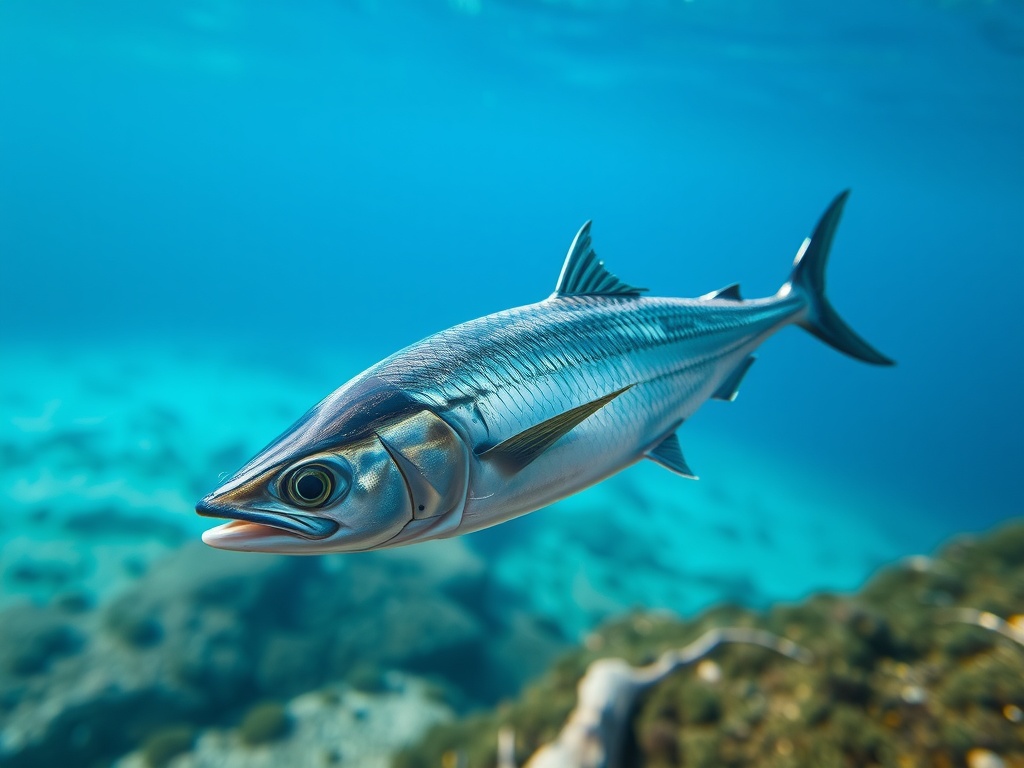
About the European Sardine
The European sardine is a small, schooling fish found abundantly in the northeastern Atlantic Ocean and the Mediterranean Sea. It has a slender, silver body with a bluish or greenish back, and typically grows up to 20 cm in length. Sardines are well known for their massive shoals, a survival adaptation that helps protect them from predators. They play a vital role in marine food webs, serving as prey for larger fish, seabirds, and marine mammals. Sardines are an important source of food for humans and are often caught and preserved in cans.
Fascinating facts
Schooling Behavior
Sardines often swim in huge schools that can number in the millions, providing safety in numbers against predators.
Wide Distribution
European sardines are found in the Atlantic Ocean from Norway to Senegal and throughout the Mediterranean Sea.
Nutritional Value
Sardines are considered a superfood due to their high content of protein, vitamins, and beneficial omega-3 fatty acids.
Detailed description
The European sardine (Sardina pilchardus) is a small, pelagic clupeid fish characterized by a laterally compressed, elongated body measuring typically 15–20 cm in length, though some individuals may reach up to 27 cm. Its body is covered in large, easily detached cycloid scales, with a distinctive silvery coloration on the flanks and a blue-green iridescent dorsal surface that provides camouflage in open water. The species has a single dorsal fin, a forked caudal fin, and a protruding lower jaw, adaptations for rapid, agile swimming. European sardines are obligate schoolers, forming dense aggregations that can number in the millions, a behavior that confers protection from predators and enhances foraging efficiency. Their gill rakers are finely spaced, allowing them to efficiently filter-feed on planktonic organisms, including copepods, diatoms, and small crustaceans, although they may also consume fish larvae and detritus. Sardines exhibit diel vertical migrations, ascending to surface waters at night to feed and descending during the day to avoid predators. They are a short-lived species, with most individuals living 3–5 years, though some may reach 7–8 years under optimal conditions. The species plays a keystone role in marine ecosystems, transferring energy from lower trophic levels (plankton) to higher predators such as tuna, dolphins, and seabirds. Their high fecundity and rapid growth rates are crucial for sustaining both natural populations and commercial fisheries.
Did you know?
A single sardine shoal can contain millions of fish, forming a moving mass that stretches for several kilometers.
Research & sources
Behaviour & social structure
European sardines are highly social and display obligate schooling behavior from early juvenile stages. Schools can be extremely large and tightly coordinated, with individuals synchronizing their movements to reduce predation risk and increase foraging success. Sardines are primarily filter feeders, swimming with their mouths open to strain plankton from the water column using specialized gill rakers. Feeding activity peaks during the night when plankton is more abundant near the surface; during daylight, sardines descend to deeper waters, reducing their visibility to predators. They exhibit a strong homing instinct, often returning to the same spawning and feeding grounds annually. Sardines are sensitive to changes in water temperature, salinity, and oxygen levels, which can influence their distribution and migratory behavior. Communication within schools is primarily visual and mechanosensory, relying on the lateral line system to detect changes in water movement and maintain group cohesion.
Reproduction & life cycle
European sardines are batch spawners, releasing eggs multiple times throughout the spawning season, which varies geographically but generally occurs from late autumn to early summer (October to June) in the Mediterranean and from winter to spring in the Atlantic. Spawning typically takes place in coastal waters at night, with females releasing between 10,000 and 60,000 pelagic eggs per season. Fertilization is external, and eggs are buoyant, developing while drifting in the plankton. Embryonic development is rapid, with hatching occurring within 2–3 days at optimal temperatures (15–20°C). Larvae are planktonic and undergo several developmental stages before settling into juvenile schools. There is no parental care; survival of offspring is largely dependent on environmental conditions and predation rates. Sexual maturity is reached at 1–2 years of age, and reproductive output is closely linked to food availability and environmental factors.
Adaptations & survival
European sardines possess several key adaptations for pelagic life. Their streamlined, laterally compressed bodies and deeply forked tails enable sustained, fast swimming, essential for both predator avoidance and long-distance migrations. The silvery, reflective scales provide countershading, reducing visibility to predators from above and below. Highly sensitive lateral line systems allow sardines to detect minute vibrations and coordinate schooling behavior. Their gill rakers are specialized for efficient plankton filtration, enabling them to exploit abundant, small prey. Sardines also exhibit physiological adaptations to variable salinity and temperature, allowing them to inhabit a wide range of coastal environments. Their high fecundity and rapid growth are evolutionary responses to high predation pressure and environmental variability.
Cultural significance
European sardines have deep cultural and economic significance in many Mediterranean and Atlantic coastal societies. They are a staple in traditional cuisines, particularly in Portugal, Spain, France, Italy, and Morocco, where they are grilled, salted, smoked, or canned. Sardine festivals, such as Lisbon's Festa de Santo António, celebrate the fish's importance in local heritage. Historically, sardines have been a symbol of abundance and prosperity, and their fisheries have shaped coastal economies for centuries. In art and folklore, sardines often represent community and cooperation, reflecting their schooling nature. The canning industry, which began in the 19th century, revolutionized food preservation and trade, making sardines one of the world's most widely consumed fish.
Recent research
Recent research on European sardines has focused on the impacts of climate change on distribution, spawning phenology, and recruitment success. Genomic studies have revealed significant population structure between Atlantic and Mediterranean stocks, informing management and conservation strategies. Stable isotope analyses have improved understanding of sardine trophic ecology and migration patterns. Ongoing studies are investigating the effects of microplastic ingestion and contaminant accumulation on sardine health and reproductive output. Acoustic surveys and advanced modeling techniques are being used to monitor population dynamics and inform adaptive fisheries management. There is also growing interest in the role of sardines in carbon cycling and their potential as indicators of ecosystem health.
Videos
Habitat
Coastal ocean waters

Conservation
The European Sardine is currently classified as Least Concern on the IUCN Red List.
Threats & challenges
Although currently listed as Least Concern by the IUCN, European sardines face several threats. Overfishing is a significant concern, particularly in the Mediterranean and parts of the Atlantic, where intense commercial exploitation has led to localized population declines and altered age structures. Environmental changes, such as rising sea temperatures, ocean acidification, and hypoxic events, can disrupt spawning, larval survival, and food availability. Sardines are also vulnerable to pollution, especially oil spills and microplastics, which can affect reproductive success and larval development. Bycatch in other fisheries and habitat degradation from coastal development further challenge population resilience. Management strategies, including catch quotas, seasonal closures, and habitat protection, are critical for ensuring long-term sustainability.
Taxonomy
Scientific name
Sardina pilchardus
- Kingdom
- Animalia
- Phylum
- Chordata
- Class
- Actinopterygii
- Order
- Clupeiformes
- Family
- Clupeidae
- Genus
- Sardina
- Species
- pilchardus
Community notes
Share your observations about the European Sardine.
No community notes yet. Be the first!
Discover more wildlife
More fascinating animals from the encyclopedia.