
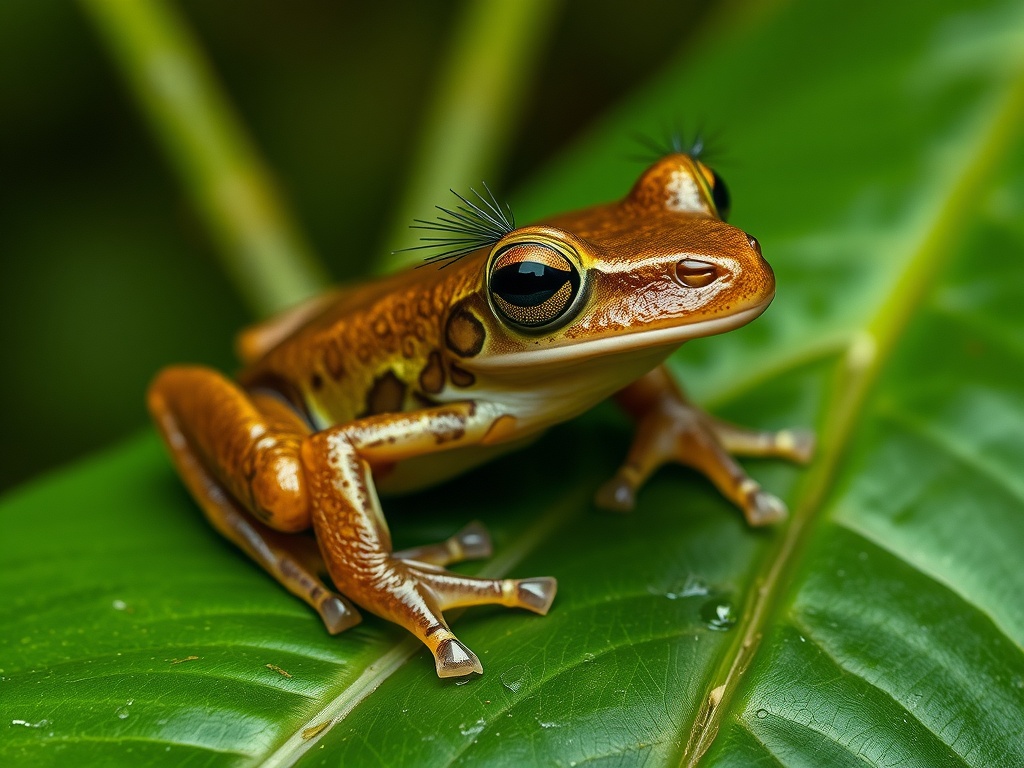
About the Eyelash Leaf Frog
The Eyelash Leaf Frog is a strikingly beautiful amphibian known for its vibrant green body, yellow sides, and blue or purple markings on its flanks. Named for the distinctive, upward-pointing skin projections above its eyes that resemble eyelashes, this nocturnal frog is expertly camouflaged among rainforest leaves. It inhabits the humid lowland and montane forests of Central and South America, spending much of its life high in the forest canopy. The species is primarily arboreal, descending only to breed in temporary pools or water-filled tree holes.
Fascinating facts
Arboreal Lifestyle
The Eyelash Leaf Frog spends almost all its life in the forest canopy, rarely descending to the forest floor.
Spectacular Colors
Its vibrant green, yellow, and blue coloration helps it blend into the foliage and startle predators when threatened.
Specialized Breeding
It lays eggs on leaves above water, a unique adaptation that helps protect eggs from aquatic predators until the tadpoles hatch and drop into the water.
Detailed description
The Eyelash Leaf Frog (Cruziohyla calcarifer) is a medium-sized tree frog, with adults typically measuring between 55 and 80 mm in snout-vent length. Its most distinctive anatomical feature is the presence of fleshy, upward-pointing dermal projections above the eyes, resembling eyelashes, which are thought to aid in camouflage by disrupting the outline of the head. The dorsal surface is a vivid green, often speckled with white or yellow spots, while the flanks display striking blue or purple markings bordered by bright yellow or orange. The ventral surface is pale, and the limbs are long and slender, with extensive webbing between the fingers and toes, facilitating both climbing and gliding short distances between branches. The eyes are large and golden, providing excellent night vision for its nocturnal lifestyle. The skin is smooth and moist, a typical adaptation for arboreal amphibians in humid environments. This species is primarily arboreal, spending most of its life in the upper canopy, where it is rarely seen except during the breeding season. Its cryptic coloration and unique eyelash-like projections provide effective camouflage among epiphytic plants and mossy branches. The Eyelash Leaf Frog is generally solitary, coming together only during the rainy season to breed in ephemeral water bodies or tree holes.
Did you know?
This frog's unique 'eyelash' projections are thought to help break up its outline, providing camouflage from predators.
Research & sources
Behaviour & social structure
Cruziohyla calcarifer is strictly nocturnal, emerging at dusk to forage for invertebrate prey such as insects, spiders, and occasionally smaller frogs. It employs a sit-and-wait hunting strategy, remaining motionless on leaves or branches and ambushing prey with a rapid extension of its sticky tongue. The species is highly arboreal, rarely descending to the forest floor except to breed. Individuals are generally solitary and territorial, using visual and acoustic signals to communicate and establish boundaries. Males produce a soft, low-frequency call to attract females and deter rivals, but their calls are less conspicuous than those of many other frog species, likely an adaptation to avoid predation. During the day, the frogs remain motionless and well-camouflaged among foliage, minimizing water loss and exposure to predators.
Reproduction & life cycle
Breeding occurs during the rainy season, typically between May and October, when temporary pools and water-filled tree holes become available. Males congregate near suitable breeding sites and call to attract females. Amplexus (the mating embrace) is axillary, with the male grasping the female behind her forelimbs. Females lay clutches of 50–100 eggs on leaves or branches overhanging water. Upon hatching, the tadpoles drop into the water below, where they continue development. The larval period lasts approximately 6–10 weeks, depending on environmental conditions. There is no parental care after egg deposition, but the choice of oviposition site is critical for offspring survival, as eggs and tadpoles are vulnerable to desiccation and predation.
Adaptations & survival
The Eyelash Leaf Frog exhibits several key adaptations for arboreal life: expanded toe pads and extensive webbing allow for efficient climbing and even limited gliding between branches. Its cryptic coloration and eyelash-like projections break up its outline, providing camouflage among leaves and moss. The frog's large eyes enhance night vision, crucial for nocturnal activity. Its skin secretes a mild toxin, deterring some predators. The reproductive strategy of laying eggs on overhanging vegetation reduces predation risk for eggs and ensures that tadpoles have immediate access to water upon hatching. The ability to breed in ephemeral water bodies helps avoid aquatic predators that inhabit permanent pools.
Cultural significance
While not widely featured in indigenous folklore, the Eyelash Leaf Frog's striking appearance has made it a symbol of rainforest biodiversity in Central and South America. It is occasionally referenced in ecotourism and environmental education programs as an ambassador species for amphibian conservation. Its unique morphology and vibrant coloration have also inspired artists and photographers, contributing to its popularity in scientific and popular media.
Recent research
Recent research has focused on the phylogenetic relationships within the genus Cruziohyla, revealing deep genetic divergence between populations across its range. Studies have also examined the species' microhabitat preferences, highlighting its reliance on undisturbed canopy environments. Ongoing research is investigating the impact of chytridiomycosis on population viability and the effectiveness of habitat corridors in maintaining genetic diversity. Additionally, bioacoustic studies are characterizing the species' vocalizations and their role in mate selection and territory establishment.
Sources
Systematics and natural history of the genus Cruziohyla (Anura: Phyllomedusidae) with the description of a new species from Ecuador
J. Faivovich, W.C. Wheeler, T. Grant, et al. (2018)
scientificCruziohyla calcarifer: The IUCN Red List of Threatened Species 2020
IUCN SSC Amphibian Specialist Group
conservationVideos
Habitat
Humid lowland and montane rainforest
 Tropical Regions
Rainforest
Dense, wet forests with the highest biodiversity on Earth, containing more than half of the world's plant and animal species.
 Global
Forest
Wooded areas with significant tree cover and diverse plant and animal communities.
 Global
Freshwater
Lakes, rivers, and wetlands with diverse aquatic ecosystems.
Conservation
The Eyelash Leaf Frog is currently classified as Vulnerable on the IUCN Red List.
Threats & challenges
The primary threats to Cruziohyla calcarifer are habitat loss and fragmentation due to deforestation for agriculture, logging, and human settlement. The species is highly sensitive to environmental changes, as it relies on pristine, humid forests and specific breeding sites. Pollution, especially from agricultural runoff, and the spread of chytrid fungus (Batrachochytrium dendrobatidis) pose additional risks. Climate change may alter rainfall patterns, reducing the availability of suitable breeding habitats. Population trends indicate a decline, with local extinctions reported in some areas. Conservation efforts focus on habitat protection and monitoring disease prevalence.
Taxonomy
Scientific name
Cruziohyla calcarifer
- Kingdom
- Animalia
- Phylum
- Chordata
- Class
- Amphibia
- Order
- Anura
- Family
- Phyllomedusidae
- Genus
- Cruziohyla
- Species
- calcarifer
Community notes
Share your observations about the Eyelash Leaf Frog.
No community notes yet. Be the first!
Discover more wildlife
More fascinating animals from the encyclopedia.