
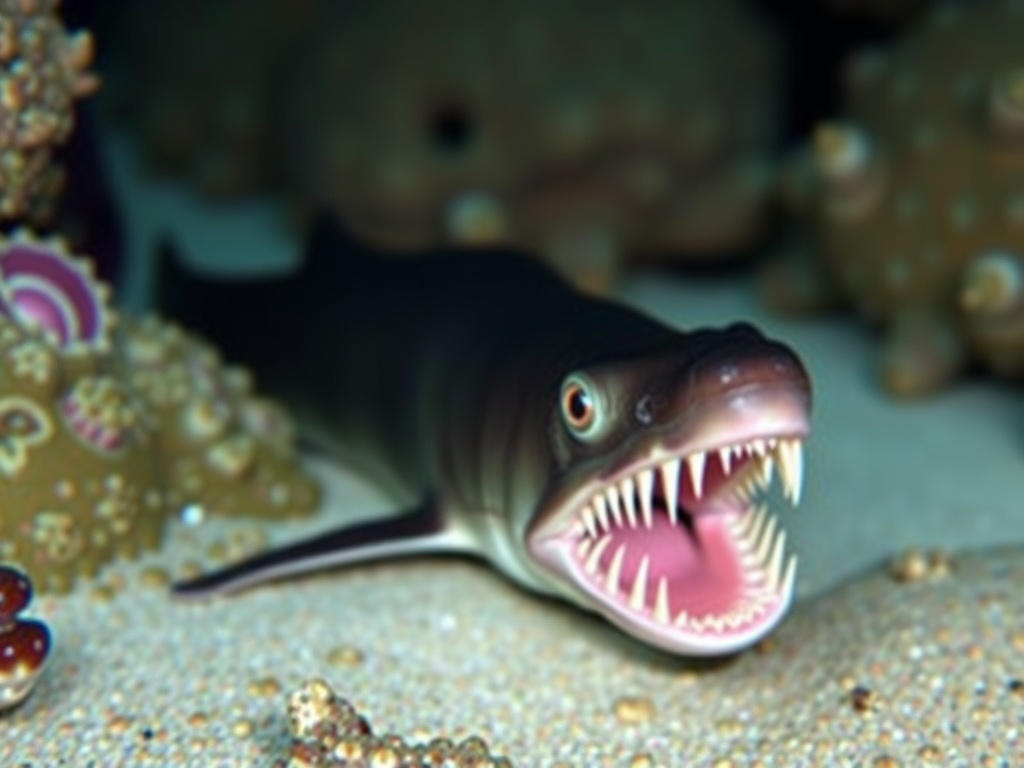
About the Fangtooth
Anoplogaster cornuta has the largest teeth of any fish in the ocean relative to its body size, and they present the animal with an obvious geometrical problem: the two lower fangs are so long that if the fish simply closed its mouth, they would drive straight through its own brain. The solution is a pair of sockets, one on either side of the braincase, into which the fangs slide as the jaw shuts — a structure with no real parallel among fishes. Despite the demonic look, the fangtooth is small, rarely more than about 16 cm, and it is dark brown-black, with a bulky head and a body that tapers away to almost nothing. It lives across the world's deep ocean, mostly between around 500 and 2,000 m but recorded far deeper, and it migrates upward at night to feed. Down there, prey is scarce and eyesight is nearly useless, so its eyes are small and its lateral line is enormous, running in broad open grooves across the head, and it appears to detect prey largely by pressure and contact, then engulf anything it can physically fit around — hence the teeth, which are for holding rather than cutting. Juveniles look so different from adults, with long head spines and no fangs, that they were once described as an entirely separate genus.
Fascinating facts
Enormous Teeth
The fangtooth's teeth are so long that the fish has special sockets on either side of its brain to accommodate them when it closes its mouth.
Deep-Sea Dweller
Fangtooths are found at incredible depths, often between 500 and 2,000 meters, where sunlight never penetrates.
Dramatic Transformation
Juvenile fangtooths look nothing like adults, with different body proportions and tooth size, adapting as they mature to life in deeper waters.
Detailed description
The common fangtooth (Anoplogaster cornuta) is a deep-sea beryciform fish recognized for its strikingly large, recurved fangs, which are the largest teeth relative to body size among all marine fishes. Adults typically measure 13–18 cm in length, though juveniles are much smaller and differ markedly in appearance, being more slender and lighter in color. The body is laterally compressed, covered in small, rough scales, and colored a dark brown to black, providing camouflage in the aphotic depths. The head is disproportionately large, with a cavernous mouth and prominent sensory canals, adaptations for detecting prey in the absence of light. The lower jaw fangs are so long they fit into special sockets on either side of the brain to allow the mouth to close. Fangtooths possess a well-developed lateral line system and specialized neuromasts, enhancing their ability to sense vibrations and movement in the water. Their eyes are relatively small and adapted for low-light vision, but olfactory and mechanosensory cues are likely more important for hunting. Fangtooths are solitary and highly territorial, rarely interacting with conspecifics outside of breeding. Their musculature and swim bladder are reduced, reflecting a largely sedentary lifestyle in the high-pressure, low-energy environment of the deep sea. Despite their fearsome appearance, fangtooths are not dangerous to humans and play a vital role as mid-level predators in deep-sea ecosystems.
Did you know?
Fangtooths can survive at pressures over 200 times greater than at sea level, thanks to their specially adapted bodies.
Research & sources
Wikipedia summary
Fangtooths are beryciform fish of the family Anoplogastridae that live in the deep sea. The name is from the Greek anoplo, meaning "unarmed", and γαστήρ, meaning "stomach". With a worldwide distribution in tropical and cold-temperate waters, the family contains only two very similar species in one genus, with no known close relatives.
Behaviour & social structure
Fangtooths are primarily solitary, exhibiting minimal social interaction except during spawning periods. They are nocturnal hunters, ascending to shallower depths (as shallow as 200 m) at night in a behavior known as diel vertical migration, likely to exploit prey resources. Their diet consists mainly of smaller fish, crustaceans, and cephalopods, which they capture using rapid lunges and their formidable teeth. Fangtooths rely heavily on mechanosensory and chemosensory cues to locate prey, as vision is limited at the depths they inhabit. They exhibit sit-and-wait predation, remaining motionless for extended periods before ambushing passing prey. Juveniles are known to inhabit shallower waters and display more active, pelagic behavior compared to adults. There is little evidence of complex social structure or group hunting; individuals are aggressive toward conspecifics, especially in confined environments.
Reproduction & life cycle
Reproductive biology in fangtooths is not fully understood due to the challenges of deep-sea research, but they are believed to be oviparous, releasing eggs and sperm into the water column for external fertilization. Spawning likely occurs seasonally, with peak activity inferred from the presence of larvae in plankton samples during certain months (often spring and summer in the North Atlantic). Eggs are buoyant and develop in the upper water column, where larvae and juveniles undergo significant morphological changes before descending to deeper habitats as they mature. There is no evidence of parental care; larvae are planktonic and develop independently. Sexual maturity is reached at a length of approximately 8–10 cm, and growth rates are slow, reflecting the low-energy environment of the deep sea.
Adaptations & survival
Fangtooths exhibit a suite of adaptations for deep-sea survival. Their large, recurved teeth and powerful jaws allow them to seize and retain slippery, agile prey. The dark pigmentation and compressed body shape provide camouflage and reduce silhouette visibility to predators and prey. Reduced eyes and enhanced lateral line and olfactory systems compensate for the lack of light. Specialized jaw sockets accommodate the enormous lower fangs, allowing the mouth to close fully. Their reduced swim bladder minimizes buoyancy issues at high pressure, and their metabolism is adapted for energy conservation in a food-scarce environment. Juvenile fangtooths' pelagic lifestyle and lighter coloration may reduce predation risk and facilitate dispersal.
Cultural significance
Fangtooths have little direct significance in human culture due to their inaccessibility and lack of commercial value. However, their fearsome appearance and extreme adaptations have made them popular subjects in documentaries, educational materials, and deep-sea exploration media, often symbolizing the mysterious and alien nature of the deep ocean. They are sometimes featured in popular culture as examples of 'monstrous' deep-sea life, but there are no known traditional uses or mythological associations.
Recent research
Recent research on fangtooths has focused on their sensory biology, particularly the molecular basis of their visual pigments and lateral line system, revealing adaptations for low-light detection. Studies using remotely operated vehicles (ROVs) and deep-sea trawls have improved understanding of their distribution, vertical migration, and ontogenetic shifts in habitat. Genetic analyses have confirmed the distinctiveness of the two Anoplogaster species and clarified their evolutionary relationships within the Trachichthyiformes. Ongoing research aims to elucidate their reproductive cycles and larval dispersal patterns, as well as their role in deep-sea food webs. Fangtooths are also used as model organisms for studying extreme pressure adaptation at the molecular and physiological levels.
Videos
Habitat
Deep ocean

Conservation
The Fangtooth is currently classified as Least Concern on the IUCN Red List.
Threats & challenges
Currently, fangtooths face minimal direct threats from human activity due to their deep-sea habitat, which is largely inaccessible to commercial fisheries and unaffected by most forms of pollution. However, potential future threats include deep-sea mining, climate change-induced shifts in ocean chemistry and temperature, and plastic pollution, which may impact prey availability and ecosystem health. Population trends are not well-documented but are presumed stable, and the species is listed as Least Concern by the IUCN. The main ecological challenge for fangtooths is the scarcity and unpredictability of food resources in the deep sea, driving their highly specialized adaptations.
Taxonomy
Scientific name
Anoplogaster cornuta
- Kingdom
- Animalia
- Phylum
- Chordata
- Class
- Actinopterygii
- Order
- Trachichthyiformes
- Family
- Anoplogastridae
- Genus
- Anoplogaster
- Species
- cornuta
Community notes
Share your observations about the Fangtooth.
No community notes yet. Be the first!
Discover more wildlife
More fascinating animals from the encyclopedia.