
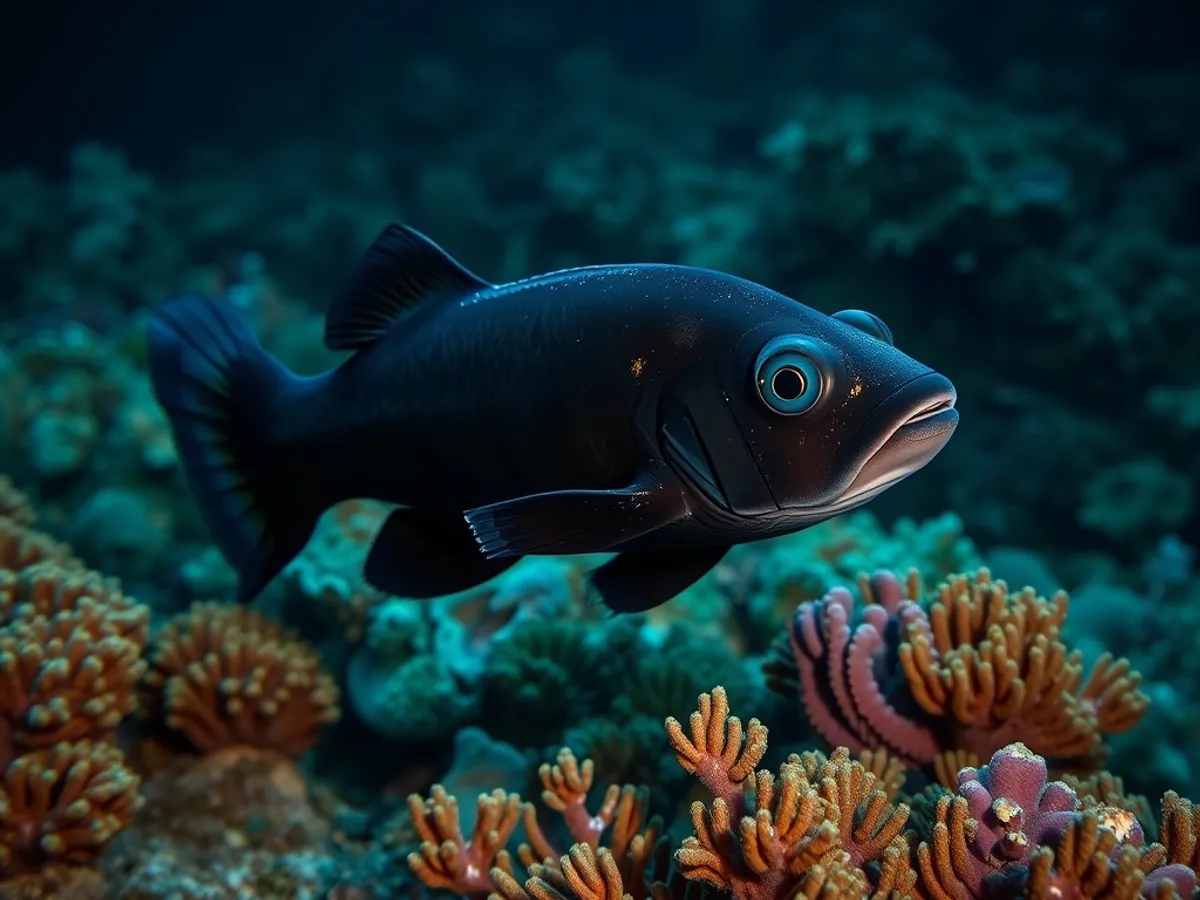
About the Flashlight Fish
Flashlight fishes carry a light organ in a pocket directly beneath each eye, and the light is not theirs. The organ is a bacterial farm, packed with luminous symbiotic bacteria that glow continuously and cannot be switched off — so the fish, unable to turn the lamp off, has evolved a shutter instead. The two main groups do it differently: Photoblepharon raises a black membrane like an eyelid over the organ, while Anomalops rotates the whole organ downward into its socket so the light points inward and disappears. Either way the fish can blink, and the blinking does at least three jobs. It draws in the small planktonic animals the fish eats, which are attracted to light. It coordinates the school in total darkness, letting fish keep station on one another. And it is an escape tactic — a fish that blinks on, swims one way, blinks off and doubles back leaves a predator lunging at a light that is no longer there, a manoeuvre known as blink-and-run. Flashlight fish come up from deep reef caves and drop-offs to feed in shallow water, but only on moonless nights, because a bright moon washes out the signal and exposes them. Divers who visit them in the Banda Islands or the Red Sea see a shoal of drifting green lamps and nothing else.
Fascinating facts
Bioluminescent Glow
Flashlight fish possess light-producing organs under their eyes that glow due to symbiotic bacteria, creating a striking appearance in the dark ocean.
Nocturnal Lifestyle
These fish are primarily active at night, using their bioluminescence to hunt for food and communicate with others in their school.
Unique Light Control
Flashlight fish can instantly 'turn off' their lights by rotating the organ or closing a flap of skin, allowing them to hide from predators or sneak up on prey.
Detailed description
Anomalops katoptron, commonly known as the splitfin flashlight fish, is a medium-sized member of the family Anomalopidae, reaching lengths of up to 35 cm, though most individuals are typically 20–25 cm. Its most distinctive feature is a pair of bean-shaped subocular light organs located beneath each eye, which house dense populations of symbiotic bioluminescent bacteria (Candidatus Photodesmus katoptron). These organs emit a blue-green light (wavelength ~490 nm), which the fish can rapidly conceal or reveal by rotating the organ downward into a specialized pocket, a mechanism unique among bioluminescent fishes. The body is laterally compressed, with a dark brown to black coloration that aids in camouflage in dimly lit reef and slope environments. The dorsal and anal fins are relatively short, and the caudal fin is forked, facilitating agile maneuvering. Flashlight fish are primarily nocturnal, spending daylight hours hiding in caves or crevices and emerging at night to feed. Their eyes are large and adapted for low-light vision, and their lateral line system is well-developed, aiding in navigation and prey detection. Socially, they often form loose aggregations or schools, especially during foraging. The light organs play a crucial role in intraspecific communication, schooling cohesion, and predator evasion, as well as in illuminating prey. Reproduction is oviparous, with external fertilization and pelagic eggs and larvae, which drift in the plankton before settling to benthic habitats.
Did you know?
Flashlight fish can shut off their bioluminescent light instantly by rotating a special organ or covering it with dark skin, making them almost invisible in the dark ocean.
Research & sources
Wikipedia summary
Flashlight fish is a common name for several fish and may refer to:Anomalopidae, a family known as the flashlight fishes, with many species referred to as flashlight fish, especially Anomalops katoptron, from the Pacific Ocean Photoblepharon palpebratum, from the eastern Indian Ocean and the Pacific Photoblepharon steinitzi, from the western Indian Ocean Myctophidae, a family sometimes known as flashlight fishes, with some species referred to as flashlight fish Electrona risso, found in oceans around the world Protomyctophum crockeri, found in the North Pacific Spotted lantern fish, found in deep waters of the Atlantic and Mediterranean Sea Stomiidae, a family with species referred to as flashlight fish Photostomias, found in deep waters
Behaviour & social structure
Flashlight fish are crepuscular and nocturnal, remaining hidden in reef crevices or caves during the day to avoid predators. At dusk, they emerge in small to medium-sized schools (ranging from a few individuals to several dozen) and disperse over sandy or rubble slopes adjacent to coral reefs. Their foraging behavior is characterized by short, rapid bursts of swimming interspersed with hovering, during which they use their bioluminescent organs to scan for zooplankton, copepods, amphipods, and small crustaceans. The light is also used to startle or confuse predators, as the fish can 'blink' the organs rapidly to create a strobe effect. Social interactions include synchronized blinking during schooling, which is believed to help maintain group cohesion in darkness. Flashlight fish are known to exhibit site fidelity, returning to the same daytime refuges. They are generally non-territorial and display minimal aggression toward conspecifics.
Reproduction & life cycle
Anomalops katoptron is an oviparous species with external fertilization. Spawning is believed to occur seasonally, often synchronized with lunar cycles, though precise timing varies regionally. During spawning events, males and females release gametes into the water column, resulting in fertilized pelagic eggs that drift with currents. There is no parental care; eggs and larvae are left to develop independently. Larvae are planktonic and undergo several developmental stages before settling to the benthos as juveniles. Sexual maturity is typically reached at 1–2 years of age. Detailed courtship behaviors are not well documented, but some evidence suggests that bioluminescent signaling may play a role in mate attraction and synchronization of spawning.
Adaptations & survival
The most notable adaptation of Anomalops katoptron is its bioluminescent organ, which is both structurally and functionally specialized. The organ is colonized by symbiotic bacteria that continuously produce light, while the fish can modulate the emission by mechanically rotating the organ. This adaptation serves multiple functions: prey detection in darkness, communication with conspecifics, predator avoidance through counter-illumination or startling flashes, and possibly mate attraction. The large eyes and enhanced rod photoreceptors are adaptations for vision in low-light environments. The dark body coloration provides camouflage against the dim background of the reef at night. Schooling behavior increases survival by reducing individual predation risk and enhancing foraging efficiency. The species' ability to rapidly retreat to crevices is an additional behavioral adaptation to avoid diurnal predators.
Cultural significance
Flashlight fish have intrigued local communities and divers due to their striking bioluminescence, often featuring in folklore as 'spirit fish' or omens in some Pacific island cultures. In Indonesia and the Philippines, fishermen have historically used the natural light of these fish to navigate or attract other fish at night, though such practices are now rare. In modern times, the species is a popular attraction in public aquaria, where its bioluminescence is showcased for educational and entertainment purposes. There are no known uses in traditional medicine or cuisine.
Recent research
Recent research has focused on the molecular biology of the symbiotic bacteria and the genetic basis of bioluminescence in Anomalops katoptron. Studies using high-speed videography have elucidated the mechanics of light organ rotation and blinking patterns, revealing that blink frequency increases in response to predation threats. Ecological studies have examined the role of bioluminescence in group cohesion and predator-prey interactions, with evidence suggesting that synchronized blinking reduces predation risk. Ongoing research includes the impact of environmental changes on bioluminescent signaling and the potential effects of anthropogenic light pollution. Genomic studies are underway to better understand the co-evolution of host and symbiont.
Videos
Habitat
Deep coastal and coral reef waters

Conservation
The Flashlight Fish is currently classified as Least Concern on the IUCN Red List.
Threats & challenges
Currently, Anomalops katoptron is classified as Least Concern by the IUCN, with no major widespread threats identified. However, localized populations may be affected by habitat degradation, particularly the loss of coral reefs and coastal development. Light pollution from coastal areas could potentially disrupt their nocturnal behaviors and bioluminescent signaling. Bycatch in artisanal fisheries and collection for the aquarium trade are minor but ongoing pressures. Climate change, leading to ocean warming and acidification, poses a longer-term threat to coral reef ecosystems on which this species depends. Population trends are considered stable, but continued monitoring is recommended.
Taxonomy
Scientific name
Anomalops katoptron
- Kingdom
- Animalia
- Phylum
- Chordata
- Class
- Actinopterygii
- Order
- Beryciformes
- Family
- Anomalopidae
- Genus
- Anomalops
- Species
- katoptron
Community notes
Share your observations about the Flashlight Fish.
No community notes yet. Be the first!
Discover more wildlife
More fascinating animals from the encyclopedia.