
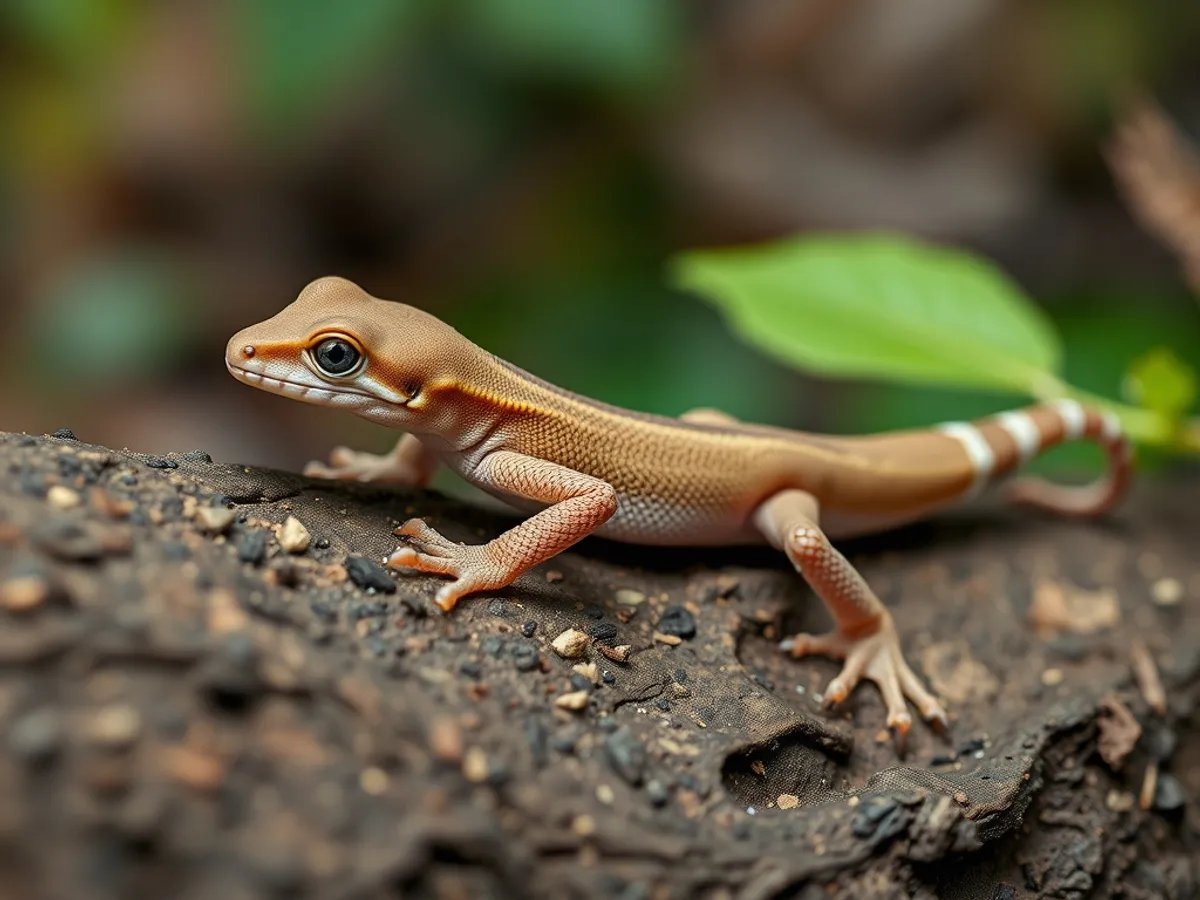
About the Flat-tailed House Gecko
The Flat-tailed House Gecko is a slender, nocturnal lizard known for its distinctive, flattened tail and ability to cling to smooth surfaces. Native to Southeast Asia, it commonly inhabits human dwellings, where it hunts insects at night and remains hidden during the day. Their semi-transparent skin and cryptic coloration provide excellent camouflage against walls and tree bark. This adaptable species has also established populations outside its native range due to accidental introduction by humans.
Fascinating facts
Flattened Tail
Their uniquely flattened tail helps them blend seamlessly into tree bark and walls, enhancing their camouflage.
House Dweller
They are frequently found inside homes, where they hunt insects attracted to lights at night.
Sticky Toes
The gecko's toe pads are covered in microscopic hairs, allowing them to climb smooth vertical surfaces with ease.
Detailed description
The Flat-tailed House Gecko (Hemidactylus platyurus) is a medium-sized gecko, typically reaching a snout-vent length of 6–8 cm, with a total length including the tail of up to 13 cm. Its most distinctive feature is the broad, flattened tail fringed with lateral skin flaps, which aid in camouflage and possibly in gliding short distances. The body is slender, with semi-transparent, granular skin that ranges in color from pale gray to light brown, often mottled with darker spots, allowing it to blend seamlessly with both natural and artificial surfaces. The toes are expanded and equipped with adhesive lamellae, enabling the gecko to climb vertical and even inverted surfaces with ease. Nocturnal by nature, H. platyurus is most active after dusk, emerging from crevices and hiding spots to hunt. Its large, lidless eyes provide excellent night vision, and the vertical pupils can contract to a thin slit during daylight. The species is generally solitary but may be observed in loose aggregations in areas with abundant food resources. When threatened, it can shed its tail (autotomy) as a defense mechanism, with the tail regenerating over time. The gecko’s vocalizations, consisting of soft clicks and chirps, are used for communication, especially during territorial disputes or courtship.
Did you know?
Despite being native to Southeast Asia, the Flat-tailed House Gecko has established populations in the Americas and Pacific islands through accidental transport in cargo shipments.
Research & sources
Wikipedia summary
The flat-tailed house gecko, also known as the frilled house gecko or Asian house gecko, is a species of Gekkonidae native to southeastern and southern Asia. The species is sometimes classified under the genus Cosymbotus.
Behaviour & social structure
Flat-tailed House Geckos are primarily insectivorous, preying on a wide variety of arthropods such as moths, flies, cockroaches, and spiders. They employ a sit-and-wait hunting strategy, remaining motionless on walls or ceilings and ambushing prey that comes within range. Their adhesive toe pads allow them to exploit vertical and smooth surfaces, including glass and painted walls in urban environments. While largely solitary, individuals may tolerate conspecifics in high-density areas, particularly around artificial lights that attract insects. Territorial behavior is observed, with males defending prime foraging sites through visual displays and vocalizations. During the day, geckos hide in cracks, behind wall hangings, or under bark to avoid predators and desiccation. They are crepuscular to nocturnal, with peak activity shortly after sunset and before dawn.
Reproduction & life cycle
Hemidactylus platyurus is oviparous, with females typically laying clutches of two hard-shelled, adhesive eggs. Breeding can occur year-round in tropical climates, but peaks are often observed during the rainy season when humidity is higher. Females may lay multiple clutches per year, depositing eggs in secure, hidden locations such as under loose bark, in wall crevices, or beneath stones. Incubation lasts approximately 45–60 days, depending on ambient temperature and humidity. There is no parental care post-oviposition; hatchlings are independent from birth and resemble miniature adults. Sexual maturity is reached within 6–9 months under favorable conditions.
Adaptations & survival
Key adaptations include the flattened tail with lateral skin flaps, which enhances camouflage and may assist in gliding or breaking up the body outline to evade predators. The specialized toe pads, composed of microscopic setae, provide exceptional adhesion via van der Waals forces, enabling locomotion on smooth and vertical surfaces. The semi-translucent skin aids in crypsis, while the ability to autotomize the tail provides an effective escape mechanism. Their nocturnal lifestyle reduces predation risk and competition with diurnal lizards. Additionally, their tolerance for a wide range of habitats, including urban environments, demonstrates behavioral plasticity and adaptability.
Cultural significance
In many Southeast Asian cultures, house geckos are regarded as benign or even beneficial, as they help control insect pests within homes. Their presence is often tolerated or welcomed, and in some regions, geckos are associated with good luck or omens, depending on local beliefs. There are few records of direct traditional uses, but their distinctive calls and nocturnal habits have made them subjects of folklore and superstition. Occasionally, their appearance in households is linked to superstitious interpretations regarding visitors or fortune.
Recent research
Recent research has focused on the biomechanics of gecko adhesion, with H. platyurus serving as a model for studies on the microstructure of setae and their application in biomimetic materials. Molecular phylogenetic studies have clarified its taxonomic placement within Hemidactylus, resolving historical confusion with the genus Cosymbotus. Ecological studies have examined its role in urban ecosystems, particularly its interactions with invasive gecko species and its adaptability to anthropogenic habitats. Ongoing research includes the impact of urbanization on genetic diversity and the potential for further range expansion due to human-mediated dispersal.
Sources
Videos
Habitat
Urban areas, forests, and woodlands

Conservation
The Flat-tailed House Gecko is currently classified as Least Concern on the IUCN Red List.
Threats & challenges
Currently assessed as Least Concern by the IUCN, Hemidactylus platyurus faces minimal direct threats across its native and introduced ranges. However, localized declines may occur due to habitat loss from urbanization, pesticide use reducing prey availability, and competition with other synanthropic gecko species. The species’ adaptability to human-modified environments has facilitated its spread, but also exposes it to risks such as predation by domestic animals and accidental transport outside its native range. Overall, populations are stable, and the species is not considered threatened at a global scale.
Taxonomy
Scientific name
Hemidactylus platyurus
- Kingdom
- Animalia
- Phylum
- Chordata
- Class
- Reptilia
- Order
- Squamata
- Family
- Gekkonidae
- Genus
- Hemidactylus
- Species
- platyurus
Community notes
Share your observations about the Flat-tailed House Gecko.
No community notes yet. Be the first!
Discover more wildlife
More fascinating animals from the encyclopedia.