
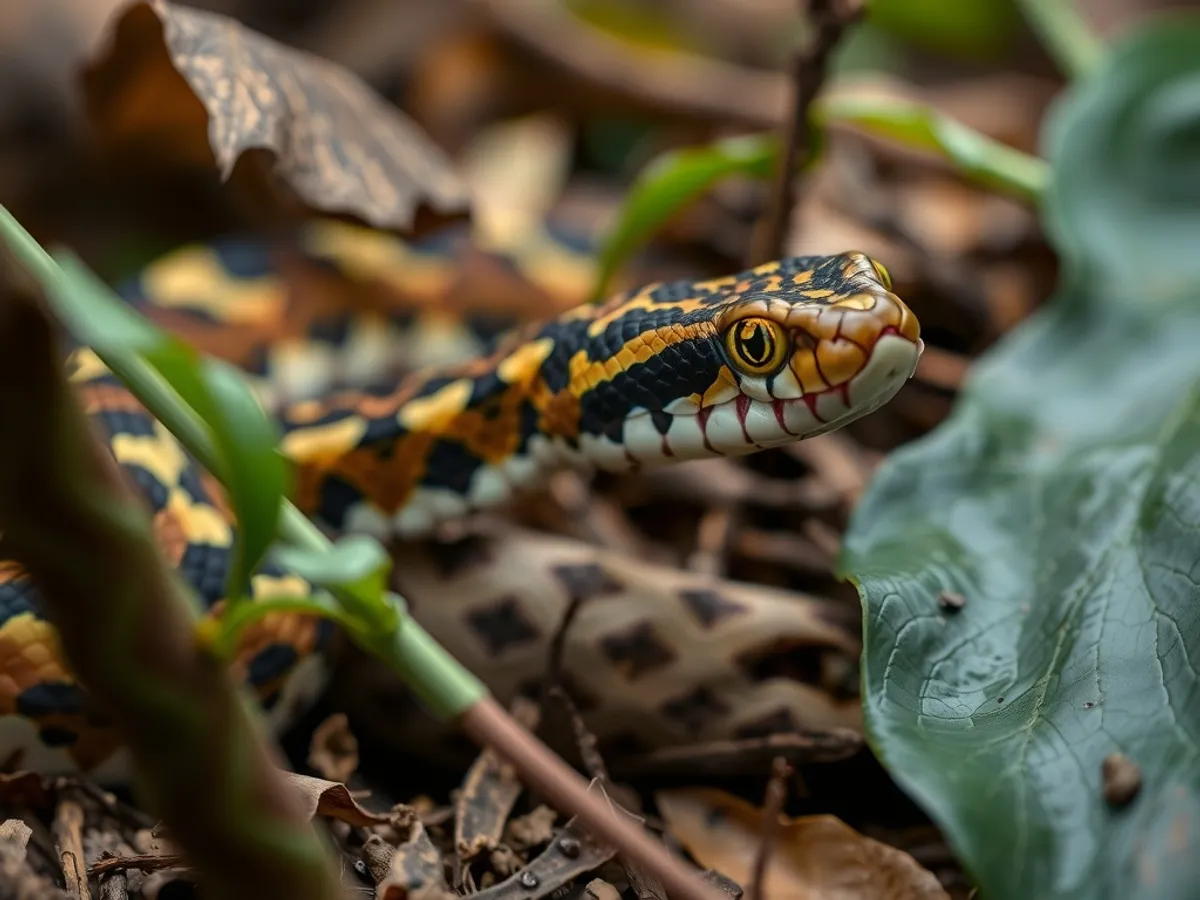
About the Gaboon Viper
The Gaboon viper has the longest fangs of any snake — approaching five centimetres — and delivers one of the largest venom yields of any species, and it is almost entirely disinclined to use either. It is famously placid, slow to strike, and its whole strategy rests on not being seen: its geometric pattern of browns and purples resolves, on a leaf-littered forest floor, into nothing at all. It will not flee when approached, and often will not move even when stepped on, which is precisely how the bites that do occur happen. It hunts by ambush, capable of lying motionless for days waiting for prey to pass within range, then striking with startling speed for so heavy an animal — and, unusually for a viper, holding onto its prey rather than releasing it and tracking it down later. It is the heaviest viper in Africa. Its danger to people is real but is mostly a danger of accident rather than aggression.
Fascinating facts
Longest Snake Fangs
The Gaboon Viper has the longest fangs of any venomous snake, measuring up to 5 cm (2 inches), allowing it to inject venom deeply into its prey.
Expert Camouflage
Its intricate skin pattern closely resembles dead leaves, enabling it to remain concealed on the rainforest floor and ambush unsuspecting prey.
Ambush Predator
This viper relies on stillness and patience, sometimes waiting motionless for days until suitable prey passes within striking distance.
Detailed description
The Gaboon viper (Bitis gabonica) is an exceptionally large and robust viperid, with adults typically measuring 120–150 cm in length, though some individuals can exceed 200 cm and weigh over 8 kg, making it the heaviest viper in Africa. Its broad, triangular head is distinctively marked with a pair of horn-like scales between the nostrils and adorned with intricate geometric patterns in shades of brown, purple, and cream, providing superb camouflage among leaf litter. The Gaboon viper possesses the longest fangs of any venomous snake, reaching up to 5.0–5.5 cm, and is capable of delivering the largest venom yield per bite (up to 600 mg dry weight). Its body is stout and muscular, adapted for a sedentary ambush lifestyle. The eyes are large and set forward, granting binocular vision, which is unusual among snakes. This species is primarily nocturnal and terrestrial, rarely climbing but sometimes found basking in low vegetation. Its slow, deliberate movements contrast with its explosive strike, which can be completed in less than 0.25 seconds. The Gaboon viper is solitary outside of the breeding season and relies heavily on cryptic coloration and stillness to avoid detection by both predators and prey. It inhabits primary and secondary rainforests, forest edges, and sometimes moist savannas across West, Central, and parts of East Africa.
Did you know?
Despite being one of the most venomous snakes in Africa, the Gaboon Viper is responsible for surprisingly few bites on humans due to its reclusive and docile nature.
Research & sources
Wikipedia summary
The Gaboon viper, also called the Gaboon adder, is a large and highly venomous viper species found in the rainforests and savannas of sub-Saharan Africa. It is the largest member of the genus Bitis. Like all other vipers, it is venomous, and it has the longest fangs of any venomous snake – up to 2 inches (5.1 cm) in length – and the highest venom yield of any snake. No subspecies are recognized.
Behaviour & social structure
Gaboon vipers are classic ambush predators, spending long periods motionless and partially buried in leaf litter, waiting for unsuspecting prey to approach. Their diet consists mainly of small to medium-sized mammals (such as rodents, hares, and occasionally monkeys), birds, and occasionally amphibians. They use a sit-and-wait strategy, relying on their camouflage and patience rather than active pursuit. When prey is within striking distance, the viper delivers a rapid, powerful strike, injecting a large quantity of venom and often holding onto the prey until it succumbs. Feeding is infrequent, with individuals capable of fasting for several months. Gaboon vipers are generally non-aggressive and will remain motionless even when approached, relying on their camouflage; defensive bites are rare but can be provoked by direct contact. They are primarily nocturnal, becoming active at dusk and remaining so through the night. Social interactions are minimal, with individuals only coming together for mating.
Reproduction & life cycle
Gaboon vipers are ovoviviparous, meaning females give birth to live young rather than laying eggs. Mating typically occurs during the rainy season, with males engaging in ritualized combat to compete for females. After successful mating, the gestation period lasts approximately 7 months. Females give birth to litters ranging from 20 to 50 neonates, each measuring about 30 cm in length and fully equipped with venom. There is no parental care post-birth; the young are independent from the moment they are born and disperse into the surrounding habitat. Breeding frequency is typically annual, but may vary with environmental conditions and food availability.
Adaptations & survival
The Gaboon viper exhibits several remarkable adaptations for survival. Its cryptic coloration and geometric dorsal patterns provide exceptional camouflage in leaf litter, making it nearly invisible to both prey and predators. The extremely long, hinged fangs allow deep penetration and efficient venom delivery, while the high venom yield ensures rapid immobilization of large prey. Its venom is a complex mixture of hemotoxins and cytotoxins, causing rapid tissue destruction and circulatory collapse in prey. The viper's slow metabolism allows it to survive long periods between meals. Sensory adaptations include heat-sensitive pits and highly developed olfactory and visual systems, aiding in prey detection. The broad, flat head and robust body are evolutionary specializations for a sedentary, ambush-based lifestyle.
Cultural significance
The Gaboon viper features in local folklore and is often regarded with a mixture of fear and respect due to its size and potent venom. In some regions, its striking appearance has inspired traditional art and symbolism, representing stealth and power. There are reports of its body parts being used in traditional medicine, though this is not widespread. The species is sometimes erroneously blamed for bites caused by other snakes, contributing to its fearsome reputation. Its impressive appearance also makes it a subject of fascination among herpetologists and wildlife enthusiasts.
Recent research
Recent research on the Gaboon viper has focused on the biochemical properties of its venom, which contains unique enzymes and proteins with potential applications in medicine, such as anticoagulants and treatments for blood pressure disorders. Studies have also examined its ecological role as a top ambush predator in rainforest ecosystems and its population genetics across fragmented habitats. Ongoing research aims to better understand its reproductive biology and the impact of environmental changes on its distribution. Advances in radio telemetry have begun to reveal more about its secretive movements and habitat use, which were previously poorly understood due to its cryptic nature.
Videos
Habitat
Rainforest


Conservation
The Gaboon Viper is currently classified as Least Concern on the IUCN Red List.
Threats & challenges
While currently listed as Least Concern by the IUCN, the Gaboon viper faces localized threats from habitat destruction due to deforestation, agricultural expansion, and urbanization. Road mortality and intentional killing by humans, often out of fear, also impact populations. The species is sometimes collected for the exotic pet trade and for its skin, though not at levels currently threatening its survival. Climate change and habitat fragmentation may pose future risks by reducing suitable habitat and isolating populations. Despite these challenges, the Gaboon viper remains relatively widespread and adaptable within its range.
Taxonomy
Scientific name
Bitis gabonica
- Kingdom
- Animalia
- Phylum
- Chordata
- Class
- Reptilia
- Order
- Squamata
- Family
- Viperidae
- Genus
- Bitis
- Species
- gabonica
Where to see a gaboon viper
3 zoos and aquariums in 1 country are recorded as keeping this species.
 National Zoological Park🇺🇸 Washington, United States
 Fresno Chaffee Zoo🇺🇸 Fresno, United States
 Los Angeles Zoo🇺🇸 United States
Community notes
Share your observations about the Gaboon Viper.
No community notes yet. Be the first!
Discover more wildlife
More fascinating animals from the encyclopedia.