
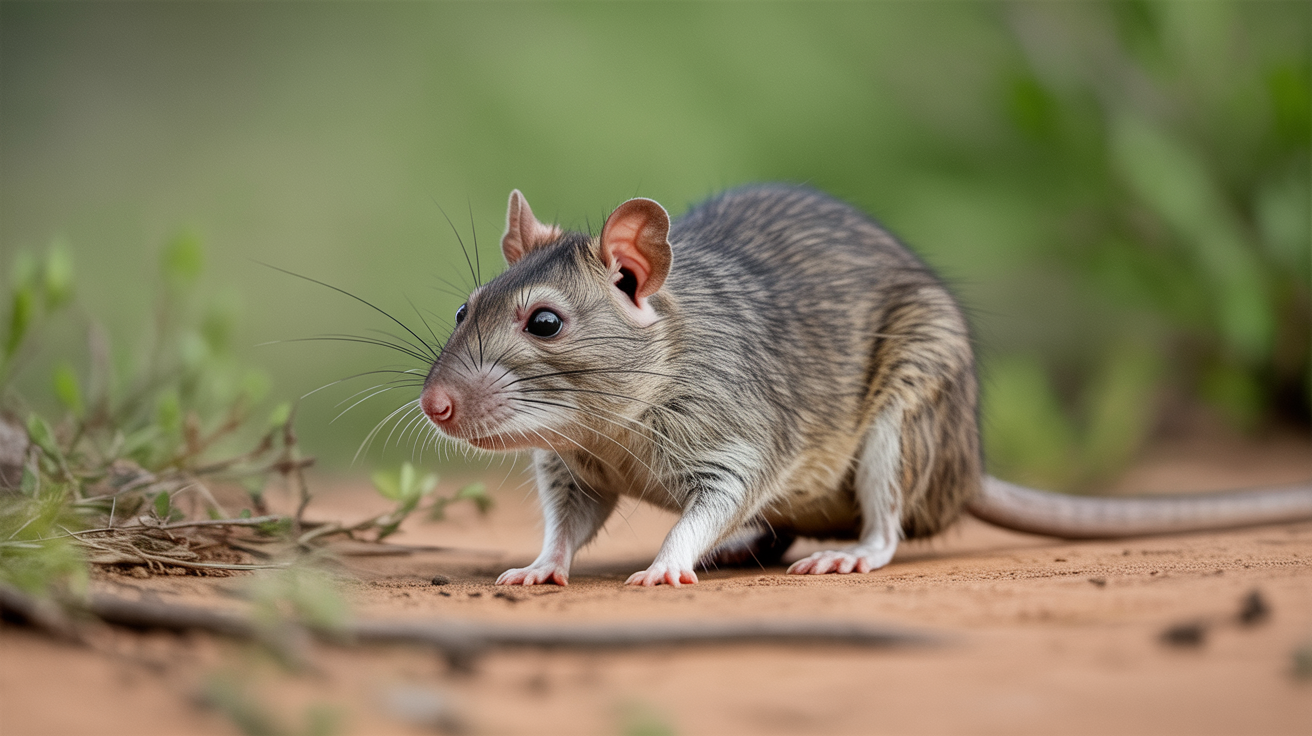
About the Gambian Pouched Rat
The Gambian Pouched Rat is a large, nocturnal rodent native to sub-Saharan Africa. Distinguished by their cheek pouches, which they use for carrying food, these rats can grow up to 90 cm (including tail), making them one of the largest muroid rodents in the world. They are highly intelligent and have an exceptional sense of smell, which has led to their use in detecting landmines and tuberculosis. Their adaptability allows them to thrive in diverse habitats, from forests to savannas and agricultural areas. Despite their size, Gambian Pouched Rats are generally shy and elusive in the wild.
Fascinating facts
Super Sniffers
Gambian Pouched Rats have an extraordinary sense of smell, allowing them to detect explosives and even diseases like tuberculosis in laboratory settings.
Cheek Pouches
Their large, hamster-like cheek pouches can stretch back to their shoulders, enabling them to transport large amounts of food to their burrows.
Invasive Species
Escaped Gambian Pouched Rats have established populations in Florida, USA, where they are considered an invasive species due to their adaptability and size.
Detailed description
The Gambian pouched rat (Cricetomys gambianus) is a robust, semi-arboreal rodent notable for its elongated body, large head, and prominent, fur-lined cheek pouches used to transport food. Adults typically weigh between 1.0 and 1.4 kg, with a head-body length of 30–45 cm and a tail nearly as long, contributing to a total length of up to 90 cm. The tail is scaly, sparsely haired, and white-tipped, aiding in balance and communication. Their fur is coarse and grizzled gray-brown dorsally, with paler underparts. The species has large, forward-facing eyes adapted for nocturnal activity, and highly developed olfactory bulbs, reflecting its reliance on scent. Gambian pouched rats are primarily terrestrial but are capable climbers and swimmers. They are omnivorous, with a diet ranging from seeds, nuts, and fruits to invertebrates, eggs, and occasionally small vertebrates. Their burrowing behavior creates complex tunnel systems for nesting and food storage. Socially, they are generally solitary or found in small family groups, exhibiting territoriality, especially among males. Vocalizations, scent marking, and tactile signals are used for communication. Lifespan in the wild is estimated at 5–7 years, though captive individuals may live up to 8 years.
Did you know?
A single Gambian Pouched Rat can search an area the size of a tennis court for landmines in just 30 minutes—a task that would take a human with a metal detector up to four days.
Research & sources
Wikipedia summary
The Gambian pouched rat, also commonly known as the African giant pouched rat, is a species of nocturnal pouched rat of the giant pouched rat genus Cricetomys, in the family Nesomyidae. It is among the largest muroids in the world, growing to about 0.9 m (3 ft) long, including the tail, which makes up half of its total length. It is widespread in sub-Saharan Africa, ranging from Senegal to Kenya and from Angola to Mozambique from sea level to 2,000 m (6,600 ft).
Behaviour & social structure
Gambian pouched rats are primarily nocturnal, emerging at dusk to forage and returning to their burrows before dawn. Foraging is solitary, with individuals covering large distances—up to several kilometers per night—in search of food. They use their acute sense of smell to locate food items, which are often collected in their cheek pouches and transported back to their burrow for caching. Their diet is highly opportunistic, shifting with seasonal availability of resources. They exhibit food hoarding and may store significant quantities in underground chambers. Social interactions are limited outside of the breeding season, with adults maintaining overlapping but distinct territories. Agonistic encounters involve vocalizations, foot stamping, and piloerection. Grooming is frequent, both for hygiene and thermoregulation. In captivity, Gambian pouched rats display remarkable trainability and problem-solving abilities, which has been harnessed for specialized tasks such as scent detection.
Reproduction & life cycle
Breeding occurs year-round in equatorial regions, but may be more seasonal in areas with pronounced wet and dry periods. Females reach sexual maturity at about 5–7 months. Courtship involves olfactory and tactile cues, with males often engaging in pursuit and sniffing of the female. After mating, gestation lasts approximately 27–36 days. Litters typically consist of 2–6 pups, born altricial (blind and hairless) in a well-lined nest chamber. The mother provides extensive parental care, nursing the young for 3–4 weeks until weaning. Paternal involvement is minimal. Juveniles become independent at around 5–6 weeks. Reproductive output can be high, with females capable of producing multiple litters per year under favorable conditions.
Adaptations & survival
Key adaptations include highly developed olfactory and tactile senses, enabling efficient nocturnal foraging and navigation in low-light environments. The expandable cheek pouches allow for rapid collection and transport of food, reducing exposure to predators. Their robust incisors and strong jaw muscles facilitate gnawing through tough seeds and roots. The species’ burrowing behavior provides shelter from temperature extremes and predation. Their climbing ability, aided by a prehensile tail and dexterous digits, allows access to arboreal food sources. Physiologically, they exhibit efficient water conservation, an adaptation to seasonally arid habitats. Behavioral plasticity and dietary generalism underpin their success in diverse environments, including human-modified landscapes.
Cultural significance
Gambian pouched rats have a complex relationship with humans. In parts of West Africa, they are hunted for food and are considered a delicacy. Their intelligence and olfactory abilities have been harnessed in humanitarian work: trained individuals are used by organizations such as APOPO to detect landmines and diagnose tuberculosis, earning them the nickname 'HeroRATs.' In some regions, they are associated with folklore and are sometimes regarded as symbols of cleverness or resourcefulness. Their presence in the exotic pet trade has led to regulatory restrictions in some countries, especially following concerns about zoonotic disease transmission.
Recent research
Recent research has focused on the neurobiology of olfaction in Gambian pouched rats, with studies revealing an expanded repertoire of olfactory receptor genes and exceptional scent discrimination abilities. Behavioral studies have documented their learning and memory capacity, supporting their use in scent detection programs. Ecological research has examined their role as seed dispersers and their impact on agricultural systems. Genetic studies are clarifying the taxonomy of the Cricetomys genus, with evidence suggesting cryptic speciation. Ongoing monitoring of invasive populations in the Americas is assessing their ecological impact and potential as disease reservoirs.
Videos
Habitat
Savanna and forest edges
 Africa
Savanna
Grasslands with scattered trees, characterized by seasonal rainfall and home to diverse grazing animals and predators.
 Various Continental Regions
Grassland
Open areas dominated by grasses rather than trees, supporting numerous herbivores and their predators.
 Global
Forest
Wooded areas with significant tree cover and diverse plant and animal communities.
Conservation
The Gambian Pouched Rat is currently classified as Least Concern on the IUCN Red List.
Threats & challenges
Currently listed as Least Concern by the IUCN, Gambian pouched rats have stable populations across much of their range. However, localized threats include habitat loss due to agricultural expansion, urbanization, and deforestation. They are sometimes hunted for bushmeat or persecuted as agricultural pests. Invasive populations, notably in Florida, USA, have raised concerns about disease transmission and ecological impacts. Their adaptability mitigates many threats, but ongoing habitat fragmentation and increased human-wildlife conflict could pose future challenges. Monitoring is needed to detect potential population declines, especially in areas of intensive land use.
Taxonomy
Scientific name
Cricetomys gambianus
- Kingdom
- Animalia
- Phylum
- Chordata
- Class
- Mammalia
- Order
- Rodentia
- Family
- Nesomyidae
- Genus
- Cricetomys
- Species
- gambianus
Where to see a gambian pouched rat
1 zoo and aquarium in 1 country are recorded as keeping this species.
Community notes
Share your observations about the Gambian Pouched Rat.
No community notes yet. Be the first!
Discover more wildlife
More fascinating animals from the encyclopedia.