
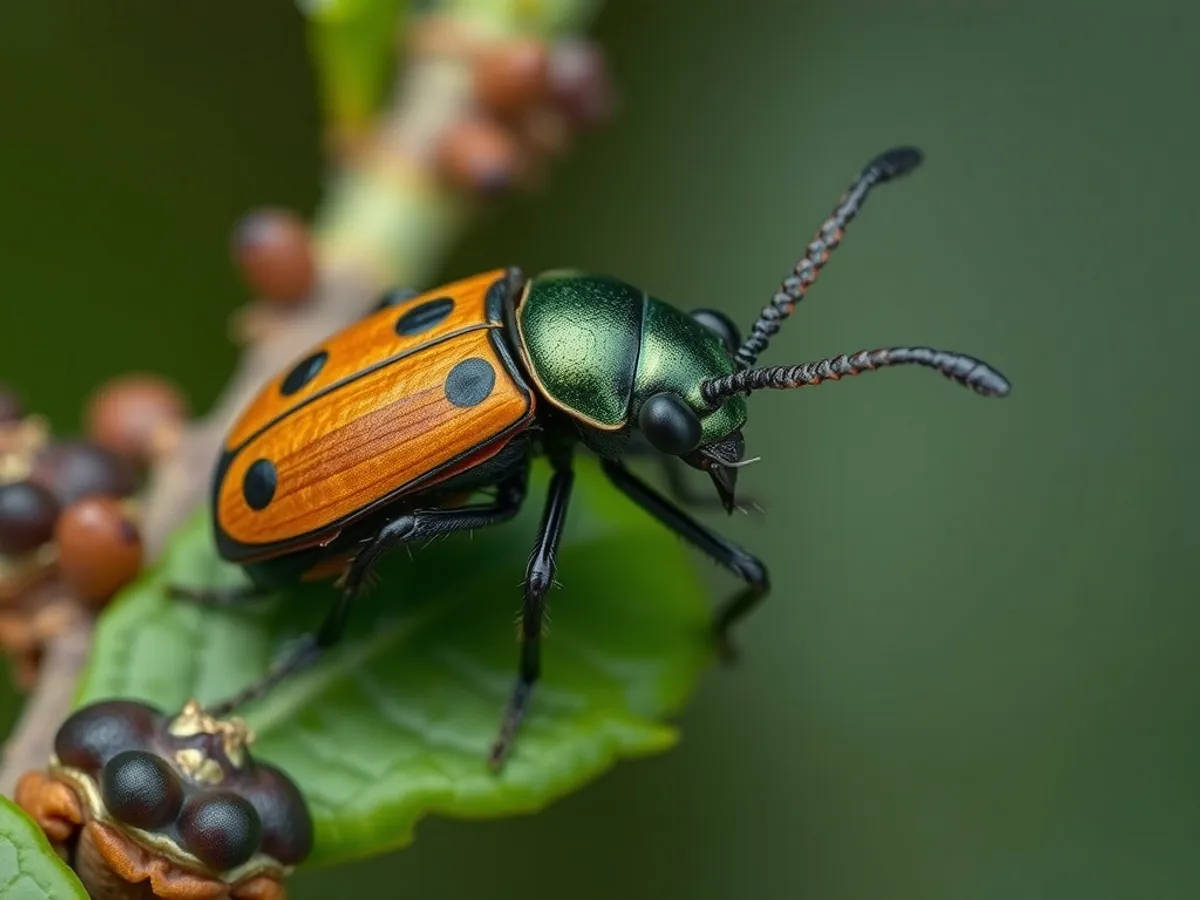
About the Garden Fruit Chafer
The Garden Fruit Chafer is a brightly colored beetle native to sub-Saharan Africa, especially common in southern regions. Sporting a distinctive yellow and brown or green pattern, it is easily recognizable as it feeds on fruit, flowers, and tree sap in gardens and woodlands. Adults are often seen flying in sunny weather, while their larvae develop underground, feeding on decaying organic matter. This species plays an important role in pollination and the breakdown of organic material in its ecosystem.
Fascinating facts
Bright Colors
Garden Fruit Chafers display vibrant yellow, orange, or green markings that help warn predators of their distasteful nature.
Pollinator Role
They contribute to pollination as they move between flowers searching for nectar and fruit.
Decomposer Larvae
The larvae live in soil and help break down decaying plant matter, enriching garden soils.
Detailed description
The Garden Fruit Chafer (Pachnoda sinuata) is a robust, medium-sized scarab beetle, typically measuring 20–25 mm in length. Its elytra (wing covers) are smooth and glossy, displaying a striking pattern of yellow or green with brown or black markings, which serve as both camouflage among foliage and warning coloration. The head is equipped with strong, clubbed antennae adapted for detecting fruit odors and pheromones. The species is diurnal, with adults most active during warm, sunny periods when they fly with a characteristic buzzing sound. The legs are well-adapted for gripping smooth surfaces, aiding in climbing fruit trees and flowers. Larvae, known as grubs, are C-shaped and creamy white, developing in the soil where they feed on decaying plant matter and contribute to nutrient cycling. Adults are often seen congregating in large numbers on ripe or fermenting fruit, sometimes causing minor agricultural damage. Their life cycle includes complete metamorphosis: egg, larva, pupa, and adult, with the entire process taking several months depending on environmental conditions. Pachnoda sinuata is an important pollinator for various indigenous and cultivated plants, as it transfers pollen while feeding on nectar and fruit juices.
Did you know?
Unlike many beetles, Garden Fruit Chafers can fly with their elytra (wing covers) closed, using a special adaptation that allows the wings to vibrate underneath.
Research & sources
Behaviour & social structure
Garden Fruit Chafers are primarily crepuscular to diurnal, with peak activity in the early morning and late afternoon. Adults are strong fliers and are attracted to brightly colored or aromatic fruit, especially figs, guavas, and marulas. They feed by rasping the surface of fruit with their mandibles, consuming juices and soft tissues. Socially, they are gregarious and often form loose aggregations on abundant food sources, though they do not exhibit complex social structures. In the presence of predators, such as birds or reptiles, they may drop to the ground and feign death (thanatosis) as a defense mechanism. Their feeding can sometimes lead to secondary infections in fruit crops, but they also help disperse seeds and facilitate decomposition. At night, adults seek shelter under bark, in leaf litter, or within dense foliage to avoid nocturnal predators.
Reproduction & life cycle
Mating occurs primarily during the warmer, wetter months, often coinciding with the fruiting season of host plants. Males locate females by following pheromone trails and may compete for access to receptive females. Copulation typically lasts several minutes, after which females lay clusters of oval, whitish eggs in moist, decaying organic matter or compost heaps. The incubation period is about 10–14 days, after which larvae emerge and begin feeding on decomposing plant material. Larval development lasts 2–4 months, depending on temperature and food availability, followed by pupation in an earthen cell. The pupal stage lasts approximately 3–4 weeks, after which adults emerge. There is minimal parental care; females select oviposition sites that provide optimal conditions for larval growth. In favorable climates, multiple generations may occur annually.
Adaptations & survival
Pachnoda sinuata exhibits several adaptations for survival in variable environments. Its bright coloration serves as aposematic signaling to deter predators, as some chafers can sequester plant toxins. The hard elytra protect against desiccation and physical damage. Clubbed antennae are highly sensitive to volatile compounds, aiding in the detection of food and mates over long distances. The larvae possess strong mandibles for breaking down tough plant material, facilitating decomposition. Adults have a rapid, erratic flight pattern that helps evade aerial predators. Their ability to exploit a wide range of fruiting plants and decaying matter allows them to thrive in both natural and human-modified habitats.
Cultural significance
While not as prominent in folklore as some other beetles, Garden Fruit Chafers are sometimes featured in local children's stories and educational materials in southern Africa, highlighting their role in pollination and decomposition. In traditional agriculture, their presence is often seen as a sign of healthy, organic-rich soils. Occasionally, their distinctive appearance makes them subjects for insect collections and educational displays. There are no known widespread traditional medicinal or symbolic uses, but their ecological role is increasingly recognized in conservation and agroecological contexts.
Recent research
Recent research has focused on the chafer's role in pollination networks, particularly its contribution to the reproductive success of indigenous fruit trees. Studies have also examined the chemical ecology of Pachnoda sinuata, including the identification of pheromones and fruit volatiles that attract adults. Ongoing work investigates the beetle's potential as a bioindicator of soil health and ecosystem function, given its reliance on decaying organic matter. Molecular studies are clarifying the phylogenetic relationships within the Cetoniinae subfamily. There is growing interest in the impact of climate variability on its phenology and population dynamics, especially in peri-urban environments.
Videos
Habitat
Woodlands, gardens, and forests


Conservation
The Garden Fruit Chafer is currently classified as Least Concern on the IUCN Red List.
Threats & challenges
Currently, Pachnoda sinuata is listed as Least Concern, with stable populations across its range. However, localized threats include habitat loss due to urbanization and intensive agriculture, which can reduce the availability of breeding sites and food sources. Pesticide use in orchards and gardens may also impact populations. In some regions, they are considered minor pests due to their feeding on commercial fruit crops, leading to targeted control measures. Climate change poses a potential long-term threat by altering fruiting seasons and habitat suitability, though the species' adaptability has so far mitigated significant declines.
Taxonomy
Scientific name
Pachnoda sinuata
- Kingdom
- Animalia
- Phylum
- Arthropoda
- Class
- Insecta
- Order
- Coleoptera
- Family
- Scarabaeidae
- Genus
- Pachnoda
- Species
- sinuata
Community notes
Share your observations about the Garden Fruit Chafer.
No community notes yet. Be the first!
Discover more wildlife
More fascinating animals from the encyclopedia.