
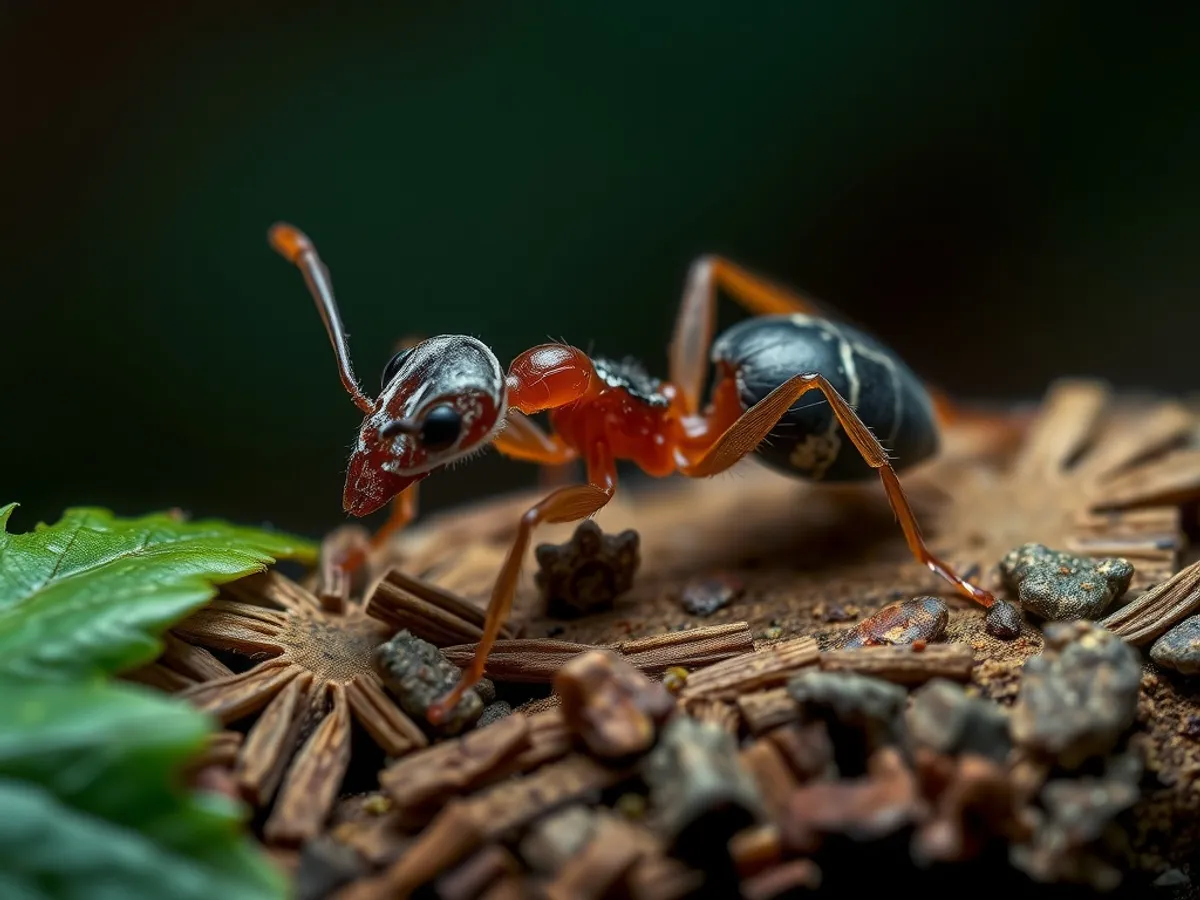
About the Ghost Ant
The ghost ant is a tiny, pale-colored ant species known for its almost translucent legs and abdomen, which give it a ghostly appearance. Originally from the Old World tropics, this ant has spread worldwide, especially in warm, humid environments and greenhouses. Ghost ants are highly adaptable, forming large colonies with multiple queens and thriving in both natural and urban habitats. Their small size and pale coloration make them difficult to detect, especially indoors where they frequently invade homes in search of food. They are commonly found in kitchens, bathrooms, and other moist locations.
Fascinating facts
Ghostly Appearance
Ghost ants have translucent legs and abdomens, making them appear almost invisible against light backgrounds.
Home Invaders
These ants are common household pests, often nesting in wall voids, potted plants, and other moist indoor spaces.
Sugar Lovers
Ghost ants have a strong preference for sweet foods and will often forage indoors for sugary substances.
Detailed description
The ghost ant (Tapinoma melanocephalum) is a diminutive ant species, typically measuring 1.3–1.5 mm in length, with a distinctive bicolored appearance: its head and thorax are dark brown, while the gaster (abdomen) and legs are almost translucent, imparting a 'ghostly' look. The antennae are 12-segmented and lack a defined club, which is characteristic of the genus Tapinoma. Workers are monomorphic, meaning they are similar in size and shape, and possess a single-segmented petiole that is concealed by the gaster when viewed from above. Colonies are highly polygynous, often containing dozens of queens and thousands of workers, which enables rapid colony expansion and resilience. Ghost ants are known for forming extensive, interconnected nests, both outdoors in soil, leaf litter, and plant cavities, and indoors in wall voids, potted plants, and behind baseboards. Their foraging trails are often erratic and difficult to trace due to their small size and pale coloration. They are highly opportunistic, feeding on a wide variety of foods, with a preference for sweets and honeydew produced by aphids and other hemipterans. The species is notorious for its ability to exploit human environments, thriving in moist, warm conditions and rapidly colonizing new areas through budding, where subgroups of the colony split off with one or more queens. Ghost ants lack a functional sting but can emit a faint, coconut-like odor when crushed, a trait common to Tapinoma species.
Did you know?
Despite their tiny size, ghost ants can establish vast colonies with interconnected nests spanning entire buildings.
Research & sources
Behaviour & social structure
Ghost ants are primarily diurnal, with peak foraging activity during daylight hours, especially in warm, humid conditions. They exhibit strong trail-following behavior, laying pheromone trails to efficiently exploit food resources. Workers forage in loosely organized columns, often forming diffuse, branching trails that allow them to cover large areas. Their diet is highly generalized; they consume sugary substances, proteins, and fats, but show a marked preference for sweets. Indoors, they are commonly found scavenging in kitchens and bathrooms, attracted to spills, crumbs, and pet food. Outdoors, they tend aphids and other sap-sucking insects for honeydew, forming mutualistic relationships. Social interactions within the colony are complex, with frequent trophallaxis (food sharing) and grooming. Colonies are highly mobile, frequently relocating nests in response to environmental changes or disturbance, a behavior facilitated by their polygynous structure. Aggression towards other ant species is moderate; ghost ants may avoid direct confrontation, relying on rapid relocation and colony fragmentation for survival.
Reproduction & life cycle
Reproduction in Tapinoma melanocephalum is continuous in tropical climates and can occur year-round indoors. Colonies are polygynous, containing multiple reproductive queens that lay eggs simultaneously, resulting in high reproductive output. Mating typically occurs within or near the nest, with males and virgin queens emerging from the brood and engaging in brief mating flights or local dispersal. After mating, queens shed their wings and begin oviposition. The developmental cycle from egg to adult worker is rapid, taking approximately 3–4 weeks under optimal conditions (25–30°C, high humidity). There is no true parental care beyond brood tending by workers, who feed and groom larvae and pupae. Colony budding is the primary mode of colony propagation, with groups of workers and one or more queens splitting off to establish new nests, often within the same building or habitat.
Adaptations & survival
Ghost ants possess several adaptations that contribute to their ecological success. Their small size and translucent coloration render them difficult to detect by predators and humans alike. The ability to form polygynous, highly mobile colonies allows rapid exploitation of new resources and resilience to disturbance. Their generalized diet and mutualistic relationships with honeydew-producing insects enable them to thrive in diverse environments. Physiologically, they tolerate a wide range of temperatures and humidity levels, but prefer moist, warm conditions. Behavioral plasticity, including flexible nesting sites and rapid colony relocation, enhances their survival in both natural and anthropogenic habitats. Their cuticular hydrocarbons are adapted for chemical communication and recognition, facilitating complex social organization and efficient resource allocation.
Cultural significance
Ghost ants have limited cultural significance, primarily known as household pests in many parts of the world. They are not featured in mythology or folklore, nor are they traditionally used for food or medicine. Their primary impact on human culture is negative, as they contaminate food, invade homes, and are difficult to control due to their cryptic nesting habits. In some regions, their presence has prompted increased research into pest management and urban entomology.
Recent research
Recent research on Tapinoma melanocephalum has focused on its invasive biology, colony structure, and pest management strategies. Molecular studies have revealed low genetic differentiation among global populations, suggesting frequent human-mediated dispersal. Investigations into their cuticular hydrocarbons and pheromones have provided insights into their sophisticated chemical communication systems. Studies on their mutualism with honeydew-producing insects have highlighted their role in urban agroecosystems. Ongoing research aims to develop more effective, environmentally friendly control methods, including bait formulations that exploit their dietary preferences and social feeding behaviors. The species is also used as a model for studying the evolution of polygyny and colony budding in ants.
Sources
Tapinoma melanocephalum (Fabricius, 1793): Global invasion history, colony structure, and pest status
Deyrup, M., Davis, L., Cover, S. (2000)
scientificPheromone communication and foraging ecology in ghost ants
Choe, D.-H., Millar, J.G., Rust, M.K. (2012)
scientificTapinoma melanocephalum (Fabricius, 1793): Taxonomy, Distribution, and Biology
AntWiki, AntWeb, and associated taxonomic authorities (2023)
scientificIUCN Red List of Threatened Species: Tapinoma melanocephalum
International Union for Conservation of Nature (IUCN)
conservationVideos
Habitat
Tropical and subtropical environments, frequently found indoors in human dwellings
 Various Continental Regions
Grassland
Open areas dominated by grasses rather than trees, supporting numerous herbivores and their predators.
 Tropical Regions
Rainforest
Dense, wet forests with the highest biodiversity on Earth, containing more than half of the world's plant and animal species.
 Global
Forest
Wooded areas with significant tree cover and diverse plant and animal communities.
Conservation
The Ghost Ant is currently classified as Least Concern on the IUCN Red List.
Threats & challenges
Currently, Tapinoma melanocephalum faces few significant natural threats due to its adaptability and association with human environments. Predation by spiders, centipedes, and other ants occurs, but is mitigated by their cryptic habits and rapid colony movement. The primary challenges are environmental extremes, such as cold temperatures, which limit their outdoor distribution in temperate regions. Human pest control measures, including insecticides and habitat modification, can temporarily reduce populations, but their polygynous, budding colonies often recover quickly. There is no evidence of population decline; in fact, the species is expanding its range globally, facilitated by international trade and transport of potted plants. As an invasive species, ghost ants can displace native ant fauna and disrupt local ecosystems, but their overall conservation status remains 'Least Concern.'
Taxonomy
Scientific name
Tapinoma melanocephalum
- Kingdom
- Animalia
- Phylum
- Arthropoda
- Class
- Insecta
- Order
- Hymenoptera
- Family
- Formicidae
- Genus
- Tapinoma
- Species
- melanocephalum
Community notes
Share your observations about the Ghost Ant.
No community notes yet. Be the first!
Discover more wildlife
More fascinating animals from the encyclopedia.