
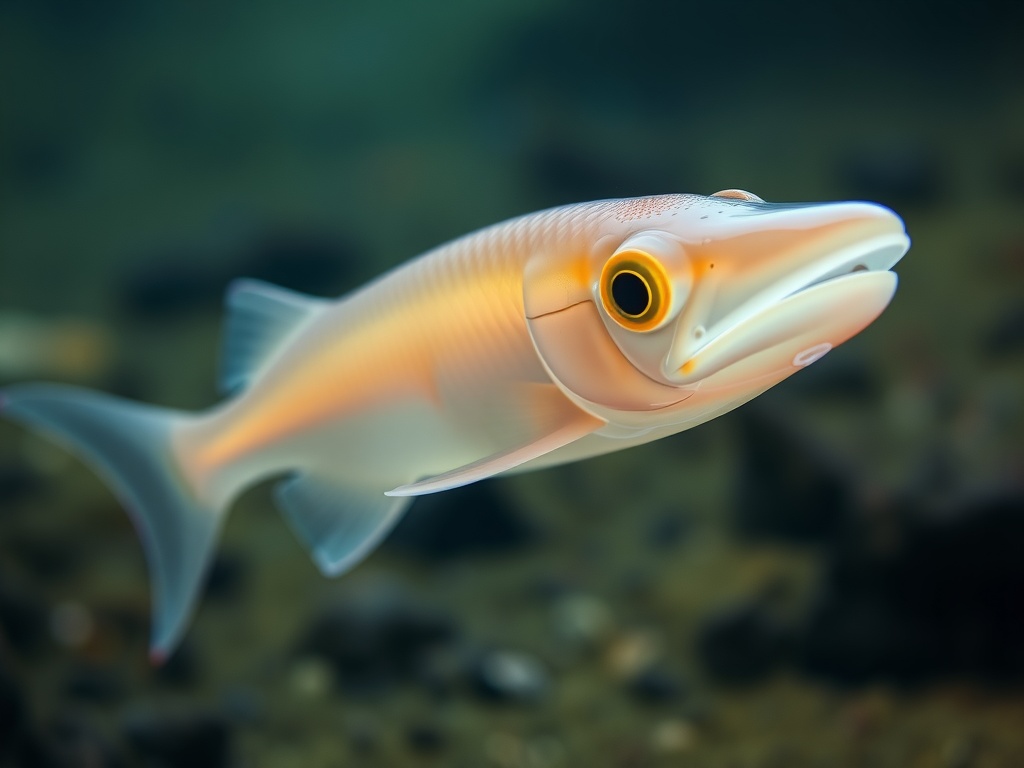
About the Ghost Knifefish
The Ghost Knifefish is a fascinating freshwater fish known for its elongated, laterally compressed body and undulating fin that runs along its underside, giving it a knife-like appearance. Native to rivers and streams in South America, it is most commonly found in slow-moving or still waters rich with submerged vegetation and debris. The species is well-known for its weak electrical field, which is used for navigation, communication, and hunting in dark or murky waters. Typically nocturnal and shy, Ghost Knifefish are popular in the aquarium trade due to their unique look and intriguing behavior.
Fascinating facts
Electric Sense
Ghost Knifefish generate weak electric fields to navigate and hunt in complete darkness, a trait known as electrolocation.
Bidirectional Swimming
Their elongated anal fin allows them to move forwards and backwards with equal agility, making them highly maneuverable.
Habitat Preference
They prefer slow-moving, densely vegetated waters where they can hide from predators and ambush prey.
Detailed description
The Ghost Knifefish (Apteronotus albifrons) is a medium-sized freshwater fish, typically reaching 20–40 cm in length, with some individuals reported up to 50 cm. Its body is laterally compressed and elongated, tapering to a blunt snout and a long, continuous anal fin that extends from beneath the gill opening to the tip of the tail, giving it a distinctive knife-like silhouette. The dorsal fin is absent, and the caudal fin is reduced to a small lobe. Its coloration is generally deep black to dark brown, with a characteristic white blaze on the snout and white bands or spots near the tail. The skin is scaleless and covered with a thin mucous layer, which aids in protection and sensory perception. Ghost Knifefish possess a highly developed electrosensory system, generating weak electric fields through a specialized organ in the tail. This adaptation allows them to navigate, communicate, and hunt in turbid or dark environments where vision is limited. They are primarily nocturnal, emerging from hiding places among submerged roots, leaf litter, or debris to forage at night. In the wild, they are solitary or loosely gregarious, exhibiting complex social behaviors mediated by electric signals. Their diet consists mainly of small invertebrates, insect larvae, and occasionally small fish. Reproduction is poorly documented in the wild, but in captivity, they exhibit courtship behaviors involving synchronized swimming and electric signaling. Ghost Knifefish are sensitive to water quality and require well-oxygenated, soft, acidic waters, mirroring their native Amazonian habitats.
Did you know?
Despite their ghostly name, Ghost Knifefish are not albino; their name comes from their pale, ethereal coloration and nocturnal habits.
Research & sources
Behaviour & social structure
Ghost Knifefish are crepuscular to nocturnal, spending daylight hours concealed in dense vegetation, submerged logs, or rocky crevices. At night, they emerge to actively forage, using their electrolocation abilities to detect prey and navigate obstacles. Their feeding behavior is characterized by slow, deliberate movements, with the undulating anal fin providing precise maneuverability in complex environments. They primarily consume aquatic insect larvae, crustaceans, worms, and occasionally small fish, capturing prey with rapid suction feeding. Social interactions are mediated by electric organ discharges (EODs), which are species-specific and can be modulated for communication, territorial displays, or courtship. In captivity, individuals may establish dominance hierarchies, with subordinate fish displaying submissive EOD patterns and avoiding direct confrontation. Aggression is generally low, but territorial disputes may arise, especially in confined spaces. Ghost Knifefish are sensitive to changes in water parameters and can become stressed or ill in suboptimal conditions.
Reproduction & life cycle
Reproduction in Apteronotus albifrons is not fully understood in the wild due to their secretive habits, but captive breeding has provided some insights. Spawning typically occurs during the rainy season, coinciding with increased water levels and temperature fluctuations. Courtship involves synchronized swimming and increased frequency of electric signaling between potential mates. Females lay adhesive eggs on submerged surfaces, such as vegetation or rocks. The number of eggs per clutch ranges from 100 to 200. There is no evidence of parental care; after spawning, adults do not guard the eggs or fry. Incubation lasts approximately 3–5 days, depending on temperature, after which larvae become free-swimming and begin feeding on small zooplankton. Sexual maturity is reached at about 1–2 years of age.
Adaptations & survival
The Ghost Knifefish exhibits several remarkable adaptations for survival in its native habitats. Its electrogenic organ allows for active electrolocation and electrocommunication, enabling it to hunt and navigate in complete darkness or turbid waters. The elongated anal fin, powered by a series of undulating waves, provides exceptional maneuverability and the ability to swim both forwards and backwards with precision. The absence of scales reduces drag and enhances sensitivity to environmental changes, while the mucous-covered skin offers protection against parasites and pathogens. Its nocturnal lifestyle reduces predation risk and competition for food. The species' ability to modulate electric signals for communication supports complex social interactions and mate selection.
Cultural significance
In its native range, the Ghost Knifefish is not a significant food fish but has gained popularity in the global aquarium trade due to its striking appearance and intriguing behaviors. In some South American cultures, electric fish are associated with folklore and believed to possess mystical or healing properties, though Apteronotus albifrons is less prominent in traditional mythology compared to other electric fish like the Electric Eel (Electrophorus electricus). Its unique electric abilities have made it a subject of fascination and study in both scientific and hobbyist communities.
Recent research
Recent research on Apteronotus albifrons has focused on its electrosensory system, particularly the neural mechanisms underlying active electrolocation and electrocommunication. Studies have revealed that the species can distinguish between self-generated and external electric fields, supporting complex social interactions and environmental awareness. Ongoing research is investigating the genetic basis of electric organ development and the evolutionary divergence of electric fish within the Gymnotiformes order. Behavioral studies in laboratory settings have provided insights into learning, memory, and sensory integration in weakly electric fish. Conservation-oriented research is limited, highlighting a need for field studies on population dynamics and habitat requirements.
Videos
Habitat
Freshwater rivers and streams


Conservation
The Ghost Knifefish is currently classified as Least Concern on the IUCN Red List.
Threats & challenges
Currently assessed as Least Concern by the IUCN, the Ghost Knifefish faces localized threats from habitat degradation, water pollution, and deforestation in the Amazon and Orinoco basins. Overharvesting for the aquarium trade has been noted but is not considered a major threat due to the species' wide distribution and relative abundance. However, ongoing deforestation, dam construction, and waterway modification pose long-term risks by altering water quality and reducing available habitat. Climate change may also impact hydrological cycles, affecting breeding and feeding patterns. Monitoring of wild populations is limited, and further research is needed to assess population trends and potential emerging threats.
Taxonomy
Scientific name
Apteronotus albifrons
- Kingdom
- Animalia
- Phylum
- Chordata
- Class
- Actinopterygii
- Order
- Gymnotiformes
- Family
- Apteronotidae
- Genus
- Apteronotus
- Species
- albifrons
Community notes
Share your observations about the Ghost Knifefish.
No community notes yet. Be the first!
Discover more wildlife
More fascinating animals from the encyclopedia.