
About the Giant deep-sea isopod
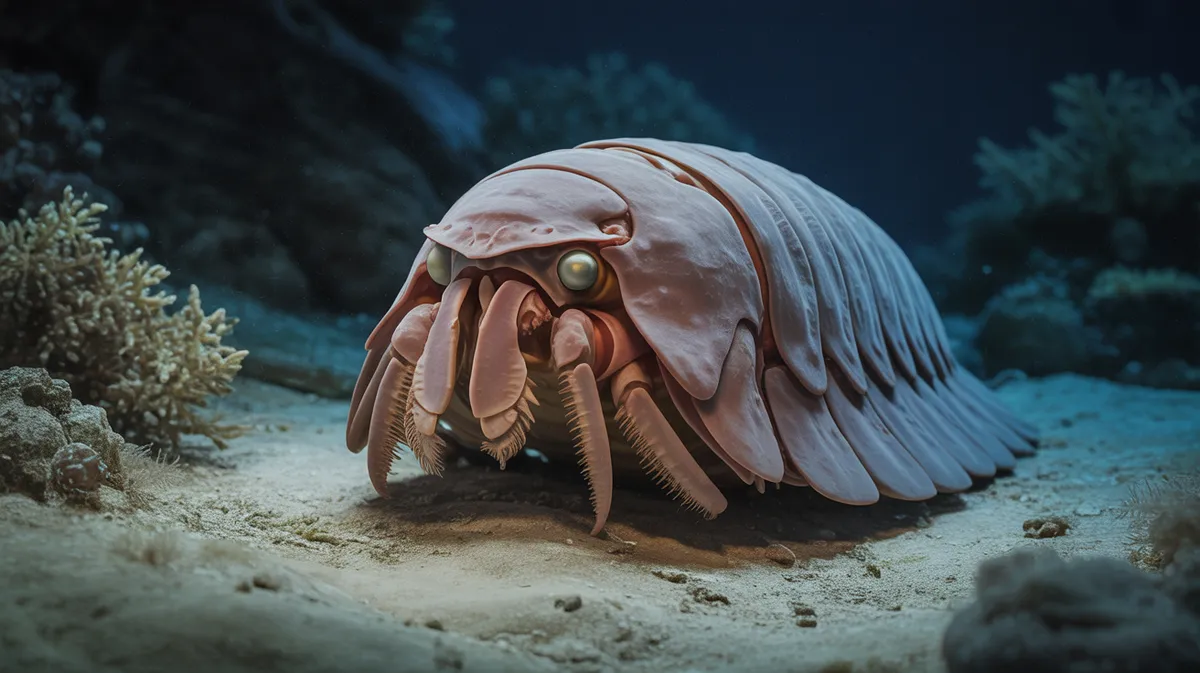
Bathynomus giganteus is a woodlouse the size of a small cat. It is a genuine relative of the pill bugs found under garden stones, sharing the same armoured, segmented body plan and the same ability to curl into a defensive ball, but the deep sea has scaled it up to nearly 50 cm — an example of deep-sea gigantism, thought to be driven by cold water, high pressure and the advantage of a large body when meals are separated by long famines. And the famines are extreme. Bathynomus lives on the abyssal floor scavenging whatever falls from above, and the only really substantial food is a large carcass: a dead whale, shark or fish. When one arrives, the isopods swarm it in numbers and gorge until their bodies are visibly distended and they can barely move. The rest of the time they simply wait. The most striking demonstration of how far they can push this came from an aquarium in Toba, Japan, where a captive Bathynomus refused all food for over five years and remained alive, an apparently voluntary fast far beyond anything a comparable shallow-water crustacean could survive. Their large compound eyes carry a reflective layer and thousands of facets, tuned to catch the faintest bioluminescence.
Fascinating facts
Deep Dwellers
Giant deep-sea isopods are typically found at depths between 170 and 2,140 meters (560 to 7,020 ft), where sunlight cannot reach.
Family Ties
They are closely related to shallow water isopods, like pill bugs and woodlice, but have evolved unique adaptations for deep-sea survival.
Feast or Famine
Their slow metabolism allows them to endure long periods without food, and they can gorge themselves when a large meal, such as a whale carcass, becomes available.
Detailed description
Bathynomus giganteus, commonly known as the giant deep-sea isopod, is a remarkable benthic crustacean belonging to the order Isopoda and family Cirolanidae. Adults typically measure between 19 and 36 centimeters in length, though rare specimens can exceed 50 centimeters, making them the largest isopods known to science. Their bodies are dorsoventrally flattened and segmented, covered by a robust, calcareous exoskeleton divided into seven overlapping pereonites, which provide both structural support and protection from predators. They possess large, compound eyes that are highly sensitive to low light, aiding navigation and foraging in the perpetual darkness of the deep sea, typically at depths ranging from 170 to over 2,140 meters. The mouthparts are adapted for scavenging, with strong mandibles capable of tearing through tough carcasses. Bathynomus giganteus has seven pairs of thoracic legs (pereopods), the first pair modified for feeding and the rest for locomotion and burrowing. Their pleon (abdomen) ends in a broad, fan-like tail (uropods), which assists in swimming and rapid escape responses. These isopods are primarily solitary, spending much of their time partially buried in soft sediment. Their metabolism is extremely slow, allowing them to survive long periods—sometimes several years—without food, an essential adaptation to the food-scarce deep-sea environment. Despite their formidable appearance, they are not aggressive and play a crucial role in recycling nutrients by consuming dead and decaying matter on the ocean floor.
Did you know?
Despite their intimidating appearance, giant deep-sea isopods are harmless scavengers and play a crucial role in recycling nutrients on the ocean floor.
Research & sources
Behaviour & social structure
Giant deep-sea isopods are predominantly nocturnal scavengers, emerging from the substrate to search for food under the cover of darkness. Their primary feeding strategy is opportunistic scavenging, targeting the carcasses of large marine animals such as fish, whales, and squid that descend to the abyssal plain. They are capable of detecting chemical cues in the water, which guide them to food sources over considerable distances. When food is abundant, Bathynomus giganteus can gorge themselves to the point of distension, storing energy for extended periods of scarcity. They exhibit minimal social interaction, with individuals often found alone except during rare aggregations at large food falls. Locomotion is generally slow and methodical, but they can swim short distances using rapid undulations of their pleopods if disturbed. Burrowing behavior is common, with individuals partially embedding themselves in sediment to avoid predators and conserve energy. There is little evidence of territoriality or complex social structures.
Reproduction & life cycle
Bathynomus giganteus exhibits separate sexes, with external fertilization typical of marine isopods. Mating is believed to occur seasonally, though precise timing varies by region and is not fully understood due to the logistical challenges of deep-sea observation. Females develop a brood pouch (marsupium) on the ventral side, where fertilized eggs are incubated. The eggs are among the largest known in marine crustaceans, measuring up to 1.3 centimeters in diameter. Embryonic development is direct, meaning juveniles hatch as miniature adults, bypassing a larval stage. Brooding females are thought to remain relatively inactive, possibly fasting during incubation, which can last several months. There is no parental care beyond brooding, and juveniles disperse shortly after hatching. Fecundity is low, with each brood containing 20–30 eggs, reflecting the high investment in each offspring.
Adaptations & survival
Bathynomus giganteus is highly specialized for survival in the extreme conditions of the deep sea. Its thick, calcified exoskeleton provides protection against both predation and the immense hydrostatic pressure found at depths exceeding 2,000 meters. The large, reflective compound eyes maximize light sensitivity, compensating for the near-total darkness of its habitat. Its slow metabolic rate is a key adaptation to the scarcity of food, allowing it to endure long fasting periods. The ability to gorge on large meals and store energy as fat reserves is another crucial survival mechanism. Chemoreceptors on the antennae enable detection of distant food sources, while the modified first pair of legs (maxillipeds) are adapted for grasping and manipulating food. The pleopods not only facilitate swimming but also function in respiration, as they are lined with gills for gas exchange in low-oxygen environments.
Cultural significance
While Bathynomus giganteus does not have a significant role in traditional human culture or mythology, it has gained popularity in recent years as a subject of fascination in public aquaria and popular science media due to its unusual appearance and size. In Japan, it has achieved a degree of pop culture status, inspiring toys, art, and even themed snacks. Its unique morphology and adaptation to extreme environments make it a frequent subject in discussions about deep-sea biodiversity and the limits of life on Earth.
Recent research
Recent research on Bathynomus giganteus has focused on its physiological adaptations to high-pressure environments, including studies of its exoskeletal composition and metabolic pathways. Advances in deep-sea submersible technology have enabled more frequent observations of its natural behavior, particularly feeding and burrowing. Genetic studies are underway to clarify its phylogenetic relationships within the Cirolanidae and to assess population structure across its wide geographic range. Notably, a 2020 study sequenced the mitochondrial genome of B. giganteus, providing new insights into its evolutionary history and adaptation mechanisms. Ongoing research also explores its role in deep-sea nutrient cycling and the potential impacts of human activities on its habitat.
Sources
The biology of Bathynomus giganteus (Isopoda: Cirolanidae) from the Gulf of Mexico
J. Hansen, Gulf and Caribbean Research (2010)
scientificDeep-sea scavenging isopods: Bathynomus giganteus feeding behavior and ecological role
M. L. Stuck & R. W. Heard (2017)
scientificVideos
Habitat
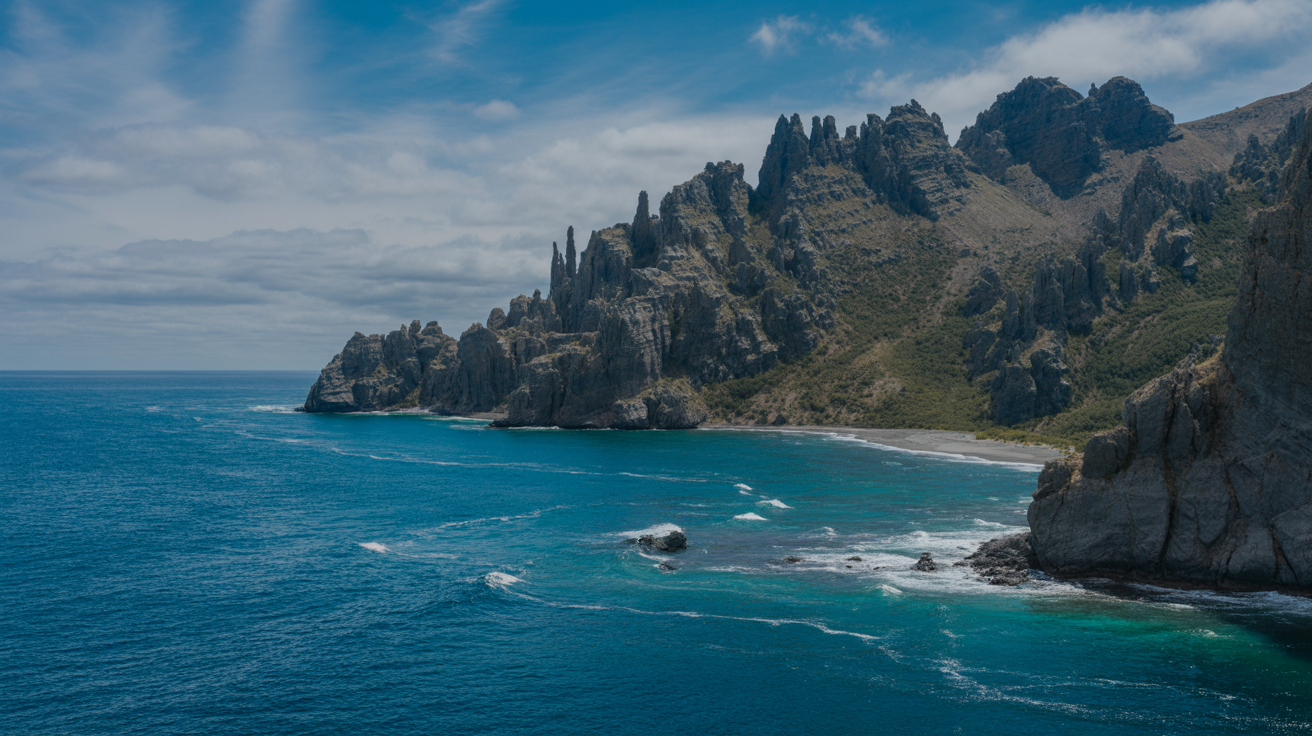
Deep ocean floor
Conservation
The Giant deep-sea isopod is currently classified as Least Concern on the IUCN Red List.
Threats & challenges
Currently, Bathynomus giganteus faces few direct natural threats due to its deep-sea habitat, which is largely inaccessible to most predators and human activities. However, increasing deep-sea trawling and mining pose potential risks by disturbing benthic ecosystems and reducing available food sources. Climate change and ocean acidification may also impact deep-sea environments, although specific effects on this species are not well understood. Population trends remain stable, and the species is listed as Least Concern by the IUCN, but the lack of comprehensive population data and the slow reproductive rate warrant continued monitoring. Bycatch in deep-sea fisheries is a localized concern, though not currently a significant threat to the species as a whole.
Taxonomy
Scientific name
Bathynomus giganteus
- Kingdom
- Animalia
- Phylum
- Arthropoda
- Class
- Malacostraca
- Order
- Isopoda
- Family
- Cirolanidae
- Genus
- Bathynomus
- Species
- giganteus
Community notes
Share your observations about the Giant deep-sea isopod.
No community notes yet. Be the first!
Discover more wildlife
More fascinating animals from the encyclopedia.