
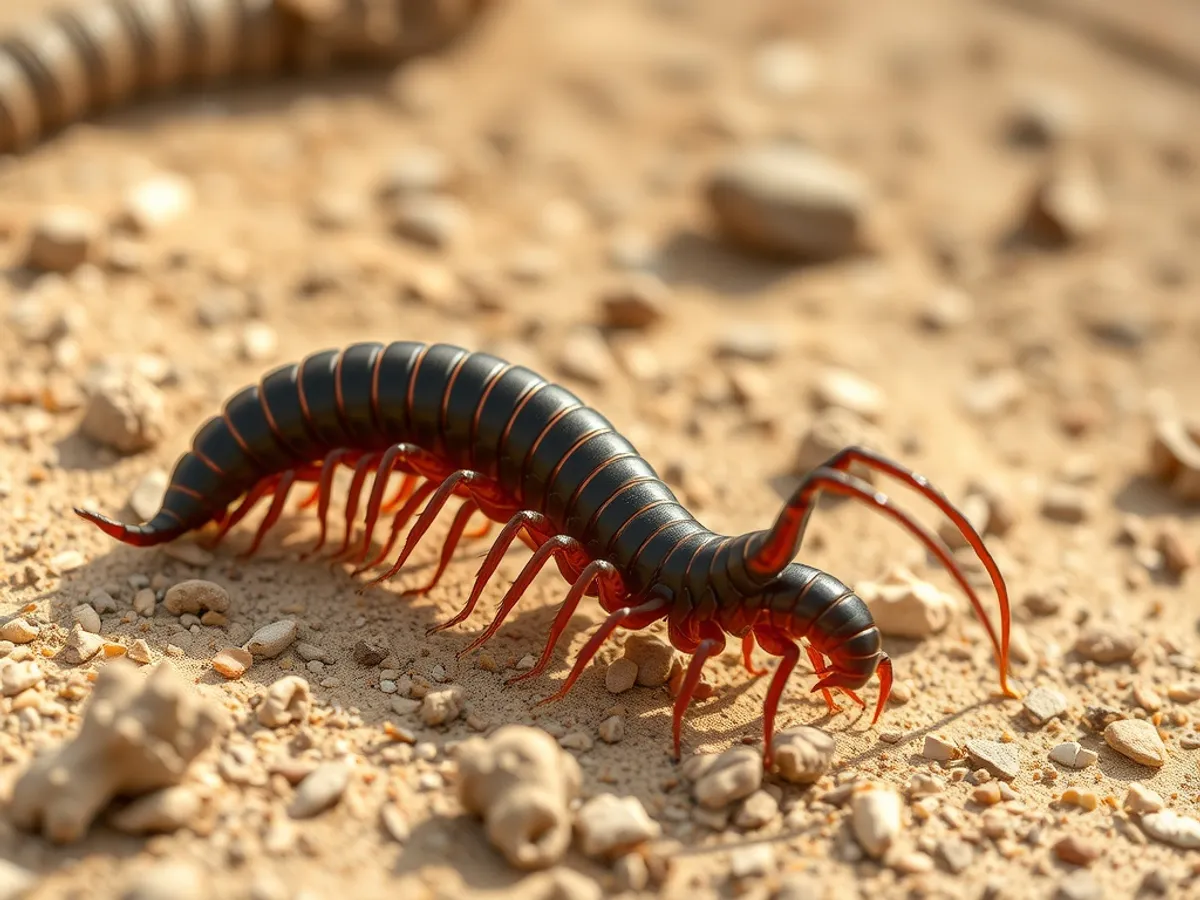
About the Giant Desert Centipede
The Giant Desert Centipede is one of the largest centipede species in North America, known for its striking coloration and impressive size. It can reach lengths up to 20 centimeters (8 inches) and is easily recognized by its alternating black and orange or reddish segments, with yellow legs. This nocturnal predator is highly adapted to arid environments, where it hunts a wide variety of prey, including insects, spiders, small reptiles, and even rodents. Despite its fearsome appearance and potent venom, its bite is rarely fatal to humans but can cause significant pain and swelling.
Fascinating facts
Venomous Bite
The centipede injects venom using modified front legs called forcipules to immobilize and digest its prey.
Desert Dweller
This species thrives in hot, arid regions of the southwestern United States and northern Mexico, often hiding under rocks and debris during the day.
Nocturnal Hunter
Giant Desert Centipedes are primarily active at night, using their sensitive antennae to detect vibrations and locate prey in complete darkness.
Detailed description
The Giant Desert Centipede (Scolopendra heros) is the largest centipede species native to North America, with adults typically measuring 15–20 cm (6–8 inches) in length, though rare specimens may exceed 23 cm (9 inches). Its body is composed of 21–23 distinct segments, each bearing a single pair of robust, yellow to orange legs, culminating in elongated, forceps-like terminal legs that can be used for defense and sensory perception. The head is equipped with a pair of long, sensitive antennae and powerful, venom-injecting forcipules—modified front legs that function as fangs. The exoskeleton displays striking aposematic coloration, typically alternating bands of black, red, and orange, which serve as a warning to potential predators. Scolopendra heros is a solitary, nocturnal predator, spending daylight hours concealed beneath rocks, logs, or within burrows to avoid desiccation in its arid habitat. It possesses a highly flexible, muscular body, enabling rapid movement and the ability to squeeze into narrow crevices. The centipede’s venom contains a complex cocktail of toxins, including serotonin, histamine, and various enzymes, which subdue prey and deter predators. Despite its fearsome reputation, S. heros is not aggressive towards humans unless provoked. Its ecological role as a top invertebrate predator is vital for controlling populations of insects and small vertebrates in desert ecosystems.
Did you know?
A Giant Desert Centipede can climb vertical surfaces and even hang upside down to catch its prey.
Research & sources
Behaviour & social structure
Scolopendra heros is primarily nocturnal, emerging from shelter at dusk to hunt. It relies on its acute chemosensory and tactile senses, using its antennae to detect prey movements in the dark. The centipede is an opportunistic ambush predator, capable of overpowering prey much larger than itself, including lizards, small snakes, amphibians, and even nestling rodents. It subdues prey with a rapid strike, injecting venom through its forcipules, then coils around the victim to immobilize it. Feeding is solitary, and cannibalism can occur, particularly in crowded or resource-scarce conditions. S. heros exhibits territoriality, often returning to favored hiding spots. During the hottest and driest periods, it may enter a state of reduced activity (aestivation) to conserve moisture. Defensive behaviors include raising the anterior body, displaying warning coloration, and using the last pair of legs to strike or distract attackers.
Reproduction & life cycle
Reproduction in Scolopendra heros occurs primarily in late spring to early summer, coinciding with increased humidity and prey availability. Males deposit a spermatophore on the substrate, which the female picks up with her genital opening during a brief courtship ritual involving antennal contact and body tapping. Females lay 15–60 eggs in a concealed, humid microhabitat such as under rocks or within rotting wood. The mother coils around the clutch, providing protection and moisture by grooming the eggs and deterring fungal growth—a rare example of parental care among arthropods. Incubation lasts 1–2 months, depending on temperature and humidity. Hatchlings (nymphs) resemble miniature adults and undergo a series of molts, reaching maturity in 2–3 years. Females may produce one or two clutches per year, and adult centipedes can live up to 5–7 years in the wild.
Adaptations & survival
Scolopendra heros is highly adapted to arid and semi-arid environments. Its waxy, chitinous exoskeleton minimizes water loss, while behavioral adaptations such as nocturnal activity and burrowing reduce exposure to heat and desiccation. The centipede’s powerful forcipules deliver venom that rapidly immobilizes prey and deters predators, while its aposematic coloration serves as a visual warning. The last pair of legs are elongated and highly mobile, used for defense, sensory input, and anchoring the body during attacks. Its rapid, undulating locomotion enables both effective predation and escape from threats. Additionally, S. heros can regenerate lost legs over successive molts, an important adaptation given the risks of predation and intraspecific aggression.
Cultural significance
The Giant Desert Centipede features in the folklore and traditional beliefs of several Indigenous peoples of the American Southwest, often symbolizing danger, resilience, or transformation. In some cultures, it is regarded with fear or respect due to its venomous bite and formidable appearance. S. heros is sometimes kept as an exotic pet, though its care requires expertise due to its aggression and venom. There are no known traditional medicinal or culinary uses, but the species has occasionally appeared in popular media and educational exhibits to illustrate desert biodiversity and arthropod adaptations.
Recent research
Recent research on Scolopendra heros has focused on the composition and pharmacological properties of its venom, revealing a complex mixture of proteins and peptides with potential biomedical applications, including novel painkillers and antimicrobial agents. Studies have also examined its ecological role as a keystone predator in desert food webs, highlighting its impact on regulating prey populations. Ongoing research addresses the species’ physiological adaptations to extreme environments, such as water conservation mechanisms and heat tolerance. Genetic studies are beginning to clarify population structure and evolutionary relationships within the genus Scolopendra. There is growing interest in the centipede’s parental care behaviors, which are relatively rare among myriapods.
Sources
The Biology of Scolopendra heros (Arthropoda: Chilopoda): Ecology, Behavior, and Venom
Shelley, R.M. & Kiser, S.B. (2000)
scientificVenom composition and pharmacological properties of Scolopendra heros
Undheim, E.A.B. et al. (2015)
scientificThe Biology of Scolopendra heros (Arthropoda: Chilopoda): Natural History, Ecology, and Venom
Shelley, R.M. & Kiser, S.B. (2000)
scientificVenom composition and bioactivity of the giant desert centipede, Scolopendra heros
Undheim, E.A.B. et al. (2015)
scientificThe Biology and Venom of Scolopendra heros (Arthropoda: Chilopoda: Scolopendridae)
Rowan H. Barrett, Journal of Arachnology (2021)
scientificVideos
Habitat
Desert
 Arid Regions
Desert
Arid lands with minimal rainfall, extreme temperatures, and specialized wildlife adapted to harsh conditions.
 Various Continental Regions
Grassland
Open areas dominated by grasses rather than trees, supporting numerous herbivores and their predators.
 Global
Forest
Wooded areas with significant tree cover and diverse plant and animal communities.
Conservation
The Giant Desert Centipede is currently classified as Least Concern on the IUCN Red List.
Threats & challenges
Currently, Scolopendra heros is classified as Least Concern, with stable populations across its range in the southwestern United States and northern Mexico. However, localized threats include habitat destruction due to urbanization, agriculture, and mining. Over-collection for the exotic pet trade has been reported but does not appear to significantly impact wild populations at present. Pesticide use and climate change, leading to altered precipitation patterns and increased drought, may pose future risks by reducing suitable microhabitats and prey availability. Natural predators include birds, mammals, and larger reptiles, though the centipede’s venom and defensive behaviors provide substantial protection.
Taxonomy
Scientific name
Scolopendra heros
- Kingdom
- Animalia
- Phylum
- Arthropoda
- Class
- Chilopoda
- Order
- Scolopendromorpha
- Family
- Scolopendridae
- Genus
- Scolopendra
- Species
- heros
Community notes
Share your observations about the Giant Desert Centipede.
No community notes yet. Be the first!
Discover more wildlife
More fascinating animals from the encyclopedia.