
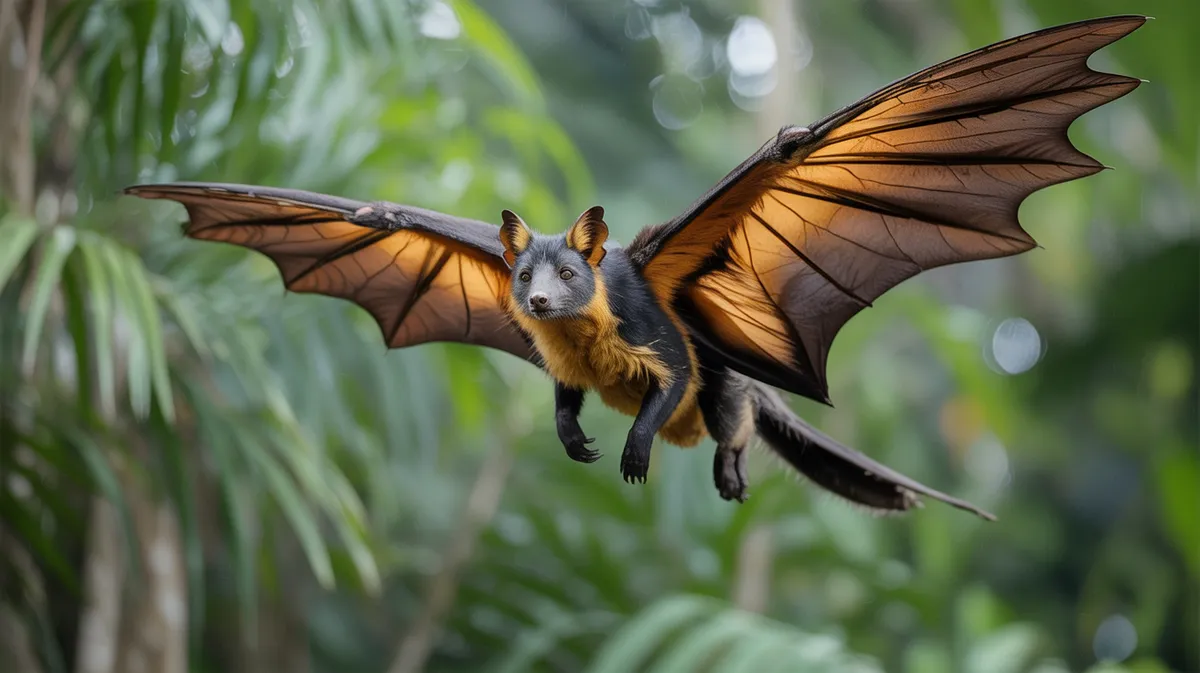
About the Giant Golden-crowned Flying Fox
Acerodon jubatus of the Philippines is one of the largest bats in the world, with a wingspan that can reach roughly 1.7 m and a body weighing over a kilogram, and it is a fruit eater with a specific job: it plants forests. Its diet is dominated by figs, and it flies long distances at night between roost and feeding trees, passing seeds intact and depositing them far from the parent tree — a service that hardly any other Philippine animal performs at that range. It has none of the equipment people expect from a bat: no echolocation, no sonar clicks, no interest in insects and no interest whatsoever in blood. It navigates and finds fruit with large forward-facing eyes and a keen nose, more like a nocturnal primate than a microbat, and it hangs in enormous mixed colonies, frequently roosting alongside the large flying fox Pteropus vampyrus. Those colonies are the species' fatal weakness: a roost is a fixed, obvious, noisy target that can hold thousands of bats, and hunting for meat combined with logging of the lowland forest they need has driven the species to endangered status, with a substantial share of known roosts abandoned. The golden fur on the head that gives it its name is a striking contrast to its dark body.
Fascinating facts
Record Wingspan
The Giant Golden-crowned Flying Fox can have a wingspan of up to 1.7 meters (5.6 feet), making it one of the largest bats in the world.
Forest Regenerator
By eating fruits and dispersing seeds over large areas, this species helps maintain and regenerate Philippine forests.
Philippines Endemic
This bat species is found only in the Philippines, primarily on the islands of Luzon, Mindoro, Leyte, and Mindanao.
Detailed description
The Giant Golden-crowned Flying Fox (Acerodon jubatus) is a spectacular megabat, notable for its immense size and distinctive coloration. Adults typically weigh between 0.7 and 1.4 kg (1.5–3.1 lbs), with a wingspan reaching up to 1.7 meters (5.6 feet), making it one of the largest bat species globally. Its most striking feature is the golden-yellow fur adorning the crown and nape, contrasting with the dark brown to black fur covering the rest of the body. The species possesses elongated forearms, with the longest recorded at 21 cm (8.3 inches), supporting its expansive wings. The face is fox-like, with large, dark eyes adapted for nocturnal vision and a relatively short snout. Unlike many bats, it lacks a tail. The dental formula is specialized for a frugivorous diet, with robust molars suited for crushing fruit pulp. Roosting in large colonies, sometimes numbering several thousand individuals, these bats prefer undisturbed primary and mature secondary forests, often selecting tall emergent trees for communal roosting. Their powerful flight allows them to traverse distances of over 40 km (25 miles) in a single night in search of food. Despite their size, they are gentle and non-aggressive, relying on keen senses of smell and vision to locate fruit. Their ecological role as seed dispersers and pollinators is critical for the maintenance and regeneration of Philippine forest ecosystems.
Did you know?
Despite their enormous size and vampire-like appearance, Giant Golden-crowned Flying Foxes feed only on fruit and never consume blood.
Research & sources
Wikipedia summary
The giant golden-crowned flying fox, also known as the golden-capped fruit bat, is a species of megabat endemic to the Philippines. Since its description in 1831, three subspecies of the giant golden-crowned flying fox have been recognized, one of which is extinct. The extinct subspecies was formerly recognized as a full species, the Panay golden-crowned flying fox. Formerly, this species was placed in the genus Pteropus; while it is no longer within the genus, it has many physical similarities to Pteropus megabats. It is one of the largest bat species in the world, weighing up to 1.4 kg (3.1 lb)—only the Indian and great flying fox can weigh more. It has the longest documented forearm length of any bat species at 21 cm (8.3 in).
Behaviour & social structure
Giant Golden-crowned Flying Foxes are strictly nocturnal, emerging from their roosts at dusk to forage. They exhibit strong site fidelity, returning to the same roosting sites for years. Socially, they are highly gregarious, forming large, noisy colonies that may include other fruit bat species such as Pteropus vampyrus. Within colonies, individuals engage in mutual grooming, vocal communication (including squawks and screeches), and wing-flapping displays to establish roosting positions. Feeding primarily on ripe fruits and occasionally leaves, figs (Ficus spp.) are a dietary staple, supplemented by other native fruits such as lamio (Ficus variegata) and breadfruit. Foraging flights can cover extensive areas, and bats may visit multiple feeding sites in a single night. They do not echolocate but rely on acute vision and olfaction to locate food. Daytime is spent resting, grooming, and thermoregulating by spreading their wings or seeking shade within the canopy.
Reproduction & life cycle
The reproductive cycle of Acerodon jubatus is not fully understood, but available evidence suggests a seasonal breeding pattern, with mating likely occurring during the dry season (January to April). Females typically give birth to a single pup annually, though twins are rare. Gestation is estimated at 5.5 to 6 months. Births are synchronized to coincide with periods of fruit abundance, maximizing offspring survival. Mothers provide extensive parental care, carrying their young clinging to their bodies for the first few weeks and nursing them for up to 2–3 months. Juveniles begin to fly at around 6–8 weeks but may remain dependent on their mothers for several more weeks. Males do not participate in direct parental care but may defend roosting territories during the breeding season.
Adaptations & survival
Acerodon jubatus exhibits several adaptations for its arboreal, frugivorous lifestyle. Its large wings and elongated forearms enable sustained, energy-efficient flight over long distances, essential for locating scattered fruit resources. The bat's keen sense of smell and excellent night vision compensate for the absence of echolocation, allowing precise detection of ripe fruit in dense forest canopies. Its robust jaws and specialized molars are adapted for crushing tough fruit pulp and seeds. Social roosting provides thermoregulatory and anti-predator benefits, while mutual grooming helps maintain fur hygiene and social bonds. The species' ability to exploit a wide variety of fruiting trees enhances its resilience to seasonal fluctuations in food availability.
Cultural significance
In Philippine culture, the Giant Golden-crowned Flying Fox is both revered and misunderstood. While some indigenous communities recognize its ecological importance and include it in local folklore as a forest guardian, others associate it with superstition or view it as a pest. Its impressive size and unique appearance have made it a subject of fascination and ecotourism, though this sometimes leads to disturbance of roost sites. In traditional medicine, bat parts have occasionally been used, though this practice is declining. Conservation outreach increasingly emphasizes the bat's role in forest regeneration and ecosystem health.
Recent research
Recent research has focused on the species' movement ecology using GPS telemetry, revealing extensive nightly foraging ranges and the importance of landscape connectivity. Studies on diet using fecal analysis have highlighted the bat's role in dispersing seeds of over 20 native tree species. Genetic studies are underway to assess population structure and connectivity between island populations, critical for conservation planning. Ongoing monitoring by local and international NGOs tracks population trends and the effectiveness of protected areas. Notably, collaborative conservation programs involving local communities have shown promise in reducing hunting pressure and promoting habitat restoration.
Videos
Habitat
Tropical forest


Conservation
The Giant Golden-crowned Flying Fox is currently classified as Endangered on the IUCN Red List.
Threats & challenges
The Giant Golden-crowned Flying Fox faces severe threats from habitat loss due to deforestation, agricultural expansion, and logging, which have dramatically reduced suitable roosting and foraging habitats. Hunting for bushmeat and traditional medicine, as well as persecution due to perceived crop damage, further exacerbates population declines. Roost disturbance and fragmentation of colonies increase vulnerability to predation and stress. The species is listed as Endangered by the IUCN, with population trends continuing downward. Conservation is complicated by the bat's large home range requirements and the need for intact forest corridors. Climate change may also impact fruiting phenology, further challenging survival.
Taxonomy
Scientific name
Acerodon jubatus
- Kingdom
- Animalia
- Phylum
- Chordata
- Class
- Mammalia
- Order
- Chiroptera
- Family
- Pteropodidae
- Genus
- Acerodon
- Species
- jubatus
Community notes
Share your observations about the Giant Golden-crowned Flying Fox.
No community notes yet. Be the first!
Discover more wildlife
More fascinating animals from the encyclopedia.