
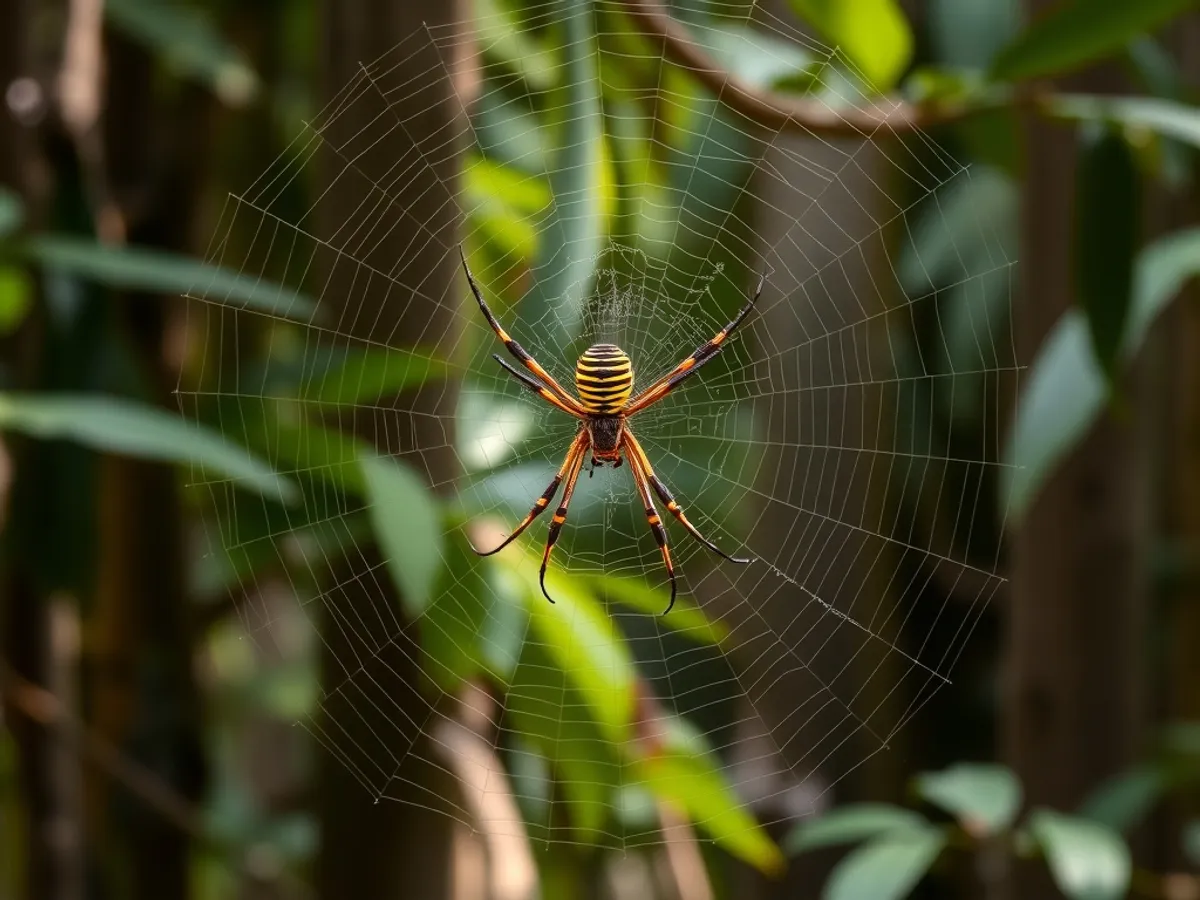
About the Giant golden orb-weaver
The giant golden orb-weaver is a large and striking arachnid known for weaving expansive, golden-colored webs that can span several meters. Females are significantly larger than males, with bodies often reaching up to 6 cm in length, while males are much smaller and less conspicuous. This spider is commonly found in forests and woodlands across Southeast Asia, Australia, and parts of the western Pacific. Its impressive web structure is not only beautiful but also extremely strong, capable of catching large insects and even small birds in rare cases. The giant golden orb-weaver plays a crucial ecological role by controlling insect populations and serving as prey for birds and wasps.
Fascinating facts
Golden Silk
The web silk of the giant golden orb-weaver appears golden in sunlight due to pigments and protein structure, making it both beautiful and efficient at attracting prey.
Extreme Sexual Dimorphism
Females are up to ten times larger than males, a dramatic size difference that is rare even among spiders.
Diet Diversity
While primarily consuming flying insects, these spiders have been known to capture and feed on small birds and bats that become ensnared in their strong webs.
Detailed description
The giant golden orb-weaver (Nephila pilipes) is one of the largest orb-weaving spiders in the world, with adult females exhibiting a striking sexual dimorphism: females can reach body lengths of 4.8–6 cm, while males are diminutive, rarely exceeding 1 cm. The female's elongated abdomen is often adorned with yellow, white, and black markings, and her legs are long, banded, and sometimes exhibit tufts of black hair. The species is renowned for its golden-hued silk, which gives its web a distinctive color and exceptional tensile strength. Webs can span over 1.5 meters in diameter and are often constructed in open spaces between trees or shrubs. N. pilipes is a sit-and-wait predator, relying on its expansive web to ensnare a wide array of prey, including large insects, small bats, and occasionally small birds. The spider's venom is potent against arthropods but poses minimal risk to humans. Females are solitary and territorial, with males often residing at the web's periphery, awaiting mating opportunities. The species exhibits a complex life cycle, with multiple molts before reaching maturity, and can live for up to a year in the wild. Their presence is a key indicator of healthy, biodiverse forest ecosystems.
Did you know?
Despite their intimidating size and appearance, giant golden orb-weavers are harmless to humans and rarely bite unless provoked.
Research & sources
Behaviour & social structure
Nephila pilipes displays primarily solitary behavior, with females aggressively defending their webs from conspecifics and other intruders. Web construction typically occurs at dusk, with spiders repairing or rebuilding their webs nightly to maintain structural integrity and prey capture efficiency. The spider remains motionless at the web's center during the day, relying on cryptic coloration for camouflage. When prey is ensnared, the spider rapidly immobilizes it with silk and injects digestive enzymes. Feeding occurs at the web, where the spider liquefies and consumes the prey's tissues. Males exhibit a unique behavioral adaptation: they cohabit the female's web, feeding on smaller prey and avoiding predation by the female through stealth and minimal movement. Cannibalism is common, especially during mating encounters. The species is primarily crepuscular to nocturnal, with peak activity at dawn and dusk.
Reproduction & life cycle
Mating in N. pilipes is a high-risk endeavor for males, as sexual cannibalism is prevalent. Males approach females cautiously, often waiting until the female is feeding to attempt copulation. Courtship involves vibrational signals transmitted through the web. Males use specialized pedipalps to transfer sperm to the female's epigyne. After mating, females lay several hundred to over a thousand eggs in a silken sac, which is attached to foliage near the web. There is no parental care post-oviposition; spiderlings disperse soon after hatching, often via ballooning (using silk threads to catch the wind). Breeding can occur year-round in equatorial regions, but in subtropical areas, it is typically synchronized with the wet season to maximize prey availability for offspring.
Adaptations & survival
N. pilipes possesses several notable adaptations: its golden silk contains nanocrystalline structures that confer exceptional strength and elasticity, making it one of the toughest biological materials known. The color of the silk may serve to attract pollinating insects or camouflage the web in dappled sunlight. The spider's large size and cryptic coloration deter many predators, while its venom is highly effective against a broad range of arthropods. The species exhibits behavioral plasticity in web placement and size, adjusting to prey abundance and environmental conditions. Males have evolved reduced size and stealthy behaviors to minimize predation risk by females during mating.
Cultural significance
The golden orb-weaver has featured in the folklore and mythology of several Asian cultures, often symbolizing patience, creativity, and feminine power due to its intricate web-building and striking appearance. In some regions, its silk has been used experimentally for textile production, with historical records of golden silk garments in Madagascar and the Philippines. The spider is also a subject of fascination in ecotourism and environmental education, highlighting the importance of arachnids in ecosystem health.
Recent research
Recent research has focused on the biomechanical properties of N. pilipes silk, revealing its potential applications in biomimetic materials and medical sutures. Genetic studies have explored the molecular basis of silk production and sexual dimorphism. Ecological studies have examined the spider's role in controlling pest populations and its interactions with web-invading kleptoparasites such as Argyrodes spp. Ongoing research is investigating the impact of environmental changes on web-building behavior and reproductive success. Notably, a 2020 study documented the spider's ability to alter web architecture in response to urban light pollution, demonstrating behavioral flexibility.
Sources
Nephila pilipes: The IUCN Red List of Threatened Species 2024
IUCN SSC Spider Specialist Group
conservationThe biology and web characteristics of Nephila pilipes (Fabricius, 1793) (Araneae: Nephilidae)
Kuntner, M. & Agnarsson, I. (2011)
scientificMolecular structure and mechanical properties of spider dragline silk from Nephila pilipes
Koh, L. D. et al. (2015)
scientificNephila pilipes (Fabricius, 1793): Taxonomy, Biology, and Ecology
World Spider Catalog, Natural History Museum Bern (2024)
scientificVideos
Habitat
Tropical and subtropical forests


Conservation
The Giant golden orb-weaver is currently classified as Least Concern on the IUCN Red List.
Threats & challenges
Currently classified as Least Concern by the IUCN, N. pilipes faces localized threats from habitat loss due to deforestation, agricultural expansion, and urbanization. Pesticide use can reduce prey availability and directly harm spider populations. Climate change may alter the distribution of suitable habitats and disrupt breeding cycles. Despite these challenges, the species remains widespread and locally abundant in many regions, thanks to its adaptability and broad ecological tolerance. There is no evidence of significant population declines at present.
Taxonomy
Scientific name
Nephila pilipes
- Kingdom
- Animalia
- Phylum
- Arthropoda
- Class
- Arachnida
- Order
- Araneae
- Family
- Nephilidae
- Genus
- Nephila
- Species
- pilipes
Community notes
Share your observations about the Giant golden orb-weaver.
No community notes yet. Be the first!
Discover more wildlife
More fascinating animals from the encyclopedia.