
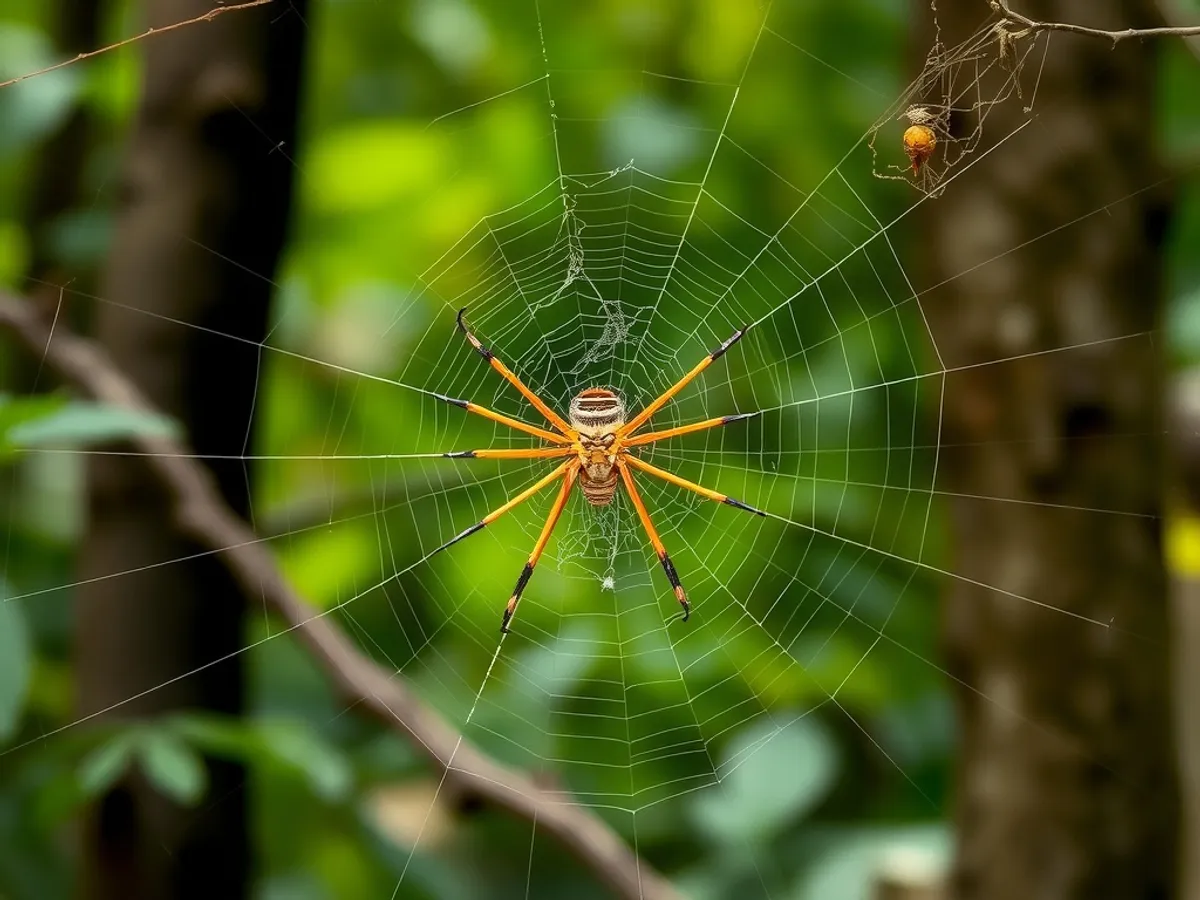
About the Giant golden silk orb-weaver
The giant golden silk orb-weaver is a striking arachnid known for its impressive size and the golden hue of its silk. Females are notably larger than males, with long, spindly legs and a body that can measure up to 5 cm in length. These spiders spin large, intricate orb-shaped webs in forested and garden environments, where their golden silk helps lure and trap flying insects. They are primarily active during warm months and are seen throughout the Americas, from the southeastern United States to South America. Despite their intimidating appearance, they are not dangerous to humans and play a significant role in controlling insect populations.
Fascinating facts
Golden Silk
The spider's web silk shines with a natural gold color, which is especially visible in sunlight and may help attract prey.
Sexual Dimorphism
Females are dramatically larger than males, sometimes up to ten times their size, a rare trait even among spiders.
Wide Range
The species is found across warm regions of the Americas, from the southeastern United States through Central America and into South America.
Detailed description
The giant golden silk orb-weaver (Trichonephila clavipes) is a large, sexually dimorphic spider, with females reaching body lengths of 25–40 mm (excluding legs) and males rarely exceeding 6 mm. The species is distinguished by its elongated, cylindrical abdomen, often adorned with yellow, white, and brown markings, and by its remarkably long legs, which are banded and covered in fine setae. The most striking feature is its web: a sprawling orb that can reach over 1 meter in diameter, woven from silk that appears golden in sunlight due to carotenoid pigments and structural properties. The silk is among the strongest natural fibers known, with exceptional tensile strength and elasticity. T. clavipes is primarily diurnal, with females remaining stationary at the hub of their webs while males, much smaller and less conspicuous, roam in search of mates. The species exhibits solitary behavior, though multiple females may build webs in close proximity, forming loose colonies. Their visual acuity is limited, relying instead on vibrational cues to detect prey and mates. The spider's chelicerae are robust, enabling it to subdue a wide variety of flying insects, including bees, wasps, and even small butterflies. Despite their formidable appearance, their venom is not medically significant to humans, causing only mild, localized symptoms if bitten.
Did you know?
Scientists have studied the golden silk for potential use in medical sutures and bulletproof materials due to its remarkable strength and flexibility.
Research & sources
Behaviour & social structure
Trichonephila clavipes is primarily a sit-and-wait predator, constructing large, vertical orb webs in open, sunlit areas along forest edges, trails, and gardens. Females rarely leave their webs, spending most of their lives at the hub, where they monitor web vibrations to detect prey or potential mates. When prey is ensnared, the spider rapidly approaches, immobilizes it with a venomous bite, and wraps it in silk for later consumption. Males exhibit wandering behavior, often residing at the periphery of female webs, where they may feed on small prey or even steal from the female's catches (kleptoparasitism). Social interactions are generally limited to mating encounters, with occasional aggression between females if webs overlap. Web maintenance, including repairs and cleaning, occurs daily, typically in the early morning or late afternoon. The species is most active during warm, humid months and may abandon webs during heavy rains or extreme weather.
Reproduction & life cycle
Reproduction in T. clavipes is characterized by pronounced sexual dimorphism and complex courtship behaviors. Males reach maturity faster and seek out females by following pheromonal cues. Upon locating a female's web, the male cautiously approaches, signaling his presence through specific web vibrations to avoid being mistaken for prey. Mating occurs on the female's web, with the male transferring sperm via specialized pedipalps. Post-mating, males may remain on the web for several days, sometimes mating multiple times, but are at risk of sexual cannibalism. Females lay several egg sacs, each containing hundreds of eggs, which are attached to the web or nearby vegetation. Incubation lasts 2–4 weeks, depending on temperature and humidity. There is no parental care after egg-laying; spiderlings disperse by ballooning, using silk threads to catch the wind and colonize new areas. Breeding typically peaks in late summer to early autumn.
Adaptations & survival
T. clavipes exhibits several key adaptations: its golden silk, rich in carotenoids and nanostructures, not only camouflages the web among sunlit foliage but may also attract insect prey by reflecting UV light. The silk's extraordinary mechanical properties provide both strength and flexibility, allowing the web to withstand large, struggling prey and environmental stresses. The spider's long legs, equipped with sensitive setae, enhance its ability to detect minute vibrations, crucial for prey capture and mate recognition. Sexual dimorphism, with tiny, mobile males and large, stationary females, reduces competition for resources and increases reproductive efficiency. Behavioral adaptations include web site selection in high-traffic insect corridors and the ability to rapidly repair or relocate webs in response to environmental changes.
Cultural significance
The golden silk orb-weaver has long fascinated humans due to its impressive size, striking appearance, and the unique properties of its silk. In some indigenous cultures of Central and South America, the silk has been used for fishing lines and textiles, and the spider features in folklore as a symbol of creativity and patience. Modern biomimetic research has focused on replicating the spider's silk for use in medical sutures, bulletproof fabrics, and high-strength materials, highlighting its importance in science and technology. The species is also a popular subject in environmental education and ecotourism.
Recent research
Recent studies have elucidated the genetic and biochemical pathways responsible for the production of golden silk, revealing unique spidroin proteins and pigment incorporation. Genomic analyses have provided insights into the evolution of sexual size dimorphism and web architecture within the Nephilidae. Ongoing research is investigating the ecological impacts of T. clavipes on local insect populations and its interactions with other web-building spiders. Notably, the species has been used as a model organism for studying the effects of environmental pollutants, such as heavy metals, on arachnid physiology and behavior. Advances in synthetic biology are attempting to replicate the mechanical properties of its silk for industrial applications.
Sources
The Biology of Trichonephila clavipes (Araneae: Araneidae): Sexual Dimorphism, Web Structure, and Silk Properties
Eberhard, W.G. et al. (2021)
scientificVideos
Habitat
Forests and woodland edges


Conservation
The Giant golden silk orb-weaver is currently classified as Least Concern on the IUCN Red List.
Threats & challenges
Currently classified as Least Concern, T. clavipes faces localized threats from habitat destruction, pesticide use, and urbanization, which can reduce prey availability and suitable web sites. Climate change may also impact their distribution, as the species is sensitive to temperature and humidity. Despite these pressures, the species remains widespread and adaptable, with stable populations across much of its range. Human persecution is rare, as the spider is not dangerous and is often tolerated or even appreciated for its pest control benefits. Invasive species and competition with other orb-weavers may pose future challenges in some regions.
Taxonomy
Scientific name
Trichonephila clavipes
- Kingdom
- Animalia
- Phylum
- Arthropoda
- Class
- Arachnida
- Order
- Araneae
- Family
- Araneidae
- Genus
- Trichonephila
- Species
- clavipes
Community notes
Share your observations about the Giant golden silk orb-weaver.
No community notes yet. Be the first!
Discover more wildlife
More fascinating animals from the encyclopedia.