
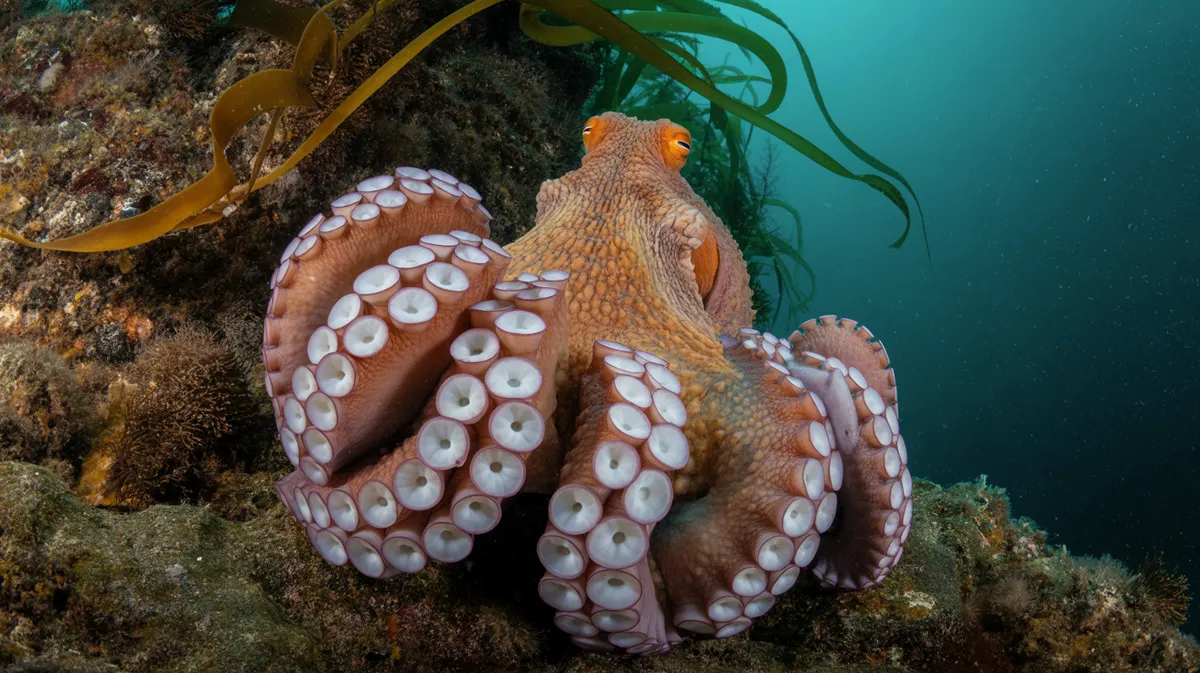
About the Giant Pacific octopus
The Giant Pacific octopus (Enteroctopus dofleini) is the largest species of octopus, often found in the temperate waters of the North Pacific Ocean, particularly along the coasts of Japan, the Aleutian Islands, and the Pacific Northwest. Individuals can reach impressive sizes, with arm spans extending up to 20 feet and weights surpassing 150 pounds. These cephalopods exhibit remarkable intelligence, capable of solving complex puzzles and navigating mazes, a testament to their highly developed nervous systems. Their skin contains specialized cells called chromatophores, allowing them to change color and texture for camouflage and communication. Unlike many marine species, the Giant Pacific octopus has a relatively short lifespan of about 3 to 5 years, which is primarily due to their semelparous reproductive strategy—females lay thousands of eggs and die shortly after the eggs hatch. This species plays a crucial role in its ecosystem as both predator and prey, feeding on crustaceans, fish, and other mollusks while being hunted by sharks and sea otters.
Fascinating facts
Master of Disguise
The Giant Pacific octopus can rapidly change its skin color and texture to mimic rocks, sand, and even algae, making it nearly invisible to predators and prey.
Highly Intelligent
This octopus is considered one of the most intelligent invertebrates, capable of navigating mazes, solving puzzles, and remembering solutions over time.
Devoted Parent
After laying her eggs, the female octopus guards and cares for them continuously, aerating and cleaning them until they hatch, after which she dies—her entire life dedicated to a single brood.
Detailed description
The Giant Pacific octopus (Enteroctopus dofleini) is the largest known octopus species, with documented arm spans reaching up to 4.3 meters (14 feet) and weights exceeding 70 kilograms (154 pounds), though most individuals are smaller. Its body is characterized by a soft, bulbous mantle, eight muscular arms lined with two rows of suckers, and a highly flexible, boneless structure that allows it to squeeze through remarkably small openings. The skin is equipped with chromatophores, iridophores, and leucophores, enabling rapid changes in color and texture for camouflage, communication, and threat displays. E. dofleini possesses a large, complex brain relative to body size, supporting advanced problem-solving, learning, and memory. Its keen eyesight, aided by camera-type eyes, allows for acute detection of movement and contrast in dim underwater environments. The species is solitary and primarily nocturnal, spending daylight hours hidden in dens constructed from rocks and shells. It is an apex invertebrate predator, preying on crustaceans, mollusks, fish, and even other cephalopods. Lifespan is relatively short, typically 3–5 years, with individuals undergoing a single reproductive event before senescence and death. The Giant Pacific octopus plays a keystone role in benthic ecosystems, influencing prey populations and serving as prey for larger marine animals such as sea otters, sharks, and marine mammals.
Did you know?
A female Giant Pacific octopus can lay up to 74,000 eggs in a single clutch, and she dedicates her final months to protecting them without eating, ultimately dying after they hatch.
Research & sources
Wikipedia summary
The giant Pacific octopus, also known as the North Pacific giant octopus, is a large marine cephalopod belonging to the genus Enteroctopus and Enteroctopodidae family. Its spatial distribution encompasses much of the coastal North Pacific, from the Mexican state of Baja California, north along the United States' West Coast, and British Columbia, Canada; across the northern Pacific to the Russian Far East, south to the East China Sea, the Yellow Sea, the Sea of Japan, Japan's Pacific east coast, and around the Korean Peninsula. It can be found from the intertidal zone down to 2,000 m (6,600 ft), and is best-adapted to colder, oxygen- and nutrient-rich waters. It is the largest octopus species on earth and can often be found in aquariums and research facilities in addition to the ocean. E. dofleini play an important role in maintaining the health and biodiversity of deep sea ecosystems, cognitive research, and the fishing industry.
Behaviour & social structure
Giant Pacific octopuses are solitary and exhibit complex behaviors, including sophisticated hunting strategies such as ambush, stalking, and active foraging. They use their arms and suckers to probe crevices, manipulate objects, and extract prey from shells using a combination of force and a paralyzing saliva delivered through their beak. They are known for tool use, such as collecting coconut shells or rocks to barricade den entrances. Octopuses are primarily nocturnal, emerging from dens at night to hunt and returning before dawn. They maintain and regularly clean their dens, discarding prey remains in a 'midden' outside the entrance. Social interactions are limited, typically occurring only during mating or territorial disputes. When threatened, they employ a suite of defensive behaviors: rapid color change, jet-propelled escape, and inking to obscure predators' vision. Their intelligence is demonstrated in laboratory settings, where they can solve mazes, open jars, and exhibit individual personalities.
Reproduction & life cycle
Reproduction in E. dofleini is semelparous, meaning individuals breed once before dying. Mating occurs year-round but peaks in late winter to early spring. Males use a specialized arm (hectocotylus) to transfer spermatophores into the female's mantle cavity. After mating, females lay between 18,000 and 74,000 eggs in strings attached to the roof of a den or cave. The female guards and aerates the eggs continuously for 5 to 10 months, depending on water temperature, ceasing to feed during this period. Upon hatching, planktonic paralarvae drift in the water column for several weeks before settling to the benthos. Both males and females die shortly after reproduction, with females succumbing to starvation and males to senescence. There is no parental care post-hatching.
Adaptations & survival
E. dofleini exhibits numerous adaptations for survival in cold, oxygen-rich waters. Its large gill surface area and high hemocyanin content facilitate efficient oxygen transport. The flexible, boneless body allows access to narrow crevices for shelter and hunting. Chromatophores and skin papillae enable rapid camouflage and mimicry of surrounding textures and colors. The species' advanced nervous system supports complex learning, memory, and problem-solving. A powerful beak and radula allow it to penetrate hard shells, while venomous saliva subdues prey. Its ability to regenerate lost arms provides resilience against predation. The octopus can also rapidly expel water through its siphon for jet propulsion, aiding in escape.
Cultural significance
The Giant Pacific octopus holds a prominent place in the folklore and mythology of Pacific Rim cultures, often symbolizing intelligence, mystery, and adaptability. Indigenous peoples of the Pacific Northwest, such as the Haida and Tlingit, feature octopuses in art and oral traditions. In Japan, the octopus (tako) appears in traditional cuisine, art, and Shinto symbolism. The species is a popular exhibit in public aquariums, serving as an ambassador for marine conservation and cephalopod research. Its remarkable intelligence and problem-solving abilities have inspired literature, film, and scientific inquiry.
Recent research
Recent research has focused on the cognitive abilities of E. dofleini, revealing advanced learning, memory, and even play behaviors. Studies using genetic markers have clarified population structure and connectivity across the North Pacific. Ongoing research investigates the impacts of climate change on physiology, reproduction, and distribution. The species is a model organism for studying cephalopod neurobiology, camouflage mechanisms, and regeneration. Notable studies have documented individual personalities and complex den-building behaviors. Advances in remote underwater observation and tagging are providing new insights into wild behavior, movement patterns, and habitat use.
Sources
Distribution of Recent Cephalopoda and implications for Plio-Pleistocene events
Philippe Bouchet, et al. (2002)
scientificEnteroctopus dofleini: The IUCN Red List of Threatened Species 2018
Allcock, L., Taite, M., Allen, G.
conservationThe giant Pacific octopus: biology, ecology, and management
Cosgrove, J.A. & McDaniel, N. (2009)
scientificVideos
Habitat
Coastal ocean waters, rocky reefs, kelp forests

Conservation
The Giant Pacific octopus is currently classified as Least Concern on the IUCN Red List.
Threats & challenges
Currently classified as Least Concern by the IUCN, the Giant Pacific octopus faces localized threats from overfishing, bycatch, habitat degradation, and pollution, particularly heavy metals and microplastics. Climate change poses emerging risks, including ocean warming, acidification, and hypoxia, which may affect reproductive success and prey availability. While populations are considered stable overall, some regional declines have been observed, necessitating ongoing monitoring. The species is targeted in commercial and recreational fisheries, but sustainable management practices are in place in many regions. Its short lifespan and high fecundity provide some resilience to exploitation, but ecosystem changes could have cascading effects.
Taxonomy
Scientific name
Enteroctopus dofleini
- Kingdom
- Animalia
- Phylum
- Mollusca
- Class
- Cephalopoda
- Order
- Octopoda
- Family
- Enteroctopodidae
- Genus
- Enteroctopus
- Species
- dofleini
Where to see a giant pacific octopus
6 zoos and aquariums in 2 countries are recorded as keeping this species.
 Dallas World Aquarium🇺🇸 Dallas, United States
 Monterey Bay Aquarium🇺🇸 Monterey, United States
 Vancouver Aquarium🇨🇦 Vancouver, Canada
 National Aquarium🇺🇸 Baltimore, United States
 National Zoological Park🇺🇸 Washington, United States
Community notes
Share your observations about the Giant Pacific octopus.
No community notes yet. Be the first!
Discover more wildlife
More fascinating animals from the encyclopedia.