
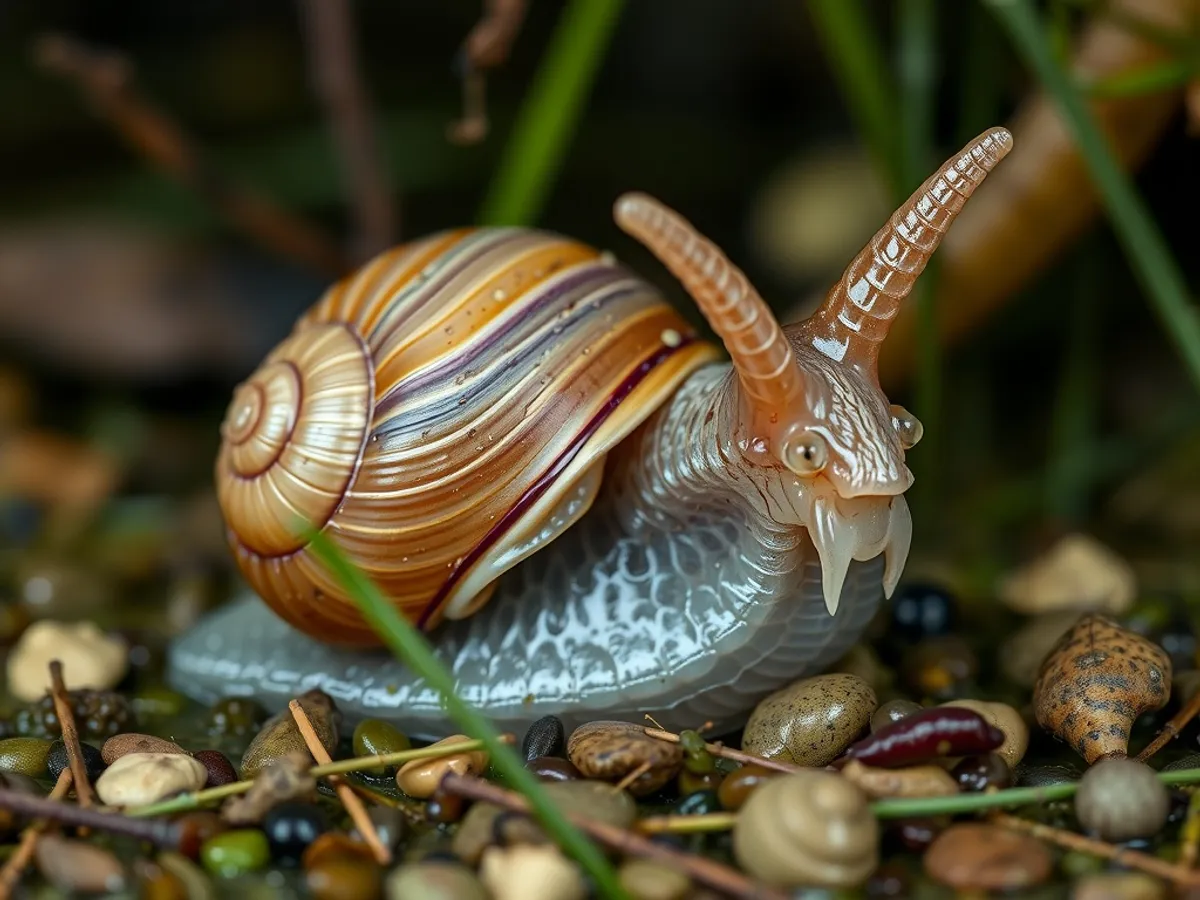
About the Giant Ramshorn Apple Snail
The Giant Ramshorn Apple Snail is a large, freshwater snail native to South America, particularly found in slow-moving rivers, lakes, and marshes. It is recognized for its round, planispiral shell, which can reach up to 5 centimeters in diameter and displays yellowish to brown banding. This species is both an efficient scavenger and herbivore, feeding on a variety of aquatic plants and detritus. Due to its adaptability, the Giant Ramshorn Apple Snail has been introduced to other regions, where it has sometimes become invasive and impacted local ecosystems. Its presence in aquariums is popular, but it requires careful management to prevent overpopulation.
Fascinating facts
Unique Shell Shape
Their planispiral shell is almost perfectly round and flat, distinguishing them from other apple snails with more globular shells.
Plant Eaters
Giant Ramshorn Apple Snails feed primarily on aquatic vegetation, making them both useful and problematic in aquatic environments.
Breathing Adaptations
This species uses both gills and a lung-like structure, allowing it to survive in low-oxygen waters by coming to the surface to breathe air.
Detailed description
The Giant Ramshorn Apple Snail (Marisa cornuarietis) is a large freshwater gastropod distinguished by its robust, discoidal shell, which can reach diameters of 4 to 5 centimeters and is typically yellowish to brown with darker spiral bands. The shell is planispiral, meaning it coils in a single plane, and is relatively flat compared to the more globular apple snails of the genus Pomacea. The body is soft, with a muscular foot used for locomotion and a siphon for breathing air at the water's surface. Marisa cornuarietis possesses both gills and a lung, allowing it to survive in oxygen-poor environments. Its radula—a ribbon-like structure with rows of tiny teeth—enables efficient scraping of algae and plant material. This species is primarily nocturnal, becoming more active at dusk and during the night. Socially, it is generally solitary but may aggregate in areas with abundant food. Reproduction is sexual, with separate male and female individuals, and females lay clusters of gelatinous eggs underwater on vegetation or hard surfaces. The snail's high reproductive rate and tolerance for a wide range of water conditions contribute to its success as both a native and invasive species.
Did you know?
Despite their name, Giant Ramshorn Apple Snails are not closely related to true ramshorn snails; their shell shape simply resembles that of ramshorns.
Research & sources
Behaviour & social structure
Marisa cornuarietis is an active forager, spending much of its time grazing on submerged vegetation, algae, and detritus. It is a generalist feeder, consuming a wide variety of aquatic plants, including invasive species such as Hydrilla verticillata, which has led to its use in biological control. The snail is capable of burrowing into soft substrates to avoid predators or unfavorable environmental conditions. While generally solitary, individuals may be found in loose aggregations where food is plentiful. They exhibit a strong negative phototaxis, preferring shaded or dimly lit environments. When threatened, the snail retracts into its shell and secretes mucus as a defensive measure. Daily activity peaks during the night, with resting periods during daylight hours.
Reproduction & life cycle
Giant Ramshorn Apple Snails are dioecious, with distinct male and female individuals. Mating involves the male mounting the female and transferring sperm via a specialized copulatory organ. Females lay eggs in gelatinous masses, typically attaching them to submerged plants or hard surfaces. Each clutch may contain 100–200 eggs, and females can lay multiple clutches during the breeding season, which in tropical regions can occur year-round. The incubation period is temperature-dependent, ranging from 7 to 21 days. There is no parental care after egg-laying; juveniles are fully independent upon hatching and resemble miniature adults. Rapid growth allows them to reach sexual maturity within 2–4 months under optimal conditions.
Adaptations & survival
Marisa cornuarietis exhibits several adaptations for survival in variable freshwater environments. Its dual respiratory system—gills and a pulmonary sac—enables it to thrive in both oxygen-rich and hypoxic waters. The robust, flattened shell provides protection from predators and facilitates burrowing. Its radula is adapted for scraping tough plant material, and the snail's tolerance for a wide range of pH (6.0–8.0) and temperature (18–30°C) allows it to colonize diverse habitats. High fecundity and rapid growth rates are evolutionary strategies that enhance its invasive potential. The ability to aestivate (enter a dormant state) during dry periods further increases its resilience.
Cultural significance
The Giant Ramshorn Apple Snail has limited direct cultural significance but is popular in the aquarium trade due to its size, distinctive appearance, and algae-eating habits. In some regions, it has been intentionally introduced for biological control of invasive aquatic plants. However, its tendency to overpopulate and consume desirable vegetation has led to mixed perceptions among aquarists and water managers. There are no known mythological or symbolic associations, but its ecological role has made it a subject of interest in environmental management.
Recent research
Recent research has focused on the use of Marisa cornuarietis in biocontrol programs, particularly for managing invasive aquatic plants like Hydrilla. Studies have also examined its physiology, including its dual respiratory system and tolerance to pollutants, making it a model organism for ecotoxicology. Genetic analyses have provided insights into population structure and dispersal patterns, especially in introduced ranges. Ongoing research is investigating its interactions with native species and its potential as a vector for parasitic diseases. Its rapid reproductive cycle and adaptability continue to make it a subject of interest in invasion biology and freshwater ecology.
Sources
Marisa cornuarietis (Linnaeus, 1758): Biology, Ecology, and Invasive Potential
Cowie, R.H. & Hayes, K.A. (2012)
scientificMarisa cornuarietis (Linnaeus, 1758): Biology, Distribution, and Invasive Potential
Cowie, R.H. & Hayes, K.A. (2012)
scientificMarisa cornuarietis: The IUCN Red List of Threatened Species 2017
IUCN SSC Mollusc Specialist Group
conservationVideos
Habitat
Freshwater bodies such as rivers, lakes, ponds, and marshes

Conservation
The Giant Ramshorn Apple Snail is currently classified as Least Concern on the IUCN Red List.
Threats & challenges
While Marisa cornuarietis is not currently threatened and is listed as Least Concern by the IUCN, it faces localized risks from habitat destruction, pollution, and collection for the aquarium trade. In regions where it has been introduced, it can become invasive, outcompeting native snail species and altering aquatic plant communities. Its role as a vector for certain parasites, such as Angiostrongylus cantonensis (rat lungworm), poses potential health risks in some areas. Population trends are generally stable in its native range, but ongoing monitoring is necessary in both native and introduced habitats to assess ecological impacts.
Taxonomy
Scientific name
Marisa cornuarietis
- Kingdom
- Animalia
- Phylum
- Mollusca
- Class
- Gastropoda
- Order
- Architaenioglossa
- Family
- Ampullariidae
- Genus
- Marisa
- Species
- cornuarietis
Community notes
Share your observations about the Giant Ramshorn Apple Snail.
No community notes yet. Be the first!
Discover more wildlife
More fascinating animals from the encyclopedia.