
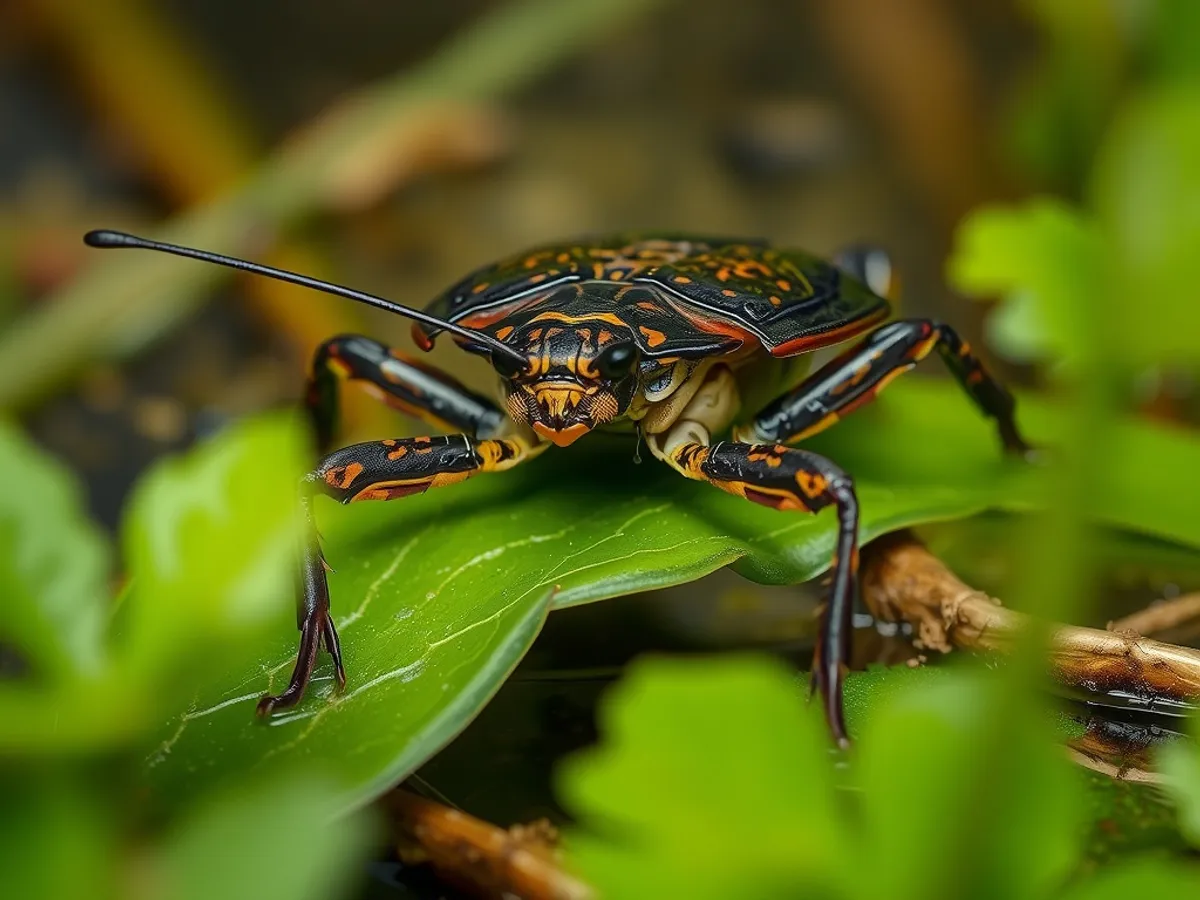
About the Giant Water Bug
Giant water bugs of the genus Lethocerus are the largest true bugs on Earth, with some New World species exceeding 10 cm, and they hunt far above their weight class: tadpoles, small fish, salamanders, snails, and even hatchling turtles and snakes have been recorded as prey. The bug seizes the victim with raptorial forelegs, drives in a stout beak, and pumps in proteolytic saliva that liquefies the tissues from the inside before sucking out the resulting slurry - so the empty prey often looks intact. In many species the male, not the female, carries the brood: she glues a dense pad of eggs to his back, and he must then spend days periodically surfacing and stroking them, because eggs left submerged suffocate and eggs left dry desiccate. The nickname "toe-biter" is earned; the bite is intensely painful to humans but medically harmless, injecting digestive enzymes rather than a true venom. Adults fly strongly at night and are drawn in enormous numbers to streetlights, which gives them their other common name, electric light bug. In Thailand, Vietnam and Laos, the related Lethocerus indicus is a prized food, its males farmed for a fruity, pear-like pheromone that flavours nam prik maeng da chili paste.
Fascinating facts
Powerful Predator
Giant Water Bugs use their strong, raptorial front legs to seize prey and inject digestive enzymes, liquefying the insides of their catch for easier consumption.
Unique Parenting
Males of some genera carry eggs on their backs, protecting them from predators, parasites, and desiccation until they hatch.
Aquatic Adaptations
These insects have a breathing tube at the end of their abdomen, allowing them to draw air while submerged, similar to a snorkel.
Detailed description
The Giant Water Bug (Lethocerus americanus) is an exceptionally large aquatic insect, with adults typically ranging from 4 to 7 cm in length, though some related species in the genus Lethocerus can exceed 12 cm. Its dorsoventrally flattened, oval body is well-adapted for aquatic life, featuring a smooth, brownish exoskeleton that provides camouflage among submerged vegetation and detritus. The forelegs are raptorial, heavily muscled, and equipped with sharp hooks for grasping prey, while the hind legs are flattened and fringed with hairs, functioning as powerful paddles for swimming. The head is broad with prominent, compound eyes and a short, robust beak (rostrum) used to inject digestive enzymes into prey. Lethocerus americanus is an obligate air-breather, surfacing periodically to replenish air stores via spiracles located at the tip of its abdomen. This species is primarily nocturnal, exhibiting peak activity during the night. It is a solitary ambush predator, relying on stealth and rapid strikes to capture a variety of aquatic animals. The Giant Water Bug is also known for its unique reproductive behavior: females lay eggs on emergent vegetation or, in some related genera, directly onto the backs of males, who then guard and aerate the eggs until hatching. This insect plays a significant role in freshwater ecosystems as both predator and prey, influencing the populations of fish, amphibians, and other invertebrates.
Did you know?
Male Giant Water Bugs in some species carry their eggs on their backs until they hatch, offering them protection and aeration.
Research & sources
Wikipedia summary
Belostomatidae is a family of freshwater hemipteran insects known as giant water bugs or colloquially as toe-biters, Indian toe-biters, electric-light bugs, alligator ticks, or alligator fleas. They are the largest insects in the order Hemiptera. There are about 170 species found in freshwater habitats worldwide, with more than 110 in the Neotropics, more than 20 in Africa, almost as many in the Nearctic, and far fewer elsewhere. These predators are typically encountered in freshwater ponds, marshes and slow-flowing streams. Most species are at least 2 cm (0.8 in) long, although smaller species, down to 0.9 cm (0.35 in), also exist. The largest are members of the genus Lethocerus, which can exceed 12 cm (4.5 in) and nearly reach the length of some of the largest beetles in the world. Giant water bugs are a popular food in parts of Asia.
Behaviour & social structure
Giant Water Bugs are solitary and highly territorial, rarely tolerating the presence of conspecifics except during mating. They are sit-and-wait predators, remaining motionless for extended periods while concealed among aquatic plants or debris. When prey such as fish, tadpoles, or aquatic insects approaches, the bug lunges forward, grasping it with its raptorial forelegs and injecting a potent mix of digestive enzymes through its rostrum. This extraoral digestion liquefies the prey's tissues, which are then sucked out. Lethocerus americanus is primarily nocturnal, often attracted to artificial lights during warm, humid nights—a behavior known as positive phototaxis. While generally non-aggressive toward humans, they can deliver a painful defensive bite if handled. Cannibalism has been observed, especially in crowded or resource-limited environments.
Reproduction & life cycle
Reproduction in Lethocerus americanus typically occurs in spring and early summer. Males establish territories and attract females through pheromonal cues and possibly substrate-borne vibrations. After copulation, females lay clusters of eggs on emergent vegetation above the waterline. Unlike some other Belostomatidae genera (e.g., Abedus), Lethocerus males do not carry eggs on their backs. Instead, they may guard the egg masses, occasionally moistening them to prevent desiccation. The incubation period lasts 1–2 weeks, depending on temperature and humidity. Upon hatching, nymphs drop into the water and undergo five instar stages before reaching adulthood, a process that can take several months. Parental care is less pronounced in Lethocerus than in some related genera, but egg guarding is still observed.
Adaptations & survival
Lethocerus americanus exhibits several key adaptations for aquatic predation. Its raptorial forelegs are specialized for rapid prey capture, while the hind legs are modified for efficient swimming. The respiratory system includes retractable siphons at the abdomen's tip, allowing the insect to breathe atmospheric air while remaining submerged. Camouflage coloration and a flattened body help avoid detection by both prey and predators. The ability to deliver a powerful, enzymatic bite enables the bug to subdue prey much larger than itself. Behavioral adaptations include nocturnal activity patterns and positive phototaxis, which may facilitate dispersal and mate finding. The reproductive strategy of egg-laying on emergent vegetation reduces aquatic predation on eggs.
Cultural significance
While Lethocerus americanus itself is not commonly consumed, related giant water bug species (notably Lethocerus indicus) are considered delicacies in Southeast Asia, where they are eaten fried or used to flavor sauces. In North America, the species is more often noted for its impressive size and painful bite, earning it nicknames like 'toe-biter.' Giant water bugs have featured in local folklore and are sometimes used in educational displays to illustrate aquatic food webs and insect adaptations. Their presence is also an indicator of healthy freshwater ecosystems.
Recent research
Recent research on Lethocerus americanus and related species has focused on their role as apex invertebrate predators in freshwater systems, their unique reproductive strategies, and the biochemical properties of their digestive enzymes. Studies have examined the impact of environmental contaminants on development and behavior, as well as the evolutionary origins of male parental care in Belostomatidae. Ongoing genetic research is clarifying relationships within the family and the mechanisms underlying their remarkable size and predatory capabilities. The species is also used as a model for studying extraoral digestion and aquatic insect respiration.
Videos
Habitat
Freshwater ponds, lakes, marshes, and slow-moving streams

Conservation
The Giant Water Bug is currently classified as Least Concern on the IUCN Red List.
Threats & challenges
Currently, Lethocerus americanus is classified as Least Concern, with stable populations across much of its range. However, local declines have been linked to habitat loss, water pollution, and the drainage of wetlands. Pesticide runoff and heavy metal contamination can negatively impact both adults and developing nymphs. Artificial lighting may increase mortality by attracting bugs away from suitable aquatic habitats, making them vulnerable to predation or desiccation. Climate change, altering water temperatures and hydrology, may also affect breeding success and distribution. Despite these challenges, the species remains widespread and adaptable.
Taxonomy
Scientific name
Lethocerus americanus
- Kingdom
- Animalia
- Phylum
- Arthropoda
- Class
- Insecta
- Order
- Hemiptera
- Family
- Belostomatidae
- Genus
- Lethocerus
- Species
- americanus
Community notes
Share your observations about the Giant Water Bug.
No community notes yet. Be the first!
Discover more wildlife
More fascinating animals from the encyclopedia.