
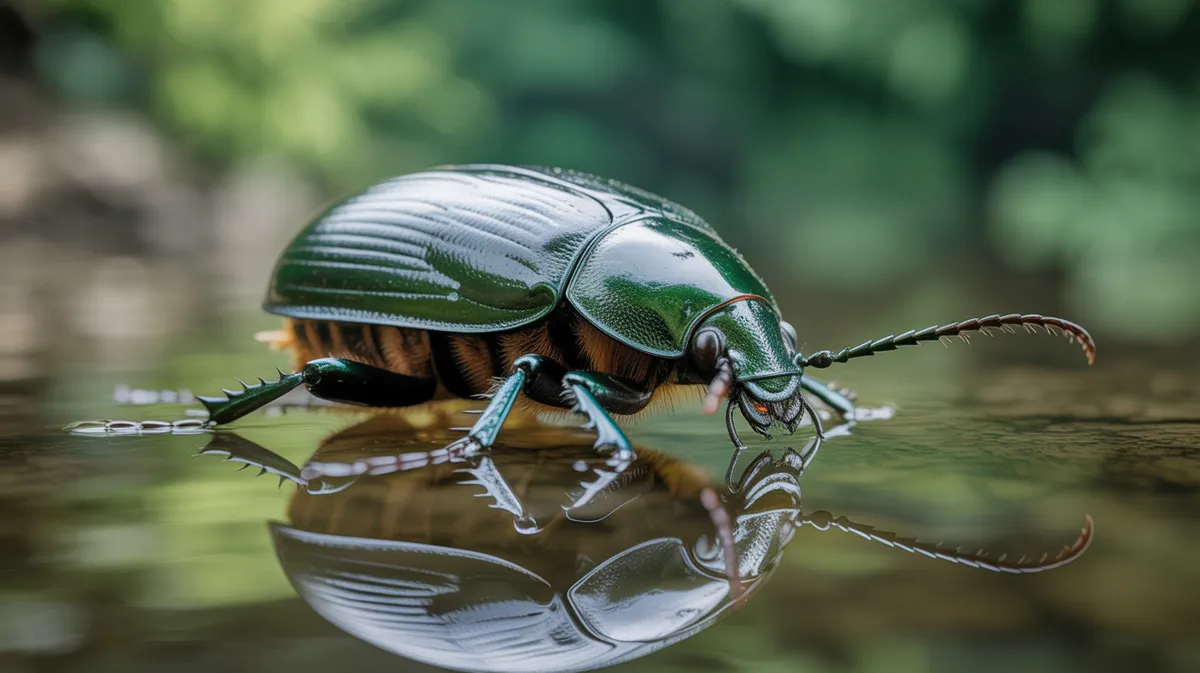
About the Giant Water Scavenger Beetle
The Giant Water Scavenger Beetle is one of the largest aquatic beetles in North America, notable for its shiny, dark brown to black body and robust size. Adapted for life in freshwater habitats, it possesses long, oar-like hind legs fringed with hairs for efficient swimming. Both adults and larvae are predatory, feeding on a variety of aquatic organisms, though adults can also consume decaying plant material. This beetle is easily identified by its streamlined, oval shape and the distinctive keel running down its thorax and abdomen. It is often found in ponds, marshes, and slow-moving streams with abundant vegetation.
Fascinating facts
Aquatic Adaptations
The beetle's hind legs are flattened and covered with hairs, functioning like paddles for powerful swimming.
Voracious Larvae
Larval Giant Water Scavenger Beetles are fierce predators, using their strong jaws to capture and consume small aquatic animals.
Strong Fliers
Adults can fly considerable distances to find new aquatic habitats, often traveling at night.
Detailed description
The Giant Water Scavenger Beetle (Hydrophilus triangularis) is a striking aquatic insect, typically measuring between 3.5 and 4.5 centimeters in length, making it one of the largest water beetles in North America. Its body is highly streamlined and oval, with a glossy, dark brown to black exoskeleton that helps reduce drag in water. The beetle's hind legs are elongated and fringed with dense hairs, functioning as powerful paddles for swimming, while the forelegs are shorter and adapted for grasping prey or substrate. The ventral side is often lighter in color and features a prominent keel running along the thorax and abdomen, which aids in stability and hydrodynamics. Adult beetles possess short, clubbed antennae and distinctive maxillary palps that are longer than the antennae, often mistaken for them. Hydrophilus triangularis is primarily nocturnal, spending daylight hours concealed among aquatic vegetation or submerged debris. Both larvae and adults are voracious predators, but adults are also known to scavenge decaying plant matter, making them true omnivores. The larvae, sometimes called 'water tigers,' are elongated, with strong mandibles for capturing prey. This beetle is capable of producing a squeaking sound (stridulation) by rubbing body parts together, possibly as a defense mechanism. Respiration is facilitated by trapping air beneath the elytra (wing covers), allowing the beetle to remain submerged for extended periods.
Did you know?
The Giant Water Scavenger Beetle can trap an air bubble under its wing covers, allowing it to breathe underwater for extended periods.
Research & sources
Behaviour & social structure
Hydrophilus triangularis exhibits solitary behavior, with individuals rarely interacting outside of mating or competition for resources. Adults are primarily active at night, emerging from hiding to forage and hunt. They are strong swimmers, using their hind legs in synchronous strokes to propel themselves efficiently through water. Feeding behavior is opportunistic; adults consume a wide range of food, including aquatic invertebrates, small fish, tadpoles, algae, and decomposing plant material. Larvae are exclusively carnivorous, actively hunting prey such as aquatic insects, snails, and small vertebrates, using their sharp mandibles to subdue and consume them. Both life stages are known to surface periodically to replenish their air supply, a behavior facilitated by their ability to trap air under the elytra. When threatened, adults may dive rapidly, release a foul-smelling secretion as a deterrent, or stridulate to startle predators. During the day, they remain hidden among submerged vegetation or mud to avoid predation by birds, fish, and mammals.
Reproduction & life cycle
Reproduction occurs primarily in late spring and early summer, coinciding with warmer water temperatures. Males locate females using chemical cues and courtship involves tactile and chemical signaling. After mating, females construct unique egg cases—resembling floating rafts or cocoons—using a silk-like secretion. These egg cases are attached to submerged vegetation or debris, providing protection from predators and desiccation. Each case can contain several dozen eggs. Incubation lasts from 7 to 14 days, depending on water temperature. Upon hatching, larvae immediately begin hunting and grow rapidly through several instars. Larval development typically takes 3–6 weeks, after which mature larvae leave the water to pupate in moist soil along the shoreline. The pupal stage lasts 1–3 weeks, after which adults emerge and return to the water. There is usually one generation per year (univoltine), but in warmer regions, a partial second generation may occur. Parental care is limited to the construction and placement of the egg case; no further care is provided.
Adaptations & survival
Hydrophilus triangularis exhibits several remarkable adaptations for aquatic life. Its streamlined, hydrodynamic body reduces water resistance, while the hind legs are flattened and fringed with setae, maximizing propulsion with each stroke. The beetle’s ability to trap a bubble of air beneath its elytra enables prolonged submersion and underwater respiration, functioning as a physical gill that facilitates gas exchange. The long maxillary palps serve both sensory and feeding functions, allowing the beetle to detect and manipulate food in murky water. Larvae are equipped with powerful, sickle-shaped mandibles and a flexible body for efficient predation. Adults can produce chemical deterrents from abdominal glands to repel predators. The construction of floating egg cases is a unique reproductive adaptation, ensuring offspring survival in aquatic environments. Behavioral adaptations include nocturnality, which reduces predation risk and competition, and the ability to stridulate as a defensive mechanism.
Cultural significance
The Giant Water Scavenger Beetle has limited direct cultural significance in North America, but it has occasionally appeared in educational materials and natural history exhibits as an example of aquatic insect diversity. In some indigenous traditions, large water beetles are symbols of adaptability and resilience, though Hydrophilus triangularis itself is not commonly featured in folklore. The beetle’s impressive size and predatory habits have made it a subject of fascination for entomologists and naturalists. It is sometimes used in classroom settings to demonstrate aquatic adaptations and insect life cycles.
Recent research
Recent research on Hydrophilus triangularis has focused on its ecological role as both predator and scavenger in freshwater ecosystems, highlighting its importance in nutrient cycling and controlling populations of other aquatic invertebrates. Studies have examined the beetle’s respiratory adaptations, particularly the efficiency of air bubble retention and gas exchange under varying environmental conditions. Ongoing research is investigating the effects of water pollution and habitat modification on population dynamics. Molecular studies have clarified the phylogenetic relationships within the Hydrophilidae family, confirming the distinctiveness of H. triangularis. There is also interest in the antimicrobial properties of the beetle’s defensive secretions, which may have biomedical applications.
Sources
Hydrophilus triangularis Say, 1823: Taxonomic and Biological Notes
Short, A.E.Z. & Fikáček, M. (2013)
scientificHydrophilus triangularis (Say, 1823): Taxonomy, Distribution, and Ecology
Short, A.E.Z. & Fikáček, M. (2013)
scientificVideos
Habitat
Freshwater

Conservation
The Giant Water Scavenger Beetle is currently classified as Least Concern on the IUCN Red List.
Threats & challenges
Currently, Hydrophilus triangularis faces relatively few direct threats and is classified as Least Concern by conservation authorities. However, local populations may be affected by habitat loss due to wetland drainage, pollution, and the introduction of invasive species that alter aquatic ecosystems. Pesticide runoff and water contamination can negatively impact both larvae and adults, as they are sensitive to changes in water quality. Predation by fish, amphibians, and waterfowl is a natural challenge, particularly for larvae and newly emerged adults. Climate change may pose future risks by altering the availability and quality of freshwater habitats. Despite these challenges, the species remains widespread and stable across its range.
Taxonomy
Scientific name
Hydrophilus triangularis
- Kingdom
- Animalia
- Phylum
- Arthropoda
- Class
- Insecta
- Order
- Coleoptera
- Family
- Hydrophilidae
- Genus
- Hydrophilus
- Species
- triangularis
Community notes
Share your observations about the Giant Water Scavenger Beetle.
No community notes yet. Be the first!
Discover more wildlife
More fascinating animals from the encyclopedia.