
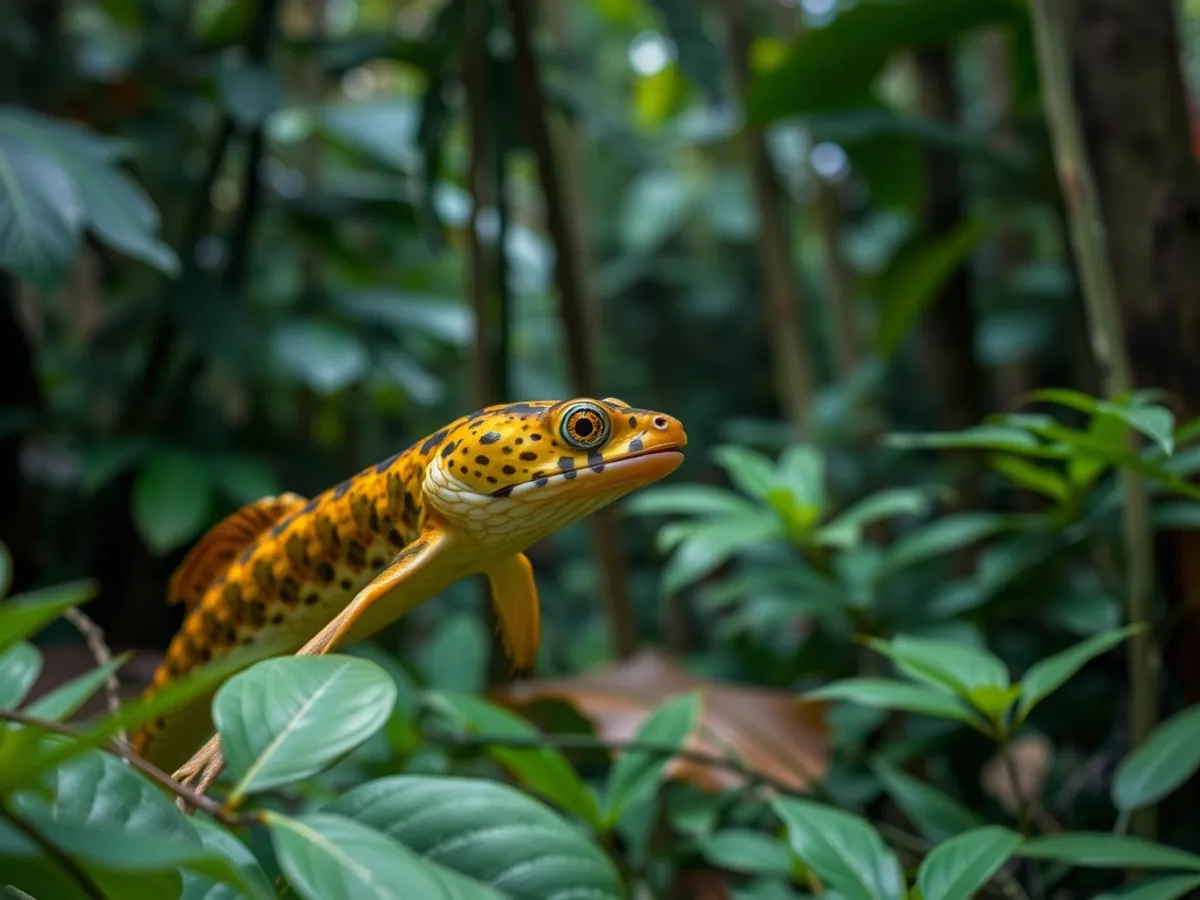
About the Golden lancehead
Bothrops insularis exists on one place on Earth: Ilha da Queimada Grande, a 43-hectare rock about 30 km off Sao Paulo, Brazil, where rising seas cut the island off from the mainland roughly 11,000 years ago. Marooned with no rodents to eat, the snake reorganised itself around migrating birds. Its venom is estimated at three to five times more potent than that of its mainland lancehead relatives, and it kills faster - a mainland pit viper can afford to bite a rat, release it, and track it down, but a bitten bird simply flies away, so the island snake must hold on and kill almost immediately. Adults spend far more time in vegetation than mainland Bothrops, ambushing exhausted migrants such as Elaenia flycatchers. Population density on the island is high but the total population is small and declining, and the species is Critically Endangered, threatened by illegal collecting and by inbreeding: an unusually high proportion of individuals are intersex, with both male and female reproductive features. The Brazilian Navy restricts access to the island, and the persistent story that it holds "one snake per square metre" is a wild exaggeration - estimates are closer to one snake per few square metres in the best habitat, and far lower island-wide.
Fascinating facts
Island Exclusive
The Golden lancehead is found nowhere else on Earth but Ilha da Queimada Grande, a 43-hectare island off the southeastern coast of Brazil.
Lethal Venom
Its venom can cause rapid tissue necrosis and is considered among the most potent of any snake, capable of killing prey almost instantly.
Avian Appetite
Unlike most pit vipers, Golden lanceheads primarily feed on migratory birds that visit the island, a unique adaptation to their isolated environment.
Detailed description
The Golden lancehead (Bothrops insularis) is a medium-sized pit viper, typically reaching lengths of 70–90 cm, with some individuals recorded up to 118 cm. Its body is slender and agile, with a prehensile tail adapted for climbing among the island’s low trees and shrubs. The snake’s coloration ranges from pale yellow to golden brown, often with faint, irregular dorsal blotches, providing effective camouflage against leaf litter and sun-dappled vegetation. The head is distinctly lance-shaped, broad and flat, with large heat-sensing pits between the eyes and nostrils, allowing precise detection of warm-blooded prey. The eyes are relatively large, with vertical pupils adapted for nocturnal and crepuscular activity. Scales are keeled, giving the skin a rough texture. The species is solitary and secretive, spending much of its time coiled in ambush among branches or rocks. Unlike many mainland Bothrops, B. insularis is highly arboreal, reflecting the abundance of avian prey and the scarcity of terrestrial mammals on Ilha da Queimada Grande. Its venom is among the most potent of any Bothrops, rapidly immobilizing birds before they can escape. Reproduction is ovoviviparous, with females giving birth to live young. The population is estimated at 2,000–4,000 individuals, making it one of the world’s rarest snakes.
Did you know?
Ilha da Queimada Grande, the only home of the Golden lancehead, is often called 'Snake Island' and is closed to the public due to the snake's deadly venom.
Research & sources
Wikipedia summary
The golden lancehead is an extremely venomous pit viper species in the subfamily Crotalinae of the family Viperidae. The species is found exclusively on the island of Ilha da Queimada Grande, off the coast of São Paulo state, in Brazil. The common name of the species refers to the light yellowish-brown color of its underside and for its lance-like head shape that is characteristic of the genus Bothrops. No subspecies of B. insularis are recognized as being valid. It is one of the most venomous snakes in Latin America.
Behaviour & social structure
Golden lanceheads are primarily ambush predators, relying on stealth and camouflage to capture prey. They are most active during the late afternoon and night, when birds roost or forage. The snake positions itself on branches or in dense foliage, striking rapidly at passing birds, lizards, or occasionally invertebrates. Feeding is infrequent, with individuals capable of fasting for months during periods of prey scarcity. Social interactions are minimal; individuals are territorial and avoid conspecifics except during the breeding season. Defensive behavior includes rapid strikes and the release of potent venom, but the species generally prefers to flee or remain motionless when threatened. Basking occurs during cooler periods, but the snake avoids prolonged exposure to direct sunlight due to risk of dehydration. There is no evidence of complex social structure or cooperative behavior.
Reproduction & life cycle
Bothrops insularis exhibits a seasonal reproductive cycle, with mating typically occurring in the spring (September–November). Males locate females by following pheromone trails, and courtship involves tongue-flicking and body alignment. Females are ovoviviparous, retaining eggs internally until they hatch. Gestation lasts approximately 5–6 months, after which females give birth to 2–10 live young, each measuring 15–20 cm in length. Neonates are independent at birth and receive no parental care. Sexual maturity is reached at around 4–6 years. Breeding frequency is low, with many females reproducing only every second or third year, likely due to the energetic demands of gestation and limited food availability.
Adaptations & survival
The Golden lancehead has evolved several unique adaptations to its insular environment. Its potent, fast-acting venom is specialized for subduing birds, which are more likely to escape after envenomation than terrestrial prey. The prehensile tail and slender body facilitate arboreal hunting, while cryptic coloration aids in both ambush predation and predator avoidance. Heat-sensitive loreal pits enable detection of endothermic prey even in low light. The species’ metabolic rate is relatively low, allowing survival during periods of prey scarcity. Evolutionary isolation has led to reduced genetic diversity, but also to the development of unique venom components not found in mainland relatives.
Cultural significance
The Golden lancehead is the subject of local legends and international fascination, often portrayed as one of the world’s deadliest snakes. Its reputation has contributed to myths about Ilha da Queimada Grande being 'Snake Island,' a forbidden and dangerous place. While there is no evidence of traditional medicinal or ritual use, the species is highly valued by herpetologists and toxinologists for its unique venom, which is being studied for potential pharmaceutical applications, including anticoagulants. The snake’s rarity and mystique have also made it a target for illegal collectors.
Recent research
Recent research has focused on the molecular composition of B. insularis venom, revealing novel toxins with potential biomedical applications, such as inhibitors of blood clotting and antimicrobial peptides. Genetic studies highlight the effects of long-term isolation, including reduced heterozygosity and signs of inbreeding depression. Ongoing ecological monitoring tracks population trends and reproductive success, informing conservation management. Captive breeding programs have been initiated in Brazilian institutions to safeguard against extinction. Studies of the snake’s diet confirm a strong reliance on migratory and resident birds, with occasional predation on lizards. The species is also used as a model for understanding rapid evolutionary adaptation in insular reptiles.
Sources
Natural history and venom composition of Bothrops insularis (Serpentes: Viperidae), an endemic and threatened snake from Brazil
Marques, O.A.V., Martins, M., Sazima, I. (2002)
scientificVideos
Habitat
Tropical island forest

Conservation
The Golden lancehead is currently classified as Critically Endangered on the IUCN Red List.
Threats & challenges
The Golden lancehead faces multiple threats, primarily due to its extremely restricted range—Ilha da Queimada Grande is less than 43 hectares in size. Habitat degradation from invasive plant species, accidental fires, and climate change pose significant risks. Illegal wildlife trade, driven by the snake’s rarity and scientific interest in its venom, has led to poaching despite strict protection. The small, isolated population is vulnerable to genetic bottlenecks, disease outbreaks, and stochastic events such as storms. Human visitation is tightly controlled by the Brazilian government, but unauthorized access remains a concern. Conservation efforts focus on habitat protection, population monitoring, and research into captive breeding as a potential safeguard.
Taxonomy
Scientific name
Bothrops insularis
- Kingdom
- Animalia
- Phylum
- Chordata
- Class
- Reptilia
- Order
- Squamata
- Family
- Viperidae
- Genus
- Bothrops
- Species
- insularis
Community notes
Share your observations about the Golden lancehead.
No community notes yet. Be the first!
Discover more wildlife
More fascinating animals from the encyclopedia.