
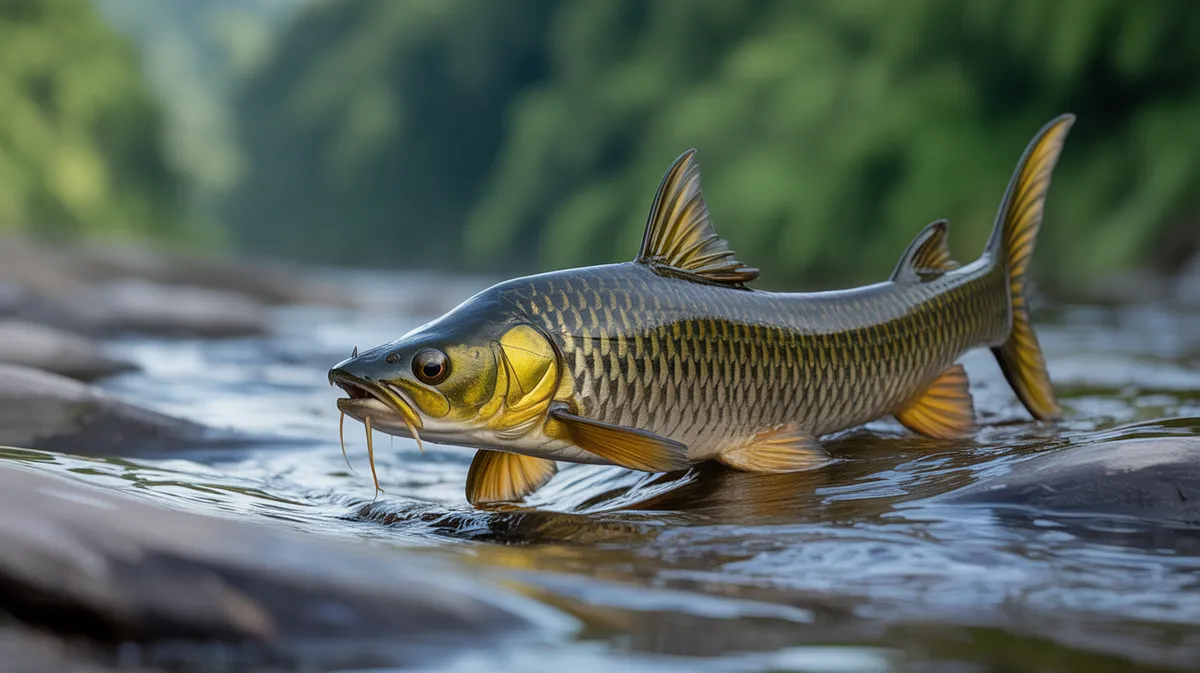
About the Golden Mahseer
The Golden Mahseer is a large, iconic freshwater fish native to the rivers and streams of the Himalayan region and South Asia. Renowned for its golden-bronze scales, powerful build, and impressive size, it is highly prized by anglers and revered in local cultures. This species thrives in fast-flowing, clear, and oxygen-rich mountain rivers, often migrating upstream during spawning seasons. Unfortunately, habitat degradation, overfishing, and river damming have placed significant pressure on its populations. Conservation efforts are underway to protect this keystone species and its freshwater ecosystems.
Fascinating facts
Mountain River Dweller
Golden Mahseer inhabit cold, clear, and well-oxygenated rivers in the Himalayan foothills and are sensitive to changes in water quality.
Impressive Size
This species can reach lengths of over 2 meters (6.5 feet) and weigh more than 50 kg (110 lbs), making it a true freshwater giant.
Angler’s Trophy
The Golden Mahseer is highly sought after in sport fishing circles for its strength and challenging fight, earning legendary status among anglers.
Detailed description
The Golden Mahseer (Tor putitora) is one of the largest cyprinid fishes, reaching lengths of up to 2.75 meters (9 feet) and weights exceeding 54 kg (119 lbs), though most individuals are considerably smaller. Its body is robust and elongated, covered with large, metallic golden to bronze scales that provide both camouflage and a striking appearance. The head is broad with a slightly subterminal mouth equipped with thick, fleshy lips and two pairs of barbels, adaptations for foraging in fast-flowing waters. The dorsal fin is well-developed, aiding in stability during powerful upstream swims. Golden Mahseer are highly migratory, moving long distances to reach suitable spawning grounds. They are primarily diurnal, actively foraging during daylight hours. Socially, juveniles often form loose schools, while adults may be more solitary or aggregate in small groups, especially during migration and spawning. Their diet is omnivorous, consisting of aquatic insects, crustaceans, mollusks, small fish, plant matter, and fruits that fall into the water. As a keystone species, they play a crucial role in nutrient cycling and maintaining the ecological balance of Himalayan river systems.
Did you know?
Golden Mahseer can grow over 2 meters in length, making them one of the largest freshwater fish species in the world.
Research & sources
Wikipedia summary
Tor putitora, the golden mahseer, putitor mahseer, or Himalayan mahseer, is an endangered species of cyprinid fish that is found in rapid streams, riverine pools, and lakes in the Himalayan region. Its native range is within the basins of the Indus, Ganges and Brahmaputra rivers. It was reported to be found in the Salween river, the natural border between Thailand and Myanmar as well, but observations of it have been very rare, having only been observed three times in 28 years.
Behaviour & social structure
Golden Mahseer exhibit complex behavioral patterns, especially related to their migratory and feeding habits. They are known for their strong swimming ability, often navigating turbulent rapids and waterfalls during seasonal migrations. Feeding occurs mainly in the early morning and late afternoon, with individuals foraging along riverbeds and banks for invertebrates, small fish, and plant material. They use their sensitive barbels to detect prey in murky or fast-moving water. During non-breeding periods, mahseer may establish home ranges, but these are abandoned during spawning migrations. Social interactions are most notable among juveniles, which form schools for protection, while adults are generally more territorial except during spawning runs. Aggressive displays, such as lateral displays and chasing, may occur when competing for food or spawning sites.
Reproduction & life cycle
Golden Mahseer are potamodromous, undertaking long upstream migrations to spawn in shallow, gravelly stretches of rivers during the pre-monsoon and monsoon seasons (typically April–September, varying by region). Spawning is triggered by increased water flow and temperature changes. Females lay thousands to tens of thousands of adhesive eggs in shallow riffles, which are externally fertilized by males. There is no parental care after spawning; eggs are left to develop in the substrate. Incubation lasts 3–7 days depending on water temperature. Larvae are initially planktonic, drifting downstream before settling in calmer waters. Sexual maturity is reached at 4–6 years of age, with larger individuals producing more eggs. The species' reproductive success is highly dependent on unimpeded river connectivity and suitable spawning habitats.
Adaptations & survival
Golden Mahseer possess several adaptations for life in fast-flowing, oxygen-rich mountain rivers. Their streamlined, muscular bodies and large, forked tails provide powerful propulsion against strong currents. The thick lips and sensitive barbels are specialized for bottom-feeding and detecting prey in turbid water. Their scales are large and reflective, offering both protection and camouflage among rocks and sunlight-dappled waters. Physiologically, they are tolerant of wide temperature ranges (5–30°C), allowing survival in both cold headwaters and warmer downstream reaches. Migratory behavior enables them to exploit seasonal resources and avoid adverse conditions. Their omnivorous diet is an evolutionary advantage, allowing flexibility in food availability.
Cultural significance
The Golden Mahseer holds immense cultural and economic significance across the Himalayan region. It is revered in Hindu mythology as a sacred fish and is often associated with purity and abundance. In several Indian states, it is considered a state fish and features in local folklore and rituals. The species is highly prized by recreational anglers for its size and fighting ability, contributing to eco-tourism and local livelihoods. Traditional fishing communities have developed sustainable harvest practices and taboos around catching spawning adults, though these are eroding with modernization. Its decline is seen as a loss of both natural heritage and cultural identity in many riverine societies.
Recent research
Recent research has focused on the genetic diversity of Golden Mahseer populations, revealing significant fragmentation and inbreeding in isolated river systems. Conservation hatcheries have been established in India and Nepal to breed and release juveniles, but concerns remain about genetic homogenization and adaptation to wild conditions. Telemetry studies have provided new insights into migration routes, habitat preferences, and the impacts of barriers like dams. Ecological research has highlighted the species' role in seed dispersal, as mahseer consume and excrete seeds of riparian plants, aiding forest regeneration. Ongoing studies are assessing the impacts of climate change on spawning phenology and riverine ecosystem health. There is increasing interest in community-based conservation and river restoration to support wild populations.
Videos
Habitat
Fast-flowing rivers and streams in mountainous regions


Conservation
The Golden Mahseer is currently classified as Endangered on the IUCN Red List.
Threats & challenges
The Golden Mahseer faces multiple threats, primarily from habitat fragmentation due to dam construction, water abstraction, and river channel modification, which disrupt migratory routes and spawning grounds. Overfishing, both for subsistence and sport, has led to significant population declines, especially of large, breeding adults. Pollution from agricultural runoff, urban waste, and mining degrades water quality and affects egg and larval survival. Invasive species, such as non-native fish, compete for resources and introduce diseases. Climate change poses additional risks by altering river flows and temperature regimes. Despite legal protections in some regions, enforcement is often weak, and illegal fishing persists. The IUCN lists the species as Endangered, with fragmented and declining populations throughout its range.
Taxonomy
Scientific name
Tor putitora
- Kingdom
- Animalia
- Phylum
- Chordata
- Class
- Actinopterygii
- Order
- Cypriniformes
- Family
- Cyprinidae
- Genus
- Tor
- Species
- putitora
Community notes
Share your observations about the Golden Mahseer.
No community notes yet. Be the first!
Discover more wildlife
More fascinating animals from the encyclopedia.