
About the Golden Tortoise Beetle
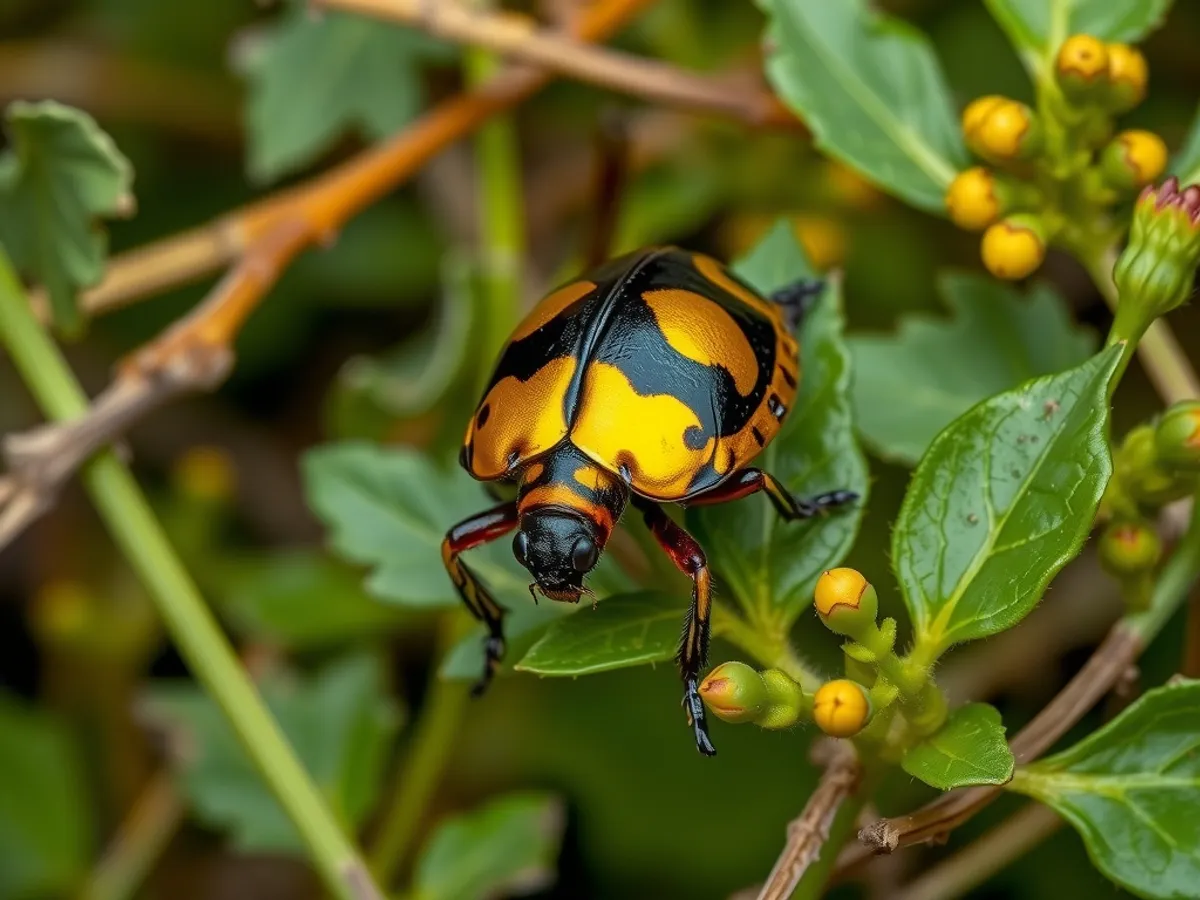
Charidotella sexpunctata is a small North American leaf beetle that looks like a drop of liquid gold pressed onto a bindweed leaf, and its metal shine is not pigment at all. The elytra are transparent, and beneath them lie layers of tissue holding minute fluid-filled channels; when the layers are hydrated they act as a stack of reflectors that bounce back gold. Disturb the beetle, or handle it, and it drains fluid from those layers, the stack collapses, and the gold fades within a minute or two to a matte reddish-orange - revealing red spots that make it look convincingly like a ladybird, which many predators avoid. The colour returns when the beetle calms and rehydrates the layers. Mating and dying beetles also lose the shine, which is why museum specimens are always dull orange and never gold. The larva is stranger still: it carries a "fecal shield", a parasol of shed skins and its own droppings held over the back on a forked tail-like structure, which it can flip forward to fend off ants and predatory bugs, and which is chemically defended by compounds from its bindweed and morning glory diet.
Fascinating facts
Color Shifter
The beetle's golden appearance can quickly change to reddish-brown when it is disturbed, thanks to fluid movement beneath its transparent shell.
Host Plant Specialist
Golden Tortoise Beetles primarily feed on plants in the morning glory and sweet potato families, both as larvae and adults.
Unique Larval Defense
Larvae create a defensive shield by carrying shed skins and fecal matter on their backs, deterring predators such as ants.
Detailed description
The Golden Tortoise Beetle (Charidotella sexpunctata) is a small chrysomelid beetle, typically measuring 5–7 mm in length. Its most striking feature is its transparent, domed elytra and pronotum, which overlay a metallic gold coloration that can shift to reddish or bronze hues when the beetle is agitated or after death, due to changes in fluid distribution beneath the cuticle. The body is broadly oval and flattened, with the elytra and pronotum extending beyond the edges of the abdomen and head, creating a shield-like appearance reminiscent of a tortoise shell. The ventral side is usually a pale yellow or brown. The beetle's legs and antennae are relatively short and adapted for clinging to the undersides of leaves. Larvae are spiny and carry exuviae and fecal shields on their backs, a unique defensive adaptation. Adults and larvae are commonly found on plants in the Convolvulaceae family, especially morning glories (Ipomoea spp.) and sweet potatoes (Ipomoea batatas), where they feed on foliage. The beetle is primarily diurnal and is most active during warm, sunny periods. Its cryptic coloration and ability to change color serve as both camouflage and a deterrent to predators. The species is distributed widely across eastern North America, from southern Canada to northern South America.
Did you know?
The golden color of this beetle fades to dull brown or red when it is handled or dies, due to changes in fluid beneath its transparent cuticle.
Research & sources
Behaviour & social structure
Golden Tortoise Beetles are solitary for most of their life cycle, although aggregations may occur on host plants when food is abundant. Adults are slow-moving and rely on their cryptic coloration and the ability to clamp tightly to leaves as primary defenses against predators. When threatened, they retract their legs and antennae beneath the elytra and pronotum, forming a tight, impenetrable shield. Feeding occurs primarily on the undersides of leaves, where adults and larvae scrape away the leaf surface, creating characteristic irregular holes or 'windowpane' damage. Larvae exhibit a unique behavior of constructing and carrying a fecal shield, composed of excrement and shed skins, which is held over their bodies using a forked anal structure; this shield deters predators and parasitoids. Adults are capable of short flights but are more often found walking between feeding sites. Both life stages are most active during the day, with feeding and mating activity peaking in the morning and late afternoon.
Reproduction & life cycle
Reproduction in Charidotella sexpunctata typically occurs from late spring through early autumn, depending on local climate. Mating involves a brief courtship, with males mounting females and engaging in copulation that can last several minutes. Females lay clusters of 10–30 yellowish, oval eggs on the undersides of host plant leaves, often near feeding sites. The incubation period ranges from 5 to 10 days, after which larvae emerge and begin feeding immediately. Larval development proceeds through four instars over 2–3 weeks, during which larvae construct and maintain their fecal shields. Pupation occurs on the host plant, with the pupa attached to the leaf surface; the pupal stage lasts 5–10 days. There may be two or more generations per year in warmer regions. Parental care is absent, and survival relies on rapid development and effective anti-predator adaptations.
Adaptations & survival
The Golden Tortoise Beetle exhibits several remarkable adaptations. Its metallic coloration is produced by multilayered cuticular structures that manipulate light, creating a gold appearance that can shift to red or brown by altering fluid content beneath the cuticle—a rapid, reversible process that confuses predators. The transparent margins of the elytra and pronotum enhance camouflage by blending with the leaf surface. The larval fecal shield is a unique evolutionary adaptation, providing both physical and chemical deterrence against predators and parasitoids. The beetle's flattened, shield-like body allows it to clamp tightly to leaves, making it difficult for birds or insects to dislodge. Additionally, the species' ability to exploit a range of host plants within the Convolvulaceae family increases its ecological flexibility.
Cultural significance
The Golden Tortoise Beetle has attracted attention for its striking appearance and color-changing abilities, making it a subject of fascination among naturalists and entomologists. It is sometimes featured in educational materials and insect collections to illustrate structural coloration and insect defenses. While it does not have a prominent role in folklore or mythology, its beauty has inspired artistic depictions and jewelry designs. In some regions, gardeners may view it as a minor pest of ornamental morning glories and sweet potatoes, but it is rarely of economic concern.
Recent research
Recent research has focused on the beetle's structural coloration, with studies using electron microscopy to elucidate the multilayered cuticle responsible for its gold appearance and rapid color change. Investigations into larval fecal shield construction have revealed its effectiveness in deterring both vertebrate and invertebrate predators, as well as parasitoid wasps. Molecular phylogenetic studies have clarified the beetle's relationships within the Cassidinae subfamily. Ongoing research is examining the potential impacts of climate change on its range and host plant associations, as well as the chemical composition of defensive secretions in both larvae and adults.
Sources
Coloration Mechanisms and Defensive Strategies in the Golden Tortoise Beetle (Charidotella sexpunctata)
Hinton, H.E. & Cassidinae Research Group (2016)
scientificDefensive Fecal Shields of Cassidinae Larvae: Structure, Function, and Evolution
Vencl, F.V. et al. (2009)
scientificBiology and Defensive Behavior of the Golden Tortoise Beetle, Charidotella sexpunctata
Olmstead, K.L. & Denno, R.F. (1992)
scientificStructural Coloration and Color Change in the Golden Tortoise Beetle
Srinivasarao, M. et al. (2001)
scientificStructural Coloration and Color Change in the Golden Tortoise Beetle Charidotella sexpunctata
K. S. Siddique et al., Journal of the Royal Society Interface (2015)
scientificVideos
Habitat
Forests, gardens, and fields with host plants
 Various Continental Regions
Grassland
Open areas dominated by grasses rather than trees, supporting numerous herbivores and their predators.
 Global
Forest
Wooded areas with significant tree cover and diverse plant and animal communities.
 Global
Freshwater
Lakes, rivers, and wetlands with diverse aquatic ecosystems.
Conservation
The Golden Tortoise Beetle is currently classified as Least Concern on the IUCN Red List.
Threats & challenges
Currently, Charidotella sexpunctata is not considered threatened and is classified as Least Concern. Its populations are stable across most of its range, largely due to its adaptability and wide host plant availability. However, localized threats include habitat loss from agricultural expansion, pesticide use in crop fields (especially sweet potato cultivation), and climate change, which may alter the distribution of host plants. Natural enemies include predatory insects, birds, and parasitoid wasps, particularly those that attack larvae. Despite these pressures, the beetle's effective camouflage and larval defenses have contributed to its resilience. No significant population declines have been documented, and it is not a major pest species.
Taxonomy
Scientific name
Charidotella sexpunctata
- Kingdom
- Animalia
- Phylum
- Arthropoda
- Class
- Insecta
- Order
- Coleoptera
- Family
- Chrysomelidae
- Genus
- Charidotella
- Species
- sexpunctata
Community notes
Share your observations about the Golden Tortoise Beetle.
No community notes yet. Be the first!
Discover more wildlife
More fascinating animals from the encyclopedia.