
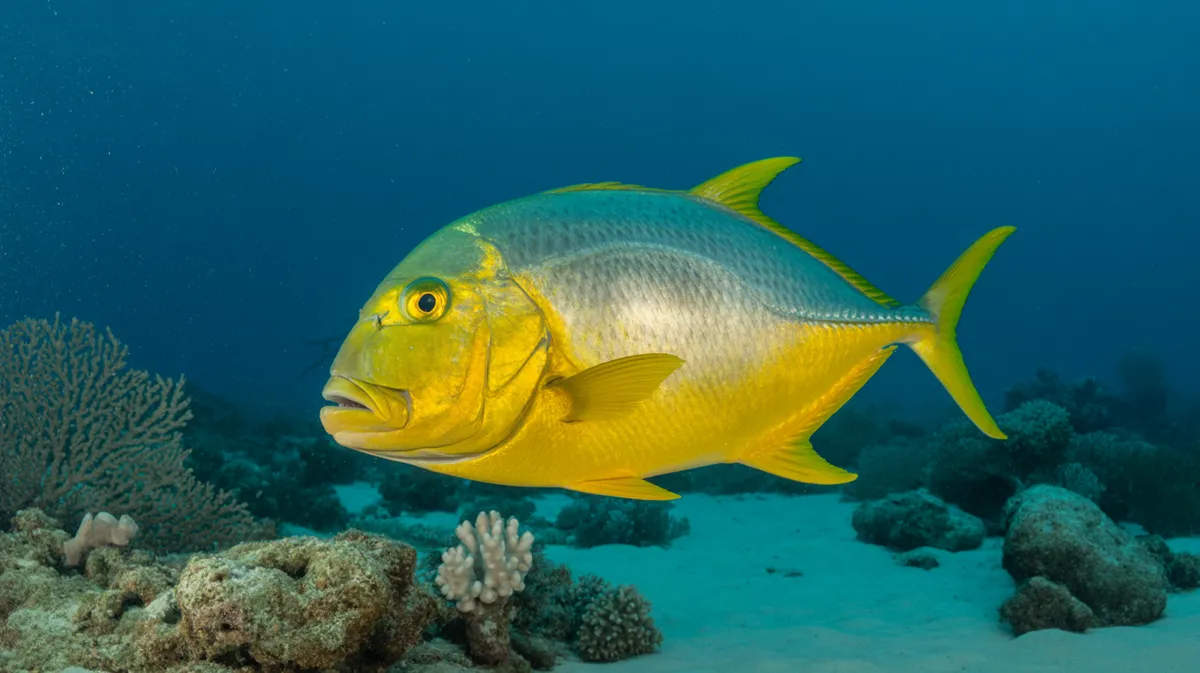
About the Golden Trevally
The Golden Trevally is a striking marine fish recognized by its bright golden-yellow body adorned with distinctive black vertical bars, especially prominent in juveniles. It is a fast-swimming, schooling species commonly found in shallow coastal waters, lagoons, and around reefs across the Indo-Pacific region. Golden Trevallies are opportunistic carnivores, feeding on small crustaceans, mollusks, and fish by using their protrusible mouths to suck prey from the sand or crevices. The species is also notable for its association with larger marine animals, such as sharks, which juveniles often follow closely for protection. Prized in both commercial and recreational fisheries, the Golden Trevally is a resilient and adaptable species.
Fascinating facts
Colorful Transformation
Golden Trevally juveniles are a brilliant gold with bold black stripes, but adults become more silvery with fading stripes as they age.
Unique Feeding Technique
This species uses its highly protrusible mouth to suck out prey from sand, mud, or reef crevices, making it an effective hunter of hidden creatures.
Unusual Companions
Young Golden Trevallies are often seen swimming with large fish, rays, or sharks for protection, sometimes even following scuba divers.
Detailed description
The Golden Trevally (Gnathanodon speciosus) is a robust, deep-bodied carangid fish, reaching up to 120 cm in length and weighing as much as 15 kg, though individuals more commonly measure 50–80 cm. Its most distinctive anatomical feature is its thick, fleshy, highly protractile lips, which are specialized for suction feeding. The body is laterally compressed with a steep, rounded forehead and a forked caudal fin, facilitating agile swimming. Juveniles display a brilliant golden-yellow coloration with 7–11 bold black vertical bars, which fade as the fish matures, leaving adults with a more uniform golden to silvery hue. The dorsal fin is divided into two sections, with the first being spiny and the second soft-rayed, while the anal fin mirrors the soft dorsal fin in shape. The species has small, cycloid scales and a lateral line with a moderate anterior curve. Golden Trevallies are known for their schooling behavior, especially as juveniles, often forming tight groups that follow larger marine animals for protection. Adults are more solitary or form loose aggregations, particularly during spawning events. Their diet is highly varied, consisting of benthic invertebrates and small fishes, which they extract from sand or crevices using their protrusible jaws. The species inhabits a range of coastal environments, from sandy lagoons and seagrass beds to coral reefs, and can tolerate a wide range of salinities, occasionally entering estuaries. They are fast-growing, resilient, and highly adaptable, contributing to their wide distribution across the Indo-Pacific.
Did you know?
Golden Trevally juveniles are so bold that they sometimes approach divers, mistaking them for large marine animals to follow for protection.
Research & sources
Wikipedia summary
The golden trevally, also known as the golden kingfish, banded trevally or king trevally, is a species of large marine fish classified in the jack and horse mackerel family Carangidae, and the only member of the monospecific genus Gnathanodon. The golden trevally is widely distributed throughout the tropical and subtropical waters of the Indian and Pacific Oceans, ranging from South Africa in the west to Central America in the east, extending to Japan in the north and Australia in the south. The species predominantly occupies inshore waters where it inhabits both reef and sandy substrates. The golden trevally is easily distinguished from its relatives by its fleshy, rubbery lips and unique colouration, which ranges from bright yellow with black bars as a juvenile to a golden-silvery colour as an adult. It is known to grow to 120 centimetres (47 in) in length and 15 kilograms (33 lb) in weight. The golden trevally schools as a juvenile, often closely following larger objects including sharks and jellyfish. The species uses its protractile jaws to suck out prey from the sand or reef, and consumes a variety of fish, crustaceans and molluscs. Spawning aggregations gather at night at different times of the year throughout its range. The golden trevally is a considerable constituent of several Middle Eastern fisheries and being of minor importance to many others, with a worldwide annual catch of 1,187 metric tons to 3,475 metric tons recorded between 2000 and 2010. The golden trevally is a popular gamefish, taken by bait, lure, fly and also spear throughout its range. Several Asian countries currently farm the fish in caged aquaculture. Due to their brilliant colouration, juveniles are popular in marine aquaria.
Behaviour & social structure
Golden Trevallies exhibit pronounced ontogenetic shifts in behavior. Juveniles are highly gregarious, forming dense schools that often shadow larger marine animals such as sharks, groupers, rays, and even turtles—a behavior thought to provide protection from predators and possibly aid in foraging by disturbing prey. As they mature, individuals become increasingly solitary or form smaller, less cohesive groups. Their feeding behavior is characterized by active foraging over sandy and reef substrates; they use their protractile mouths to create a powerful suction, extracting prey such as crustaceans (crabs, shrimps), polychaete worms, mollusks, and small fishes from the substrate. Golden Trevallies are diurnal, with peak activity during daylight hours, and may rest in deeper waters or near reef structures at night. They are opportunistic feeders and may follow trawlers or other disturbances to exploit dislodged prey. Social interactions are generally peaceful, but competition for food can occur, particularly in dense schools or during spawning aggregations.
Reproduction & life cycle
Golden Trevallies are oviparous, with external fertilization. Spawning typically occurs in large aggregations at night, often on the outer edges of reefs or over sandy substrates, and is synchronized with lunar cycles in some regions. Breeding seasons vary geographically but generally coincide with warmer months; for example, spawning peaks from October to March in Australian waters. Females are highly fecund, releasing hundreds of thousands to several million pelagic eggs per spawning event. The eggs are buoyant and hatch within 24–48 hours, depending on water temperature. There is no parental care; larvae are planktonic and undergo several developmental stages before settling in shallow nursery habitats such as lagoons or estuaries. Juveniles grow rapidly, reaching sexual maturity at around 2–3 years of age and approximately 35–45 cm in length.
Adaptations & survival
Golden Trevallies possess several notable adaptations. Their thick, protrusible lips and highly extensible jaws are specialized for suction feeding, allowing them to extract prey from sand, mud, or crevices with remarkable efficiency. The bright coloration and vertical barring of juveniles provide disruptive camouflage among sunlit shallow waters and may also serve as a social signal within schools. Their streamlined, laterally compressed bodies and deeply forked tails enable fast, sustained swimming, aiding both in predator avoidance and in covering large distances while foraging. The species’ ability to tolerate a range of salinities and habitats, including estuaries and turbid waters, enhances its ecological flexibility. Schooling behavior in juveniles reduces predation risk and may increase foraging success, while the tendency to follow large animals may provide both protection and feeding opportunities.
Cultural significance
The Golden Trevally holds considerable value in recreational fisheries across the Indo-Pacific, prized for its fighting ability and striking appearance. In some Middle Eastern and Southeast Asian countries, it is an important food fish, sold fresh or salted in local markets. Juveniles are popular in the marine aquarium trade due to their vivid coloration, although their large adult size makes them unsuitable for most home aquaria. In traditional Hawaiian culture, trevallies (known locally as ulua) are featured in folklore and are considered symbols of strength and agility, though the Golden Trevally is less prominent than some congeners. The species is also featured in ecotourism, with divers and snorkelers seeking encounters with large schools in tropical reefs.
Recent research
Recent research on Gnathanodon speciosus has focused on its aquaculture potential, with studies examining optimal diets, growth rates, and disease resistance in captive settings. Genetic analyses have clarified its phylogenetic position as the sole member of its genus, distinct from other carangids. Tagging and telemetry studies have provided insights into movement patterns, habitat use, and site fidelity, revealing that adults may undertake seasonal migrations linked to spawning. Stable isotope and stomach content analyses have expanded understanding of its trophic ecology, highlighting its role as a mesopredator in coastal ecosystems. Ongoing research is investigating the impacts of habitat degradation and climate change on recruitment and population dynamics.
Sources
Gnathanodon speciosus (Golden Trevally): Biology, Ecology, and Fisheries
Smith-Vaniz, W.F. & Williams, I. (2016)
scientificFeeding ecology and habitat use of juvenile golden trevally (Gnathanodon speciosus) in tropical estuaries
Sheaves, M. & Molony, B. (2000)
scientificVideos
Habitat
Shallow coastal waters, lagoons, and coral reefs

Conservation
The Golden Trevally is currently classified as Least Concern on the IUCN Red List.
Threats & challenges
Currently assessed as Least Concern by the IUCN, the Golden Trevally faces localized threats from overfishing, particularly in parts of the Middle East and Southeast Asia where it is targeted for both commercial and recreational purposes. Habitat degradation, especially of coastal nurseries such as mangroves and seagrass beds, poses a potential long-term threat. Bycatch in trawl and gillnet fisheries can also impact populations. However, the species’ wide distribution, high fecundity, rapid growth, and adaptability have so far buffered it against significant declines. Aquaculture is expanding in several Asian countries, which may alleviate some fishing pressure but also introduces concerns about genetic diversity and disease transmission. Climate change, with associated impacts on coral reefs and coastal habitats, represents an emerging challenge that may affect recruitment and distribution in the future.
Taxonomy
Scientific name
Gnathanodon speciosus
- Kingdom
- Animalia
- Phylum
- Chordata
- Class
- Actinopterygii
- Order
- Carangiformes
- Family
- Carangidae
- Genus
- Gnathanodon
- Species
- speciosus
Where to see a golden trevally
1 zoo and aquarium in 1 country are recorded as keeping this species.

Community notes
Share your observations about the Golden Trevally.
No community notes yet. Be the first!
Discover more wildlife
More fascinating animals from the encyclopedia.