
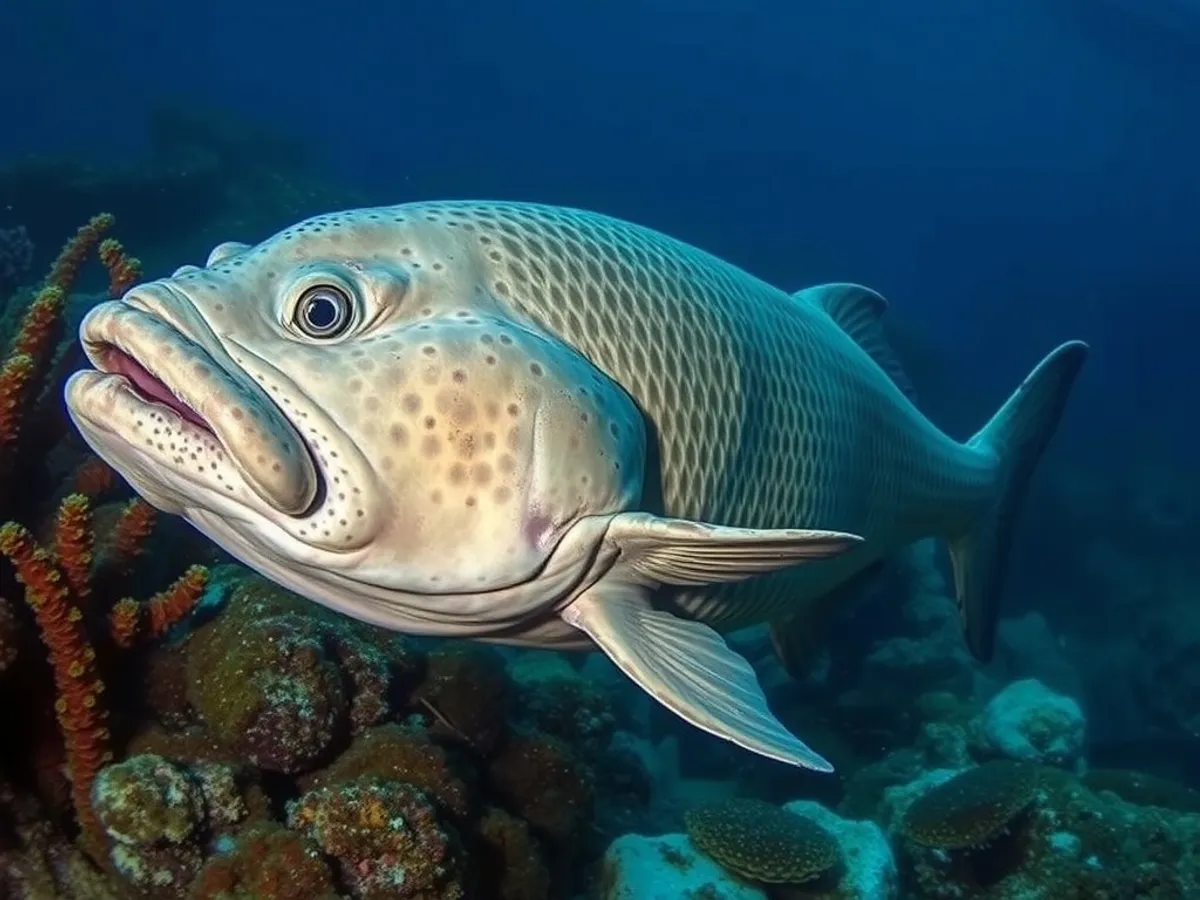
About the Goliath grouper
Epinephelus itajara, the Atlantic goliath grouper, grows to about 2.5 m and 360 kg, making it the largest grouper in the Atlantic, and it holds territory around wrecks, ledges and mangrove roots rather than roaming. It does not chase prey so much as inhale it: the fish flares its enormous gill covers and drops its jaw, generating a suction gulp that pulls in crabs, stingrays and fish in a fraction of a second. When threatened - and goliaths readily confront divers and steal speared fish - it produces a low, chest-thumping boom by contracting muscles against its swim bladder, a sound audible and physically felt from tens of metres away. Juveniles depend almost entirely on mangrove creeks in southwest Florida for their first five or six years, which ties the adult population directly to coastal wetland health. Because the fish are long-lived, slow to mature, and gather in predictable spawning aggregations that are trivially easy to fish out, they were driven to near-collapse and the US closed the fishery completely in 1990. Numbers rebounded strongly in Florida over the following three decades, and a limited, tightly restricted harvest was reintroduced in 2023 - a decision that remains contested among scientists.
Fascinating facts
True Giant
The Goliath grouper is among the largest bony fish in the Atlantic, with individuals exceeding 2.5 meters in length and 360 kilograms in weight.
Habitat Specialist
This species prefers shallow waters near coral reefs, mangroves, and shipwrecks, where it can find shelter and ambush prey.
Booming Calls
Goliath groupers produce deep, resonant booming sounds using their swim bladders, which can be heard underwater and are used to communicate or ward off intruders.
Detailed description
The Atlantic goliath grouper (Epinephelus itajara) is a colossal marine fish, reaching lengths up to 2.5 meters (8.2 feet) and weights exceeding 360 kg (790 lbs), making it one of the largest bony fishes in the Atlantic. Its robust, elongated body is covered in small, rough scales and displays a mottled pattern of brown, yellow, and greenish hues, providing effective camouflage among reefs and mangroves. The head is broad and rounded, with a wide mouth lined with villiform teeth adapted for grasping large prey. Notably, the dorsal fin is continuous with a spiny anterior portion, and the pectoral and caudal fins are rounded, aiding in maneuverability in tight reef spaces. Goliath groupers possess a swim bladder that enables them to produce low-frequency 'booming' sounds, used in territorial displays and possibly communication. These fish are typically solitary, occupying home ranges centered around reef structures, shipwrecks, or submerged logs. Their slow growth rate and late sexual maturity (typically 5-8 years) make them particularly vulnerable to overexploitation. Despite their size, they are generally non-aggressive toward humans. Their ecological role as apex predators helps regulate populations of smaller fish and invertebrates, contributing to reef health and balance.
Did you know?
Goliath groupers can sometimes be seen 'gulp-feeding' on entire small sharks, demonstrating their impressive predatory power.
Research & sources
Wikipedia summary
Goliath grouper can refer to:Atlantic goliath grouper, Atlantic Ocean, including the Caribbean Pacific goliath grouper, East Pacific
Behaviour & social structure
Goliath groupers are primarily sedentary ambush predators, spending much of the day resting in caves, under ledges, or within shipwrecks. They exhibit site fidelity, often remaining within a specific territory for extended periods. Their hunting strategy involves slow, deliberate movements followed by rapid suction feeding, engulfing prey such as crustaceans (crabs, lobsters), fish, octopuses, and occasionally small sharks. Feeding typically occurs during dawn and dusk (crepuscular activity), although they may opportunistically feed at any time. Social interactions are limited outside of the spawning season, but juveniles may aggregate in mangrove habitats for protection. Adults communicate and defend territory using deep, resonant vocalizations produced by vibrating their swim bladders. These sounds can be heard by divers and are believed to play a role in both deterrence and mate attraction.
Reproduction & life cycle
Goliath groupers are protogynous hermaphrodites, meaning individuals first mature as females and may later transition to males, although the precise mechanisms and triggers for sex change remain under study. Spawning occurs in large aggregations at specific sites, typically during the summer months (July to September) in the Western Atlantic. These aggregations can consist of dozens to over a hundred individuals. Fertilization is external, with females releasing millions of eggs into the water column, where males simultaneously release sperm. The pelagic eggs hatch within 30-40 hours, and larvae drift with currents before settling in shallow mangrove habitats, which serve as critical nursery grounds. There is no parental care post-spawning. Sexual maturity is reached at approximately 5-8 years of age, with females maturing at smaller sizes than males.
Adaptations & survival
Goliath groupers exhibit several adaptations for survival in complex coastal ecosystems. Their cryptic coloration and robust bodies allow them to blend seamlessly into reef and mangrove environments, avoiding predation and ambushing prey. The large mouth and powerful jaws enable them to swallow prey whole, while the villiform teeth prevent escape. Their swim bladder not only aids in buoyancy control but also functions as a resonating chamber for sound production, facilitating communication and territorial defense. Juveniles possess a higher tolerance for low salinity, allowing them to exploit mangrove and estuarine nursery habitats less accessible to many predators. The species' slow metabolism and sedentary lifestyle reduce energy requirements, enabling survival in resource-scarce environments.
Cultural significance
Goliath groupers have long captured the imagination of coastal communities, featuring in local folklore as 'giant sea monsters' or 'jewfish.' Historically, their meat was prized for its mild flavor, and their large size made them a sought-after trophy in recreational fisheries. However, concerns about mercury accumulation and conservation status have reduced their consumption. In some Caribbean and Latin American cultures, goliath groupers are associated with traditional fishing practices and are occasionally depicted in art and storytelling. Their presence on reefs is now valued for ecotourism, with divers seeking encounters with these gentle giants.
Recent research
Recent research has focused on population genetics, revealing limited gene flow between regional populations, which underscores the importance of localized conservation efforts. Acoustic telemetry studies have mapped home ranges and spawning aggregation sites, informing management strategies. Ongoing research is investigating the impacts of climate change and red tide events on goliath grouper health and distribution. Studies on their reproductive biology, including sex change mechanisms and larval dispersal, are critical for understanding population dynamics and recovery potential. There is also interest in the ecological role of goliath groupers as keystone predators and their influence on reef community structure.
Videos
Habitat
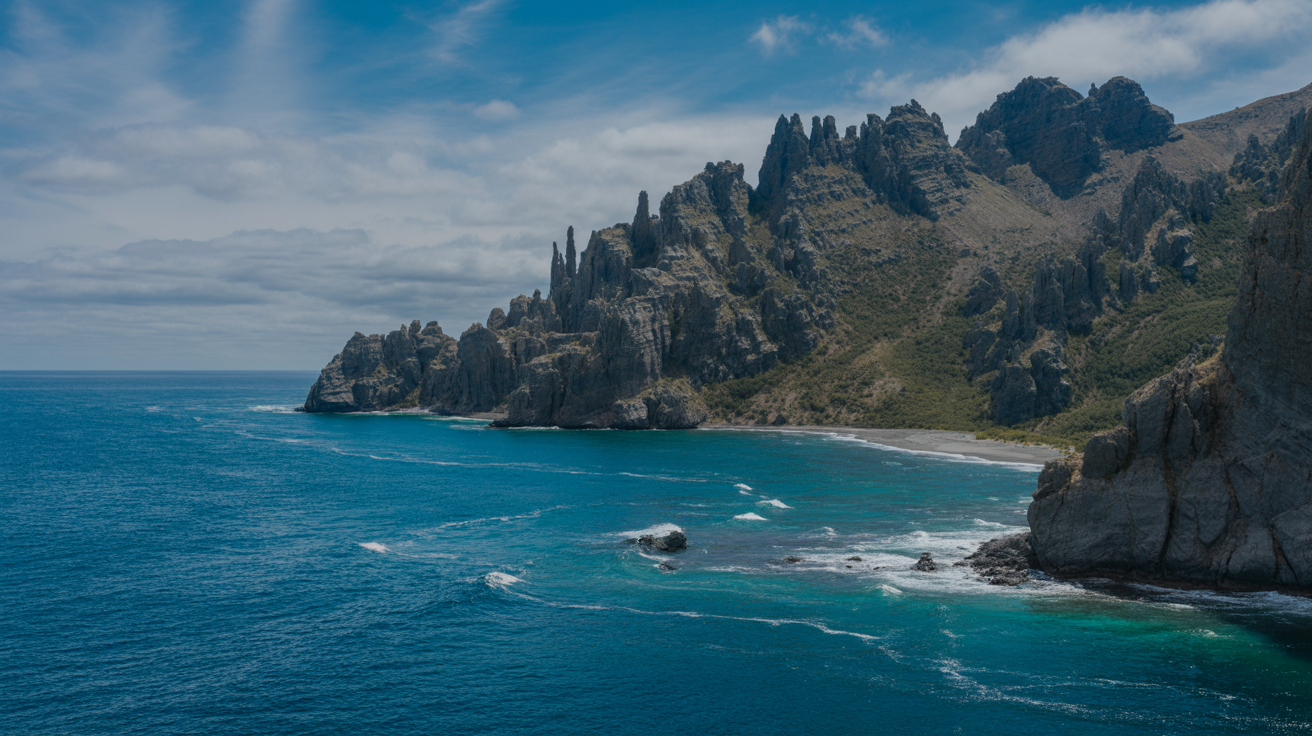
Shallow tropical and subtropical coastal waters, coral reefs, and mangroves
Conservation
The Goliath grouper is currently classified as Critically Endangered on the IUCN Red List.
Threats & challenges
The primary threats to goliath groupers are overfishing, habitat loss, and environmental degradation. Historically, they were heavily targeted by commercial and recreational fisheries due to their size and ease of capture, leading to dramatic population declines throughout their range. Their slow growth, late maturity, and predictable spawning aggregations make them especially susceptible to overexploitation. Habitat destruction, particularly the loss of mangrove nurseries and coral reefs, further exacerbates population pressures. Pollution, climate change, and red tide events (harmful algal blooms) also pose significant risks. Although fishing for goliath grouper is now prohibited or strictly regulated in many regions (e.g., U.S. federal waters since 1990), illegal poaching and bycatch remain concerns. Population recovery is slow, and the species is currently listed as Critically Endangered by the IUCN.
Taxonomy
Scientific name
Epinephelus itajara
- Kingdom
- Animalia
- Phylum
- Chordata
- Class
- Actinopterygii
- Order
- Perciformes
- Family
- Epinephelidae
- Genus
- Epinephelus
- Species
- itajara
Where to see a goliath grouper
1 zoo and aquarium in 1 country are recorded as keeping this species.

Community notes
Share your observations about the Goliath grouper.
No community notes yet. Be the first!
Discover more wildlife
More fascinating animals from the encyclopedia.