
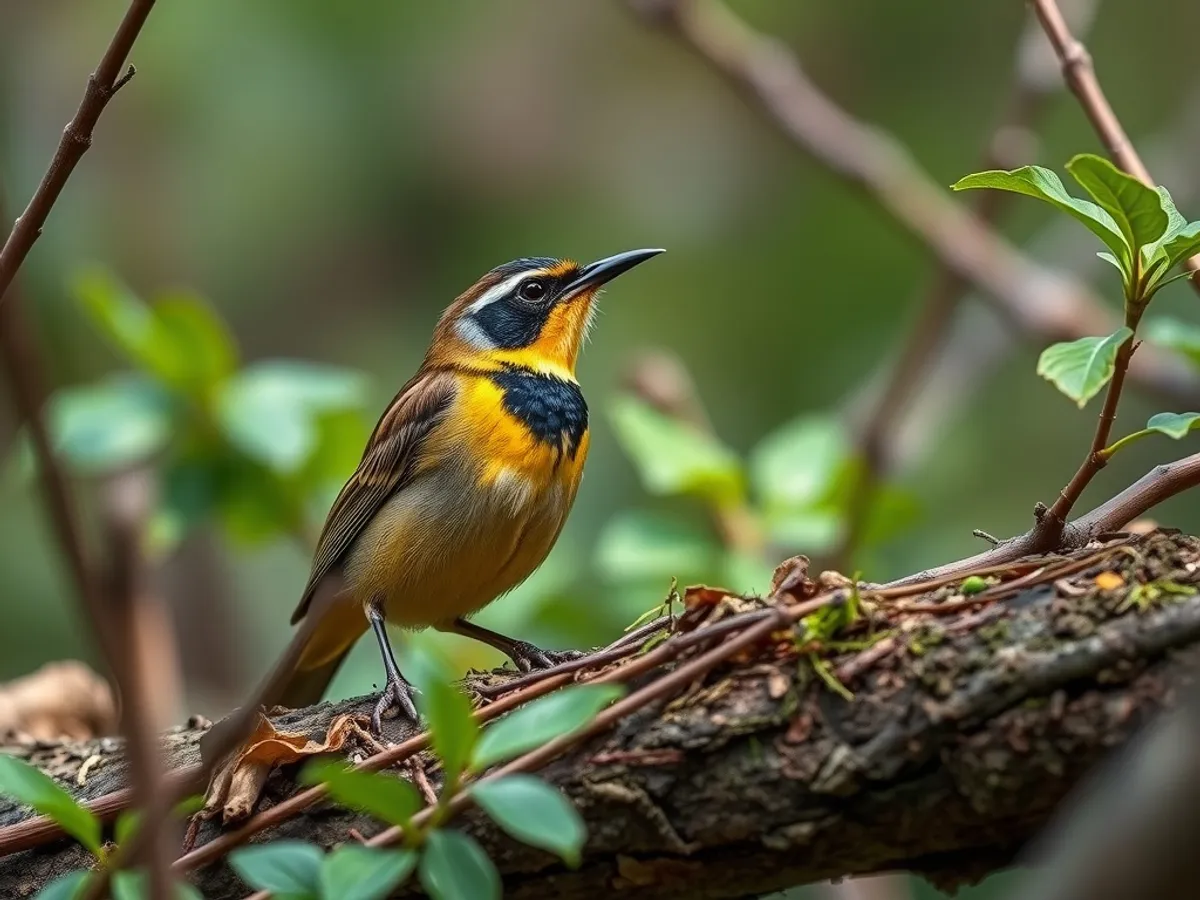
About the Great Bowerbird
Chlamydera nuchalis, of northern Australia, builds an avenue bower - two parallel walls of sticks - and then does something no other animal is known to do: it constructs a forced-perspective illusion. The male lays out a court of bones, snail shells and pale stones in front of the bower entrance and arranges them by size, smallest nearest the avenue and largest furthest away. Viewed by a female standing inside the avenue, where the male's display is staged, that gradient flattens the apparent depth of the court and makes the whole scene, and the male himself flashing his lilac nuchal crest above the objects, appear more uniform and larger. Laboratory work by John Endler in 2010 and 2012 showed the effect is deliberate: reverse the stones and males restore the original gradient within days, and males that produce better-quality illusions achieve more matings. The bower is not a nest - the female builds a plain cup nest elsewhere and raises the young alone. Males spend a large fraction of the year maintaining the bower, stealing decorations from rivals and destroying their neighbours' bowers, so bower quality is also a record of a male's ability to survive social attack.
Fascinating facts
Bower Building
Male Great Bowerbirds construct intricate stick structures, known as bowers, and decorate them with colorful objects to attract females.
Vocal Mimicry
These birds can mimic a variety of sounds, including other bird calls, environmental noises, and even human-made sounds.
Object Arrangement
Males meticulously arrange objects by size and color, creating optical illusions that enhance the appearance of their bowers.
Detailed description
The Great Bowerbird (Chlamydera nuchalis) is the largest member of the bowerbird family, measuring 33–38 cm in length and weighing approximately 180–250 grams. Its plumage is predominantly pale brown to grey-buff, with a distinctive lilac-pink nuchal crest on the back of the neck, which is usually concealed and displayed during courtship rituals. The bill is robust and slightly decurved, adapted for a varied omnivorous diet. Eyes are pale yellow, and legs are strong and greyish, suited for terrestrial foraging. Males are renowned for constructing elaborate avenue-type bowers, which are symmetrical structures made from twigs and decorated with a striking array of white, green, and occasionally metallic or glass objects. These bowers serve as courtship arenas rather than nests. Females are slightly smaller and less vividly colored, lacking the prominent crest. The species is highly vocal, with a repertoire of harsh churring, mimicry, and mechanical sounds. Great Bowerbirds are generally solitary outside the breeding season, but may form loose foraging groups. They are highly intelligent, capable of complex problem-solving and spatial manipulation, as evidenced by their bower construction and object arrangement. Their range extends across northern Australia, inhabiting a variety of habitats including open woodlands, monsoon forests, vine thickets, and mangrove edges, often near water sources.
Did you know?
Despite their elaborate courtship displays, female Great Bowerbirds raise their young entirely on their own, with no help from the males.
Research & sources
Wikipedia summary
The great bowerbird is a common and conspicuous resident of northern Australia, from the area around Broome across the Top End to Cape York Peninsula and as far south as Mount Isa and Townsville. Favoured habitat is a broad range of forest and woodland, and the margins of vine forests, monsoon forest, and mangrove swamps.
Behaviour & social structure
Great Bowerbirds are diurnal and spend much of their day foraging on the ground for fruits, seeds, insects, and small vertebrates. Males dedicate significant time to building and maintaining their bowers, meticulously arranging objects to create visual illusions that enhance their attractiveness to females—a phenomenon known as forced perspective. They are known to steal decorations from neighboring bowers, leading to complex social interactions and territorial disputes. Vocalizations are used for communication, territory defense, and mimicry of other species, including predators and human-made sounds. Outside the breeding season, individuals may forage in small, loose groups, but are otherwise solitary. They exhibit strong site fidelity, often returning to the same bower sites year after year. Bower maintenance and decoration are continuous activities, with males frequently rearranging objects and repairing structural damage.
Reproduction & life cycle
The breeding season for Great Bowerbirds typically occurs from October to February, coinciding with the onset of the wet season. Males attract females to their bowers through elaborate displays, which include puffing out the nuchal crest, vocalizations, and object manipulation. Copulation occurs at the bower, but the male provides no parental care. Females build a separate, well-concealed nest in dense foliage, usually within 50–200 meters of the bower. The nest is a cup-shaped structure made from twigs and lined with softer materials. Clutch size is usually 1–2 eggs, which are pale and blotched. Incubation lasts about 19–21 days, and only the female incubates and cares for the chicks. Fledging occurs at approximately 20–22 days post-hatching, with the female continuing to feed the young for several weeks.
Adaptations & survival
Great Bowerbirds exhibit several remarkable adaptations. The male’s ability to construct complex bowers and use forced perspective is a unique evolutionary trait, likely driven by sexual selection. Their strong, dexterous bills and feet are adapted for manipulating objects and foraging on the ground. The cryptic plumage provides camouflage in dappled woodland light, while the hidden nuchal crest acts as a visual signal during courtship. Cognitive adaptations include advanced spatial memory and problem-solving skills, essential for bower construction and object arrangement. Vocal mimicry may serve both to deter rivals and attract mates. Their omnivorous diet allows flexibility in resource-scarce environments.
Cultural significance
While not a prominent figure in Aboriginal mythology compared to some other Australian birds, the Great Bowerbird’s unique courtship behavior has fascinated naturalists and ornithologists since European colonization. Its bower-building is often featured in documentaries and educational programs as an example of animal architecture and sexual selection. In some regions, local communities recognize the bird for its habit of collecting shiny objects, occasionally leading to folklore about its 'thieving' nature.
Recent research
Recent research has focused on the cognitive abilities of Great Bowerbirds, particularly their use of forced perspective in bower decoration—a rare example of non-human visual illusion construction. Studies have shown that males who create stronger illusions are more successful in attracting mates, suggesting a link between spatial cognition and reproductive success. Ongoing research includes the impact of environmental changes on bowerbird behavior and the role of vocal mimicry in social dynamics. Genetic studies are also underway to examine population structure and gene flow across the species’ extensive range.
Videos
Habitat
Open woodland and forest edges


Conservation
The Great Bowerbird is currently classified as Least Concern on the IUCN Red List.
Threats & challenges
Currently classified as Least Concern by the IUCN, the Great Bowerbird maintains stable populations across its range. However, localized threats include habitat loss due to land clearing, urban development, and altered fire regimes. Predation by introduced species such as cats and foxes poses a risk to eggs and chicks. Climate change may impact habitat suitability and food availability in the future. Despite these challenges, the species’ adaptability and wide distribution have so far mitigated significant population declines.
Taxonomy
Scientific name
Chlamydera nuchalis
- Kingdom
- Animalia
- Phylum
- Chordata
- Class
- Aves
- Order
- Passeriformes
- Family
- Ptilonorhynchidae
- Genus
- Chlamydera
- Species
- nuchalis
Community notes
Share your observations about the Great Bowerbird.
No community notes yet. Be the first!
Discover more wildlife
More fascinating animals from the encyclopedia.