
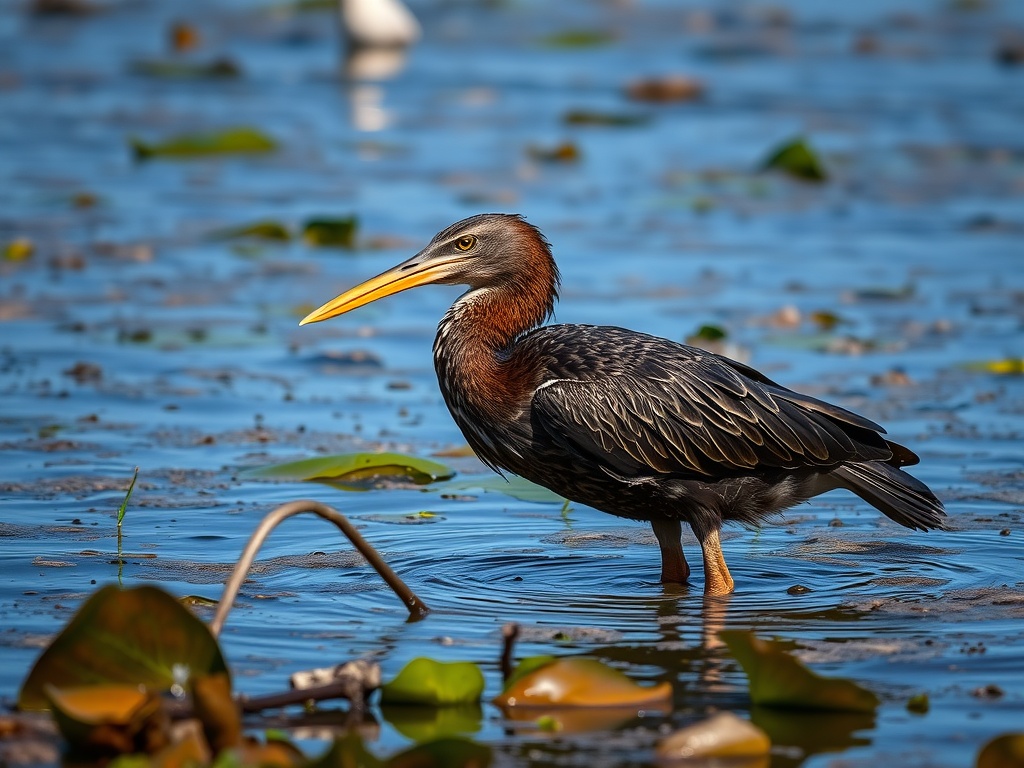
About the Greater Siren
The Greater Siren is a large, aquatic salamander native to the southeastern United States. This eel-like amphibian is characterized by its long, slender body, external feathery gills, and the absence of hind limbs, possessing only small, reduced forelimbs. Greater Sirens inhabit slow-moving or stagnant freshwater environments, such as swamps, marshes, ponds, and ditches. They are primarily nocturnal and are known for their secretive behavior, often hiding in dense vegetation or burrowing into the mud during dry periods.
Fascinating facts
No Hind Limbs
Unlike most salamanders, Greater Sirens lack hind legs entirely, giving them a unique, elongated appearance.
Estivation Experts
During droughts, Greater Sirens can survive by estivating—secreting mucus to encase themselves in mud and slowing their metabolism until water returns.
Nocturnal Hunters
They are primarily active at night, feeding on insects, crustaceans, snails, and small fish in dense aquatic vegetation.
Detailed description
The Greater Siren (Siren lacertina) is a large, fully aquatic salamander distinguished by its elongated, eel-like body, which can reach lengths of 50–97 cm (20–38 in), making it one of the largest North American amphibians. Its skin is smooth and typically olive to gray-green, often mottled with darker spots, and it possesses conspicuous external gills—three feathery red or pink gill filaments on each side of the head—adapted for underwater respiration. Unlike most salamanders, the Greater Siren lacks hind limbs entirely and has only small, reduced forelimbs with four toes each. The eyes are small and lidless, adapted for a primarily nocturnal and aquatic lifestyle. The lateral line system is well-developed, allowing detection of vibrations and movement in murky waters. The body is laterally compressed, aiding in navigation through dense aquatic vegetation. Sirens are capable of producing vocalizations, such as clicks or yelps, especially when disturbed. During periods of drought, they can aestivate by burrowing into mud and secreting a mucous cocoon, reducing metabolic activity until water returns.
Did you know?
Despite their large size and snake-like appearance, Greater Sirens are completely harmless to humans and play an important role in controlling aquatic invertebrate populations.
Research & sources
Wikipedia summary
The greater siren is an amphibian and one of the five members of the genus Siren. The largest of the sirens and one of the largest amphibians in North America, the greater siren resides in the coastal plains of the southeastern United States.
Behaviour & social structure
Greater Sirens are primarily nocturnal, emerging from dense aquatic vegetation or mud at night to forage. They are solitary and territorial, often defending feeding grounds from conspecifics through aggressive displays or biting. Their diet consists mainly of aquatic invertebrates—such as insects, worms, snails, and crustaceans—but they will also consume small fish, amphibian larvae, and occasionally plant material. Sirens use a combination of chemosensory cues and the lateral line system to locate prey, employing rapid side-to-side head movements and suction feeding. When threatened, they may emit loud vocalizations and can deliver a painful bite. During dry periods, sirens burrow into the substrate and enter a state of dormancy (aestivation), surviving for months without food or water. They are known to be long-lived, with some individuals in captivity surviving over 25 years.
Reproduction & life cycle
Breeding typically occurs from late winter to early spring, though timing can vary with local conditions. Males and females engage in courtship behaviors, including tactile stimulation and body undulations. Fertilization is external; females lay gelatinous strings of eggs (up to several hundred) attached to submerged vegetation or debris. Incubation lasts approximately 1–2 months, depending on water temperature. There is no parental care after egg deposition. Larvae hatch fully aquatic, resembling miniature adults with external gills and lacking hind limbs. Metamorphosis is incomplete, as sirens retain larval features (neoteny) throughout life, never developing hind limbs or losing their gills.
Adaptations & survival
The Greater Siren exhibits several key adaptations for its aquatic lifestyle: external gills for efficient underwater respiration; a lateral line system for detecting water movement; and the ability to aestivate during drought, encasing itself in a mucous cocoon to conserve moisture and reduce metabolism. The absence of hind limbs and streamlined body facilitate movement through dense aquatic vegetation. Their skin secretes mucous, which reduces friction and offers some protection against pathogens. Sirens are also capable of regenerating lost limbs and tail tissue, a trait shared with some other salamanders. Their tolerance for low-oxygen environments allows them to inhabit stagnant or hypoxic waters where few predators can survive.
Cultural significance
The Greater Siren has intrigued naturalists since its description by Linnaeus in 1766, often featuring in regional folklore as a mysterious 'eel with legs.' Due to its secretive habits and unusual appearance, it has sometimes been mistaken for mythical creatures or 'water monsters' in local stories. In scientific culture, sirens are valued as model organisms for studying neoteny, regeneration, and amphibian physiology. They are occasionally kept in educational or research collections but have little direct economic or traditional use.
Recent research
Recent studies have focused on the Greater Siren’s remarkable regenerative abilities, including limb and tissue regeneration, which may have biomedical implications. Population genetics research has revealed significant genetic diversity across its range, suggesting possible cryptic species or subspecies. Ecological studies have examined their role as top invertebrate predators in wetland ecosystems and their resilience to environmental stressors, such as drought and pollution. Ongoing research is investigating the impact of habitat fragmentation and climate change on siren populations, as well as their unique physiological adaptations to hypoxic and variable aquatic environments.
Videos
Habitat
Freshwater wetlands


Conservation
The Greater Siren is currently classified as Least Concern on the IUCN Red List.
Threats & challenges
While currently listed as Least Concern, the Greater Siren faces localized threats from habitat destruction, wetland drainage, water pollution, and the introduction of predatory fish. Urbanization and agricultural runoff can degrade water quality and reduce suitable habitat. Climate change poses additional risks by altering hydrological cycles and increasing the frequency of droughts, potentially impacting aestivation survival. Despite these challenges, the species remains widespread and locally abundant across much of its range, with stable population trends in many areas.
Taxonomy
Scientific name
Siren lacertina
- Kingdom
- Animalia
- Phylum
- Chordata
- Class
- Amphibia
- Order
- Urodela
- Family
- Sirenidae
- Genus
- Siren
- Species
- lacertina
Where to see a greater siren
1 zoo and aquarium in 1 country are recorded as keeping this species.

Community notes
Share your observations about the Greater Siren.
No community notes yet. Be the first!
Discover more wildlife
More fascinating animals from the encyclopedia.