
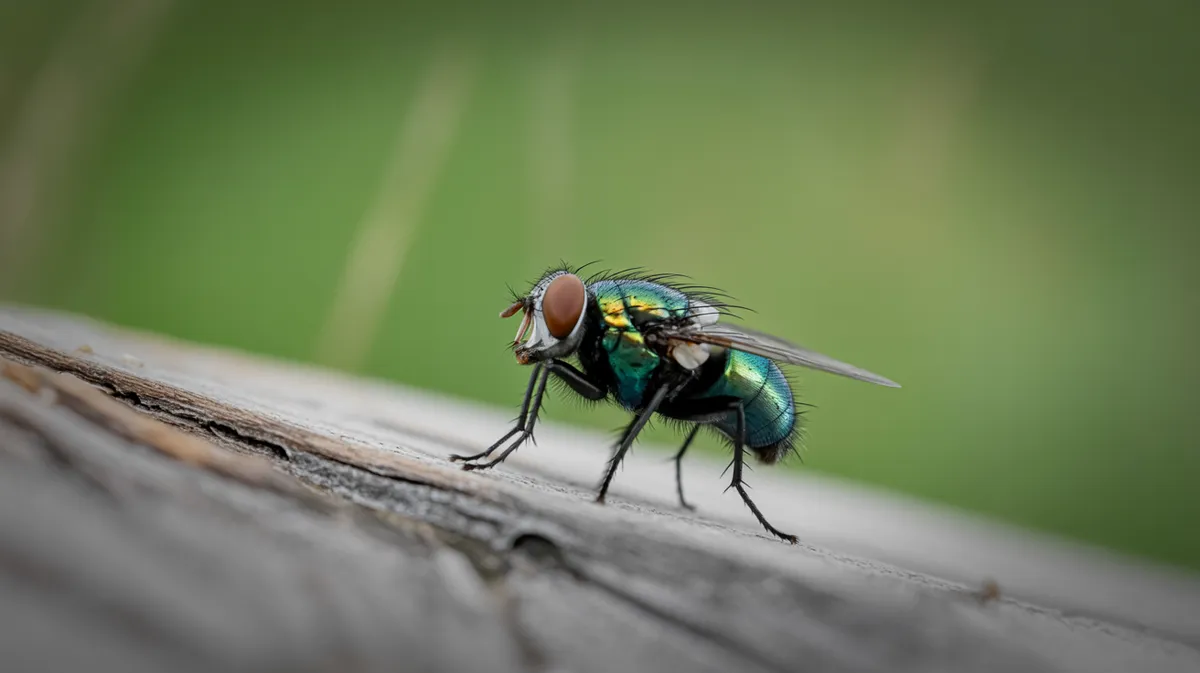
About the Green bottle fly
The green bottle fly is a striking metallic-green insect commonly found around decaying organic matter and in urban areas. As a member of the blow fly family, it plays an essential ecological role in decomposing dead animals and recycling nutrients. The adult flies are known for their shiny, iridescent appearance, while their larvae (maggots) are frequently used in forensic science and medical maggot therapy. This species is widespread across many continents and adapts well to a variety of environments.
Fascinating facts
Rapid Reproduction
A single female green bottle fly can lay up to 2,000 eggs during her short lifetime, which hatch into larvae within just a day.
Medical Maggots
Sterile larvae of Lucilia sericata are used in hospitals to safely remove dead tissue from wounds, promoting healing.
Forensic Role
Their developmental stages help forensic entomologists estimate postmortem intervals, making them crucial in solving crimes.
Detailed description
The green bottle fly (Lucilia sericata) is a medium-sized blow fly, typically measuring 10–14 mm in length, with a distinctive metallic green or blue-green exoskeleton that often displays bronze or coppery reflections. The thorax and abdomen are covered in short, bristly hairs, and the wings are clear with prominent veins. The compound eyes are large and reddish-brown, providing excellent vision for detecting movement and locating food sources. Lucilia sericata is holometabolous, undergoing complete metamorphosis with egg, larval (maggot), pupal, and adult stages. Adults are strong fliers, capable of rapid, agile movements, and are often seen basking in sunlight or hovering near decaying matter. The larvae are saprophagous, feeding primarily on necrotic tissue and decaying organic material, which makes them important decomposers in many ecosystems. Social structure is generally solitary, though adults may aggregate in large numbers at rich food sources or breeding sites. The species is highly adaptable, thriving in diverse environments ranging from urban centers to rural pastures. Lucilia sericata is also notable for its medical significance, as its larvae are used in maggot debridement therapy to clean chronic wounds by selectively consuming dead tissue.
Did you know?
Forensic scientists use the life cycle of green bottle flies to estimate the time of death in criminal investigations.
Research & sources
Wikipedia summary
Lucilia is a genus of blow flies in the family Calliphoridae. Various species in this genus are commonly known as green bottle flies.
Behaviour & social structure
Green bottle flies are diurnal and most active during warm daylight hours, especially in temperatures above 15°C (59°F). Adults are attracted to strong odors, particularly those of decaying flesh, feces, and certain flowers, which they use as cues for feeding and oviposition. Their feeding behavior is opportunistic; adults consume a variety of substances including nectar, honeydew, and fluids from carrion or excrement. They use sponging mouthparts to lap up liquid food. Larvae exhibit gregarious feeding, often forming dense clusters within decomposing material, which accelerates decomposition and nutrient cycling. While not social in the eusocial sense, adults may display aggregation behavior at abundant resources. Flies are also known for their rapid response to newly available carcasses, often arriving within minutes to hours, making them crucial in forensic entomology for estimating post-mortem intervals.
Reproduction & life cycle
Reproduction in Lucilia sericata is characterized by rapid and prolific breeding. Females are capable of laying up to 3,000 eggs in their lifetime, typically in batches of 150–200 on moist, decaying organic matter or open wounds. Oviposition occurs within hours of locating a suitable substrate. Eggs hatch within 8–24 hours depending on temperature, and larvae pass through three instars over 3–10 days. Pupation occurs in soil or leaf litter near the food source and lasts 6–14 days. There is no parental care; after oviposition, adults do not interact with their offspring. Breeding can occur year-round in warm climates, but is typically seasonal in temperate regions, peaking in late spring and summer.
Adaptations & survival
Lucilia sericata exhibits several notable adaptations. Its metallic coloration may serve as a form of aposematism or camouflage among foliage. The species has highly sensitive chemoreceptors on its antennae and tarsi, allowing it to detect trace amounts of volatile organic compounds from decaying matter over long distances. Rapid development and high fecundity enable quick exploitation of ephemeral resources. Larvae secrete proteolytic enzymes to liquefy tissue, facilitating efficient feeding. Additionally, the larvae's ability to survive in hypoxic, microbe-rich environments is aided by specialized spiracles and antimicrobial secretions, which also make them effective in medical maggot therapy. Adults are strong fliers, capable of dispersing over several kilometers to locate new resources.
Cultural significance
Green bottle flies have a complex relationship with humans. Historically, they have been regarded as pests due to their association with filth and disease transmission. However, their larvae have been used since antiquity in maggot therapy, a practice revived in modern medicine to treat chronic wounds and ulcers by removing necrotic tissue and promoting healing. In forensic science, Lucilia sericata is a key indicator species for estimating time of death in criminal investigations. The fly's striking appearance has also inspired references in literature and art, often symbolizing decay or the fleeting nature of life.
Recent research
Recent research on Lucilia sericata has focused on its role in maggot debridement therapy, with studies demonstrating the larvae's secretion of antimicrobial peptides effective against antibiotic-resistant bacteria such as MRSA. Genomic and transcriptomic analyses have identified genes involved in tissue digestion and immune modulation. Ongoing studies are investigating the fly's microbiome and its influence on larval development and wound healing efficacy. In forensic entomology, advances in developmental rate modeling and molecular identification techniques have improved the accuracy of post-mortem interval estimations. Additionally, there is growing interest in the fly's potential as a model organism for studying insect-microbe interactions.
Videos
Habitat
Urban areas, grasslands, forests, and near decaying organic matter
 Various Continental Regions
Grassland
Open areas dominated by grasses rather than trees, supporting numerous herbivores and their predators.
 Global
Forest
Wooded areas with significant tree cover and diverse plant and animal communities.
 Global
Freshwater
Lakes, rivers, and wetlands with diverse aquatic ecosystems.
Conservation
The Green bottle fly is currently classified as Least Concern on the IUCN Red List.
Threats & challenges
Currently, Lucilia sericata faces few significant natural threats and is classified as Least Concern by conservation authorities. However, local populations may be affected by widespread pesticide use, habitat loss, and competition with other synanthropic fly species. In some regions, climate change may alter seasonal abundance and distribution patterns. Human activities, such as improved sanitation and waste management, can reduce breeding opportunities in urban areas. Conversely, the species can become a nuisance or veterinary pest, causing myiasis in livestock and occasionally humans, particularly in regions with poor wound care or hygiene.
Taxonomy
Scientific name
Lucilia sericata
- Kingdom
- Animalia
- Phylum
- Arthropoda
- Class
- Insecta
- Order
- Diptera
- Family
- Calliphoridae
- Genus
- Lucilia
- Species
- sericata
Community notes
Share your observations about the Green bottle fly.
No community notes yet. Be the first!
Discover more wildlife
More fascinating animals from the encyclopedia.