
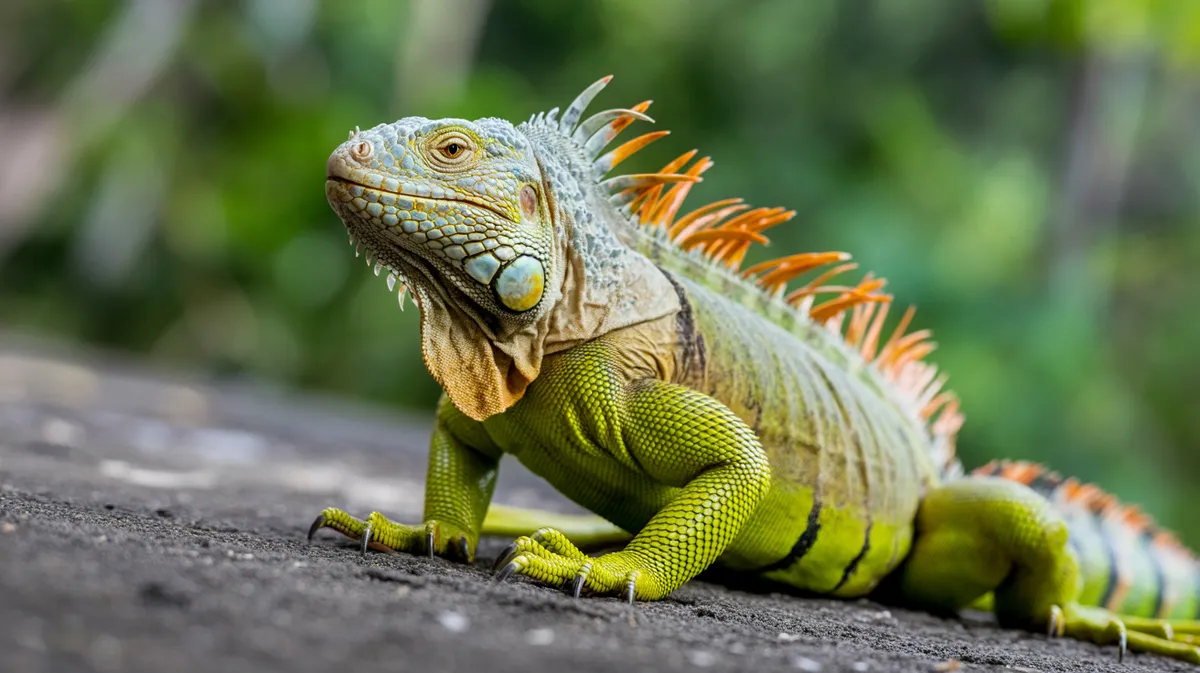
About the Green Iguana
The Green Iguana (Iguana iguana) is a large, arboreal lizard native to the rainforests of Central and South America, often found from Mexico to Brazil. Adults can reach lengths of up to 2 meters, with tails comprising over half of their total body length. These reptiles are primarily herbivorous, feeding on leaves, flowers, and fruit, though juveniles may consume insects. Their vibrant green coloration provides camouflage among the dense foliage, a crucial adaptation for avoiding predators like hawks and snakes. Unlike some reptiles, green iguanas are diurnal, basking in the sun to regulate their body temperature, which is essential for their digestion and overall metabolism. Despite their name, not all green iguanas are green; some exhibit shades of blue, orange, or even pink, depending on their location and age. Compared to their close relatives, such as the Lesser Antillean Iguana, green iguanas are more robust and have longer limbs, aiding in their arboreal lifestyle.
Fascinating facts
Tree Dwellers
Green Iguanas spend most of their lives in trees, rarely descending except to mate, lay eggs, or bask.
Strict Herbivores
Their diet consists mainly of leaves, flowers, and fruits, making them important seed dispersers in their habitats.
Tail for Defense
If threatened, a Green Iguana can whip its tail as a defense mechanism or even detach it to escape predators.
Detailed description
The Green Iguana (Iguana iguana) is a large, robust lizard reaching adult lengths of 1.2 to 2 meters (4–6.6 ft), with males typically larger than females. Its body is laterally compressed, covered in overlapping scales, and features a prominent dewlap under the chin, which aids in thermoregulation and social signaling. The dorsal crest, composed of elongated spines running from the nape to the tail, is especially pronounced in males. Coloration varies with age and locality, ranging from vivid green in juveniles to more muted greens, grays, or even orange hues in adults, particularly during the breeding season. Green Iguanas possess strong limbs with sharp claws for climbing and a long, muscular tail that can be used defensively, capable of autotomy (self-amputation) if grasped by predators. Their keen vision and well-developed parietal eye (a photosensory organ on the top of the head) help detect movement and changes in light, aiding in predator avoidance. Primarily arboreal, they spend most of their lives in the forest canopy, descending mainly to bask, nest, or access water. Green Iguanas are diurnal, relying on external heat sources to regulate their body temperature, and are highly territorial, especially during the breeding season. Their lifespan in the wild can exceed 15 years, with some individuals living over 20 years in captivity under optimal conditions.
Did you know?
Despite their common name, not all Green Iguanas are green—some can be blue, red, orange, or even lavender depending on age, location, and mood.
Research & sources
Wikipedia summary
The green iguana, also known as the American iguana or the common green iguana, is a large, arboreal, mostly herbivorous species of lizard of the genus Iguana. Usually, this animal is simply called the iguana. The green iguana ranges over a large geographic area; it is native from southern Brazil and Paraguay as far north as Mexico.
Behaviour & social structure
Green Iguanas are primarily solitary but may be observed basking in loose aggregations, especially in areas with abundant sunlight. They are highly territorial, with males displaying head-bobbing, dewlap extension, and body posturing to assert dominance and deter rivals. Feeding occurs during the day, with iguanas foraging for leaves, flowers, fruits, and occasionally insects or small vertebrates, though such animal matter is rare in their diet. Their digestive system relies on microbial fermentation in the hindgut to break down fibrous plant material. Iguanas are agile climbers and swimmers; when threatened, they may leap from branches into water, using lateral undulations of the tail for propulsion. Daily routines include basking in the morning to elevate body temperature, followed by foraging and periods of rest. Juveniles often form small groups for increased protection, while adults maintain defined home ranges.
Reproduction & life cycle
Green Iguanas exhibit seasonal breeding, typically coinciding with the dry season (December to February in much of their range). Males become highly territorial and display increased aggression and vivid coloration during this period. Courtship involves head-bobbing, nuzzling, and chasing, with copulation occurring after the female accepts the male. Females lay a single clutch per year, depositing 20–70 eggs in burrows dug in sandy or soft soil, often in communal nesting sites. Incubation lasts approximately 65–90 days, depending on temperature and humidity. Hatchlings are fully independent at birth, receiving no parental care, and must immediately fend for themselves, often forming small cohorts for mutual protection. Sexual maturity is reached at 2–4 years, with growth rates influenced by diet and environmental conditions.
Adaptations & survival
Green Iguanas possess several adaptations for arboreal life, including long, prehensile tails for balance, strong limbs with sharp claws for gripping branches, and laterally compressed bodies for maneuvering through dense foliage. Their coloration provides camouflage among leaves, while the dewlap and dorsal crest serve both thermoregulatory and social functions. The parietal eye detects changes in light intensity, warning of aerial predators. Iguanas are capable swimmers, using their tails for propulsion and can remain submerged for up to 30 minutes. Their digestive tract is specialized for processing fibrous plant material, relying on symbiotic gut flora. Autotomy allows them to escape predators by shedding the tail, which later regenerates, albeit less perfectly.
Cultural significance
Green Iguanas hold varied roles in human culture across their range. In Central and South America, they are sometimes referred to as 'gallina de palo' (chicken of the tree) and are hunted for their meat and eggs, considered delicacies in some communities. They feature in indigenous folklore and symbolism, often associated with rainforests and riverine environments. In the pet trade, Green Iguanas are popular for their striking appearance, though their large size and complex care requirements often lead to abandonment. Invasive populations have prompted management campaigns and public education efforts in affected regions.
Recent research
Recent research has focused on Green Iguana thermoregulation, demonstrating sophisticated behavioral adaptations to maintain optimal body temperatures in fluctuating environments. Genetic studies have revealed significant population structure across their range, with evidence of cryptic speciation and local adaptation. Investigations into their gut microbiome have provided insights into their herbivorous diet and digestive efficiency. Studies on invasive populations have highlighted their ecological impacts, including competition with native species and alteration of vegetation. Ongoing research addresses the effects of climate change on nesting success and hatchling sex ratios, as Green Iguana eggs exhibit temperature-dependent sex determination.
Videos
Habitat
Tropical rainforests near rivers and streams
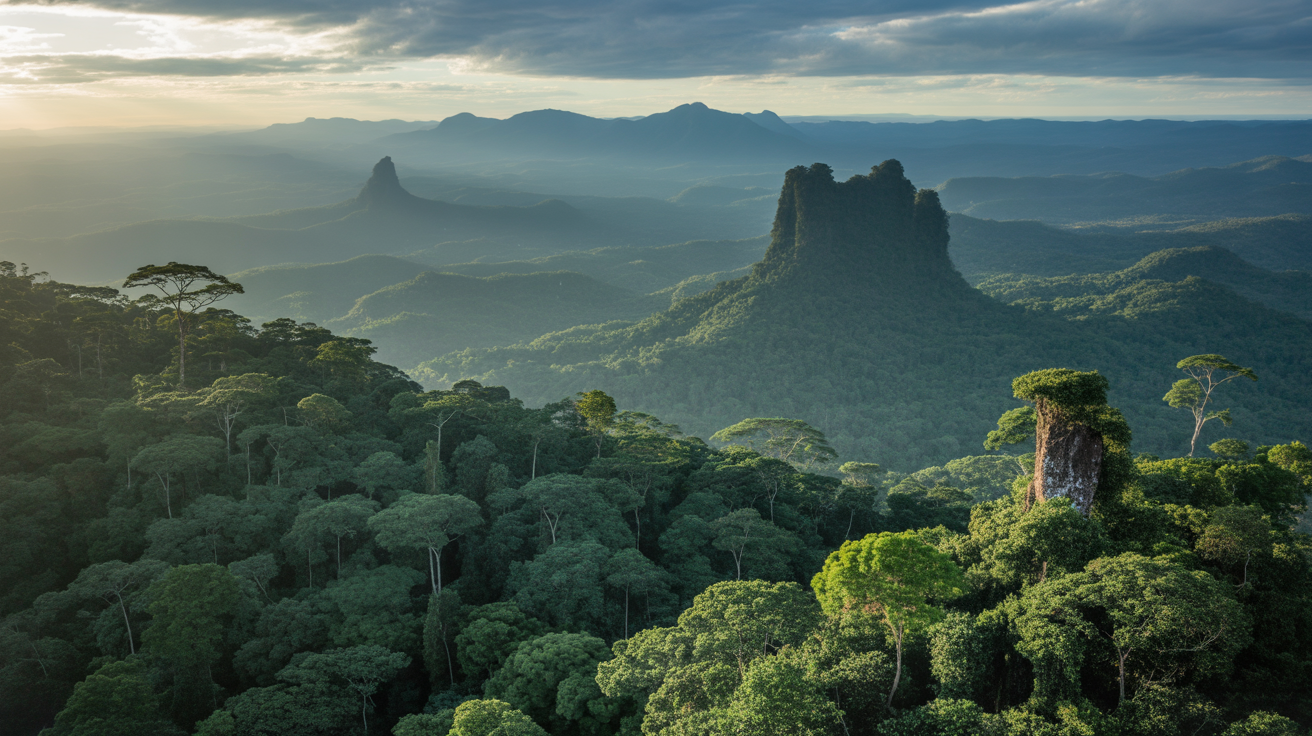 Tropical Regions
Rainforest
Dense, wet forests with the highest biodiversity on Earth, containing more than half of the world's plant and animal species.
 Global
Forest
Wooded areas with significant tree cover and diverse plant and animal communities.
 Global
Freshwater
Lakes, rivers, and wetlands with diverse aquatic ecosystems.
Conservation
The Green Iguana is currently classified as Least Concern on the IUCN Red List.
Threats & challenges
Despite their 'Least Concern' status, Green Iguanas face several threats, including habitat destruction due to deforestation, hunting for meat and the pet trade, and predation by introduced species such as dogs, cats, and mongooses. In some areas, over-collection for the pet industry has led to local population declines. Conversely, in regions where they have been introduced (e.g., Florida, Puerto Rico), Green Iguanas have become invasive, impacting native flora and fauna. Climate change poses a long-term threat by altering nesting sites and food availability. Disease outbreaks, particularly in captive populations, can also impact wild stocks through release or escape of infected individuals.
Taxonomy
Scientific name
Iguana iguana
- Kingdom
- Animalia
- Phylum
- Chordata
- Class
- Reptilia
- Order
- Squamata
- Family
- Iguanidae
- Genus
- Iguana
- Species
- iguana
Where to see a green iguana
10 zoos and aquariums in 4 countries are recorded as keeping this species.
 Belfast Zoo🇬🇧 Belfast, United Kingdom
 Honolulu Zoo🇺🇸 Honolulu, United States
 Śląski Ogród Zoologiczny🇵🇱 Chorzów, Poland
 Brevard Zoo🇺🇸 Melbourne, United States
 London Zoo🇬🇧 London, United Kingdom
Community notes
Share your observations about the Green Iguana.
No community notes yet. Be the first!
Discover more wildlife
More fascinating animals from the encyclopedia.