
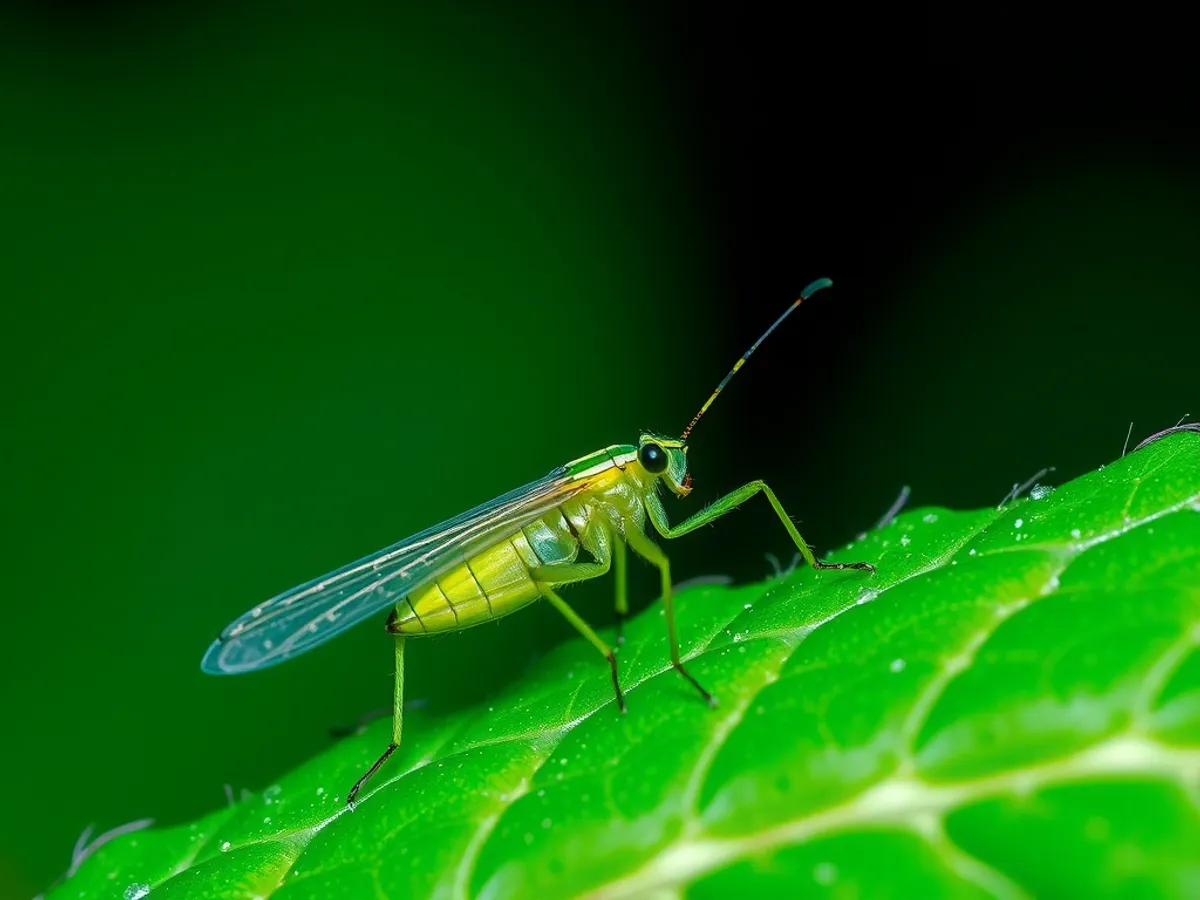
About the Green Lacewing
The green lacewing is a delicate, soft-bodied insect known for its bright green wings and golden eyes. Its finely veined, translucent wings give it a lacy appearance, hence the name. Green lacewing larvae are voracious predators, feeding on aphids, mites, and other small arthropods, making them valuable allies in natural pest control. Adults are typically more nectarivorous, but some species may also feed on honeydew and pollen. They are widespread across temperate and subtropical regions and are commonly found in gardens, forests, and grasslands.
Fascinating facts
Lacy Wings
The wings of green lacewings are covered in a complex network of veins, giving them a delicate, lace-like appearance that helps them blend into vegetation.
Predatory Larvae
Lacewing larvae are fierce hunters, using their large, sickle-shaped jaws to inject digestive enzymes and suck out the contents of prey like aphids.
Unique Egg Laying
Lacewing eggs are laid singly on the tips of slender stalks, which prevent the cannibalistic larvae from eating each other upon hatching.
Detailed description
The green lacewing (Chrysoperla carnea) is a slender, soft-bodied neuropteran insect measuring 10–15 mm in length, with an impressive wingspan of 20–30 mm. Its most distinctive features are its large, iridescent golden compound eyes and two pairs of finely veined, translucent wings that overlap at rest, creating a characteristic tent-like appearance. The adult's body is pale green, sometimes tinged with yellow, and covered in fine setae, which may aid in camouflage among foliage. Lacewing larvae, often called 'aphid lions,' are elongated, mottled brown or gray, and equipped with prominent sickle-shaped mandibles adapted for piercing and sucking prey. Adults are primarily nocturnal and are attracted to light sources at night. Their antennae are long and filiform, providing acute sensory perception for mate location and environmental cues. The species exhibits holometabolous development, progressing through egg, larval, pupal, and adult stages. Green lacewings are renowned for their role in biological pest control, with larvae capable of consuming hundreds of aphids and other soft-bodied arthropods during their development. Adults, while less predatory, contribute to pollination and the spread of beneficial microorganisms by feeding on nectar, pollen, and honeydew.
Did you know?
Green lacewings are so effective at controlling pests that they are mass-reared and sold for use in organic and sustainable agriculture.
Research & sources
Behaviour & social structure
Green lacewing larvae are solitary, highly aggressive predators that actively hunt aphids, thrips, whiteflies, and small caterpillars. They employ an ambush strategy, using their camouflage to remain undetected before seizing prey with their curved mandibles and injecting digestive enzymes to liquefy tissues. Larvae exhibit 'ant mimicry' in some populations, reducing predation risk. Adults are crepuscular to nocturnal, often hiding in vegetation during the day and becoming active at dusk. They communicate using substrate-borne vibrational signals for mate recognition, a complex behavior unique among many insects. Adults are generally solitary but may aggregate where food sources are abundant. Daily routines involve sheltering during adverse weather and foraging during optimal conditions. Both larvae and adults exhibit thanatosis (death-feigning) when threatened.
Reproduction & life cycle
Chrysoperla carnea exhibits a sophisticated courtship involving species-specific vibrational duets produced by abdominal oscillations, ensuring reproductive isolation from closely related species. Mating typically occurs in spring and summer, with females laying up to 600 eggs individually on the tips of slender stalks secreted from their abdomen, reducing cannibalism among hatching larvae. Eggs hatch in 3–6 days, depending on temperature. The larval stage lasts 2–3 weeks, followed by pupation in a silken cocoon attached to leaves or bark. There is no parental care post-oviposition. In temperate regions, the species may overwinter as adults or pupae, with multiple generations per year (multivoltine) in favorable climates.
Adaptations & survival
Green lacewings possess several key adaptations: their cryptic coloration and delicate body structure provide camouflage among leaves, while the larvae's sickle-shaped mandibles are highly specialized for predation. The ability to produce vibrational signals for mate recognition is a notable evolutionary specialization, preventing hybridization with similar species. Eggs are laid on stalks to minimize predation and cannibalism. Adults can tolerate a wide range of temperatures and humidity, contributing to their cosmopolitan distribution. The larvae secrete a waxy substance that may deter predators and parasitoids. Their generalist predatory habits allow them to exploit diverse prey populations, enhancing their survival in fluctuating environments.
Cultural significance
Green lacewings have long been recognized as beneficial insects in agriculture and horticulture, symbolizing natural pest control and ecological balance. They are widely used in integrated pest management (IPM) programs worldwide. In some cultures, lacewings are associated with good luck or are seen as harbingers of a healthy garden. There are no significant mythological or medicinal uses documented, but their role in sustainable agriculture has made them a subject of educational outreach and environmental awareness campaigns.
Recent research
Recent research has focused on the vibrational communication system of Chrysoperla carnea, revealing complex species-specific 'songs' that play a critical role in reproductive isolation and speciation. Genomic studies have elucidated genes involved in chemosensory perception and resistance to certain pesticides. Ongoing studies are investigating the impacts of climate change on voltinism (number of generations per year) and the efficacy of lacewing releases in various crop systems. Advances in mass-rearing techniques and the use of artificial diets are improving the cost-effectiveness of lacewings as biocontrol agents. There is also growing interest in the microbiome of lacewing larvae and its role in digestion and immunity.
Sources
The green lacewing genus Chrysoperla (Neuroptera: Chrysopidae): Relating song structure, morphology and molecular genetics
Charles S. Henry et al. (2013)
scientificBiology, ecology, and economic importance of green lacewings (Neuroptera: Chrysopidae)
Tauber, M.J., Tauber, C.A., Daane, K.M., Hagen, K.S. (2000)
scientificVideos
Habitat
Forests, gardens, grasslands, and agricultural areas


Conservation
The Green Lacewing is currently classified as Least Concern on the IUCN Red List.
Threats & challenges
Currently listed as Least Concern, Chrysoperla carnea faces few direct threats due to its adaptability and widespread distribution. However, intensive pesticide use in agriculture can reduce populations by killing both larvae and adults and depleting prey availability. Habitat fragmentation and loss of floral resources may impact adult nutrition and reproductive success. Climate change could alter phenology and distribution, but the species' ecological plasticity suggests resilience. Commercial mass-rearing for biological control has not shown negative effects on wild populations, but genetic homogenization is a potential concern.
Taxonomy
Scientific name
Chrysoperla carnea
- Kingdom
- Animalia
- Phylum
- Arthropoda
- Class
- Insecta
- Order
- Neuroptera
- Family
- Chrysopidae
- Genus
- Chrysoperla
- Species
- carnea
Community notes
Share your observations about the Green Lacewing.
No community notes yet. Be the first!
Discover more wildlife
More fascinating animals from the encyclopedia.