
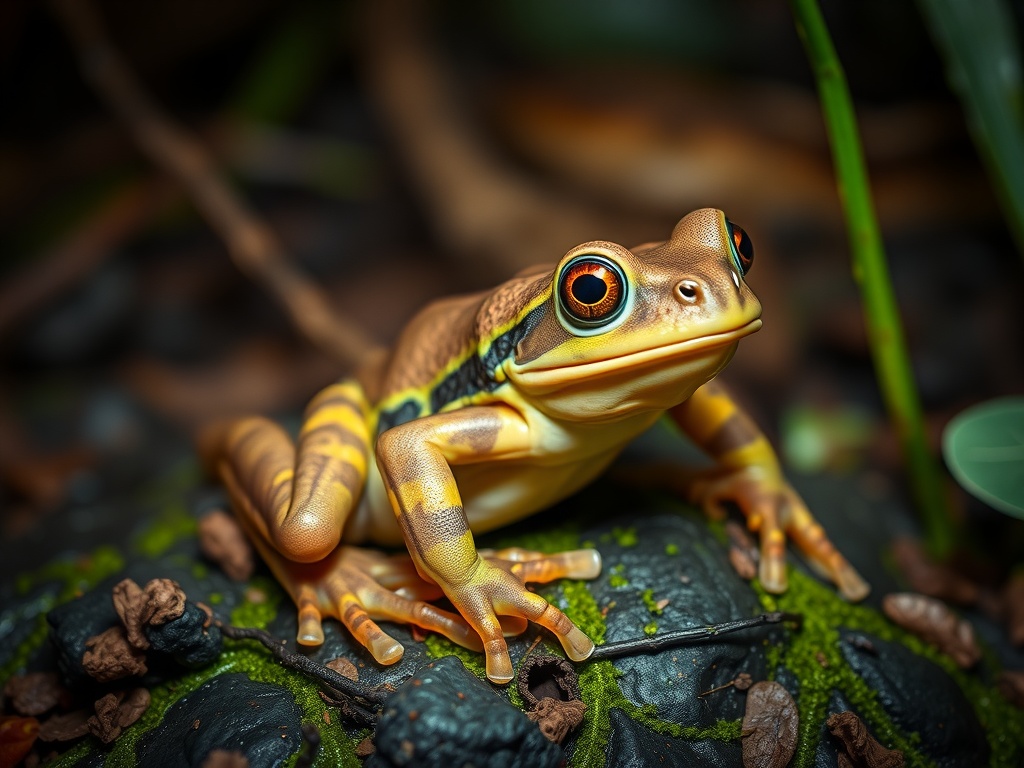
About the Günther's Marsupial Frog
Günther's Marsupial Frog is a remarkable amphibian native to the cloud forests of the Andes in Colombia and Ecuador. This medium-sized frog is best known for the unique brood pouch on the female's back, where she carries and protects her developing eggs. Its coloration ranges from green to brown, providing effective camouflage among mosses and foliage. Primarily nocturnal, it is an expert climber and spends much of its life in trees. Its reproductive strategy and arboreal lifestyle make it a fascinating subject for biologists.
Fascinating facts
Direct Development
Unlike many frogs, this species' young develop directly into froglets inside the mother's pouch, bypassing the free-swimming tadpole stage.
Arboreal Lifestyle
Günther's Marsupial Frog spends most of its life in trees, using its strong limbs and adhesive toe pads to climb and cling to branches and leaves.
Parental Care
Females exhibit unique parental care by carrying fertilized eggs in a specialized dorsal pouch until they are ready to hatch.
Detailed description
Günther's Marsupial Frog (Gastrotheca guentheri) is a medium-sized, arboreal amphibian, with adults typically reaching a snout-vent length of 45–65 mm. Its dorsum varies from bright green to mottled brown, often with subtle patterning that enhances camouflage among mosses and bromeliads. The skin is smooth, with a granular texture on the flanks and ventral surfaces. Notably, females possess a dorsal brood pouch, a specialized structure where fertilized eggs are incubated—a hallmark of the genus Gastrotheca. The species has large, forward-facing eyes with horizontal pupils, providing excellent night vision for its nocturnal lifestyle. Expanded toe pads and partially webbed fingers facilitate adept climbing in the humid, epiphyte-rich canopy of Andean cloud forests. Günther's Marsupial Frog is primarily arboreal, rarely descending to the forest floor except during dispersal or in search of new territories. Its call is a soft, melodious trill, used by males to attract females during the breeding season. The species is generally solitary outside of the breeding period, exhibiting territoriality among males. Its unique reproductive strategy, along with its cryptic coloration and arboreal habits, make it a model organism for studies on amphibian adaptation and parental care.
Did you know?
Günther's Marsupial Frog can rapidly change its skin color to blend with different backgrounds, aiding in camouflage.
Research & sources
Behaviour & social structure
Günther's Marsupial Frog is predominantly nocturnal, emerging at dusk to forage among leaves and branches. It is an opportunistic insectivore, preying on a variety of arthropods such as beetles, ants, spiders, and caterpillars, which it locates using its acute vision and a sit-and-wait hunting strategy. The frog uses its adhesive toe pads to navigate the slippery, moss-covered branches and leaves of its cloud forest habitat. Social interactions are limited; individuals are mostly solitary, except during the breeding season when males establish small calling territories. Aggressive encounters between males are rare but may involve vocalizations and posturing. During the day, the frog remains motionless in concealed locations, relying on its cryptic coloration to avoid predators such as snakes, birds, and small mammals.
Reproduction & life cycle
Reproduction in Gastrotheca guentheri is highly specialized. Breeding typically coincides with the onset of the rainy season, from March to July, when humidity is highest. Males call from elevated perches to attract females. Amplexus is axillary, and fertilization is external but occurs as the female releases eggs, which are then transferred by the male into the female's dorsal brood pouch. The pouch can accommodate 10–25 eggs, where they develop in a protected, moist environment. Embryonic development lasts approximately 3–4 weeks, after which fully formed froglets (not tadpoles) emerge, bypassing the free-living larval stage—a process known as direct development. Females exhibit parental care by carrying the eggs until hatching, providing both protection from desiccation and predation. After release, juveniles are independent and disperse into the surrounding vegetation.
Adaptations & survival
Günther's Marsupial Frog exhibits several remarkable adaptations for arboreal life and reproductive success. Its expanded toe pads and partial webbing enhance grip on wet, smooth surfaces, while cryptic coloration provides camouflage in the dappled light of the canopy. The dorsal brood pouch is a unique evolutionary adaptation, allowing eggs to develop in a controlled, humid environment, reducing dependence on standing water and minimizing predation risk. Direct development eliminates the vulnerable aquatic tadpole stage, an advantage in habitats where ephemeral pools are scarce. The frog's large eyes and horizontal pupils are adapted for nocturnal activity, optimizing light capture and depth perception. Behavioral adaptations include nocturnality to avoid diurnal predators and minimize water loss.
Cultural significance
There is limited direct cultural significance attributed to Günther's Marsupial Frog in local Andean communities, likely due to its secretive, arboreal habits and nocturnal activity. However, marsupial frogs as a group are sometimes referenced in regional folklore as symbols of rain and fertility, reflecting their association with cloud forests and seasonal rains. In scientific and conservation circles, the species is valued as an indicator of cloud forest ecosystem health and as a model organism for studies on reproductive adaptation.
Recent research
Recent research on Gastrotheca guentheri has focused on its reproductive biology, particularly the physiological mechanisms of the brood pouch and the hormonal regulation of direct development. Studies have also examined its role as a bioindicator for cloud forest integrity, given its sensitivity to microclimatic changes. Genetic analyses have provided insight into population structure and connectivity across fragmented habitats. Ongoing research is investigating the species' susceptibility to chytridiomycosis and other emerging amphibian pathogens, as well as the potential impacts of climate change on its reproductive timing and distribution.
Sources
Systematics and reproductive biology of marsupial frogs (Gastrotheca spp.)
Duellman, W.E. (2015)
scientificGastrotheca guentheri: The IUCN Red List of Threatened Species 2020
IUCN SSC Amphibian Specialist Group
conservationVideos
Habitat
Cloud forest


Conservation
The Günther's Marsupial Frog is currently classified as Least Concern on the IUCN Red List.
Threats & challenges
Although currently listed as Least Concern by the IUCN, Günther's Marsupial Frog faces several localized threats. Habitat loss due to deforestation, agricultural expansion, and infrastructure development in the Andes is a primary concern. Climate change poses additional risks by altering cloud forest microclimates, potentially impacting breeding cycles and habitat suitability. The species is also susceptible to emerging infectious diseases such as chytridiomycosis (caused by Batrachochytrium dendrobatidis), which has devastated amphibian populations globally. While populations remain stable in protected areas, ongoing habitat fragmentation and environmental changes warrant continued monitoring.
Taxonomy
Scientific name
Gastrotheca guentheri
- Kingdom
- Animalia
- Phylum
- Chordata
- Class
- Amphibia
- Order
- Anura
- Family
- Hemiphractidae
- Genus
- Gastrotheca
- Species
- guentheri
Community notes
Share your observations about the Günther's Marsupial Frog.
No community notes yet. Be the first!
Discover more wildlife
More fascinating animals from the encyclopedia.