
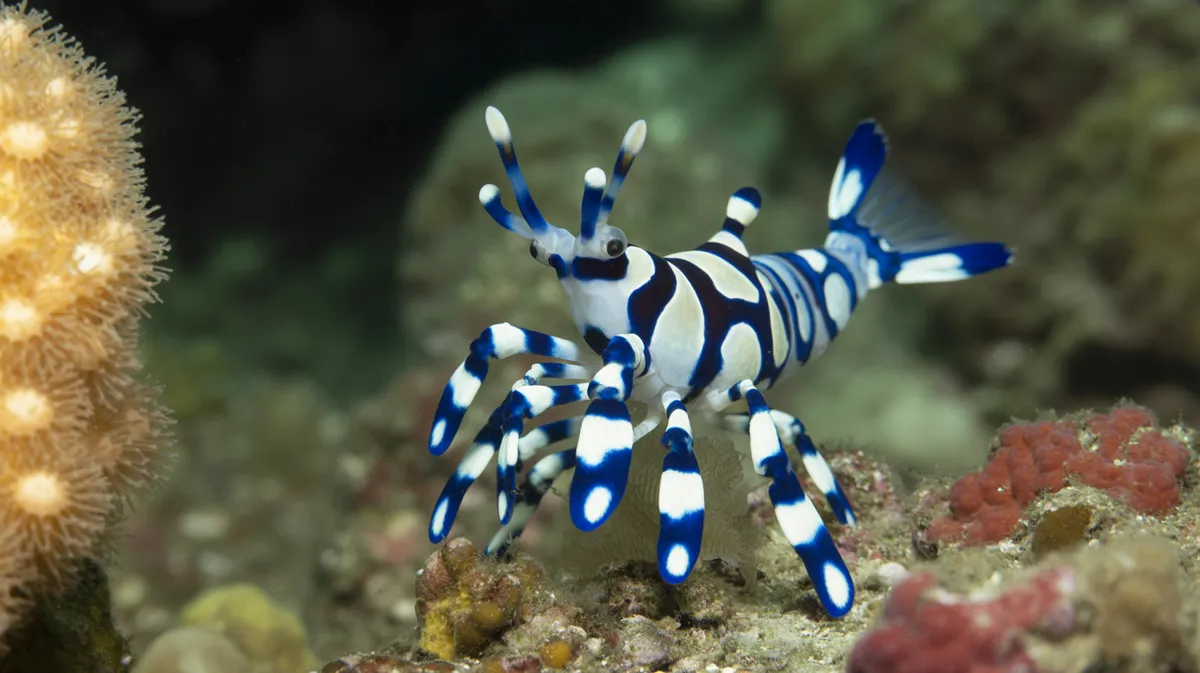
About the Harlequin shrimp
Hymenocera picta eats one thing: sea stars. It has no fallback diet, and its entire body plan is a set of tools for that job. The flattened, petal-like antennules sniff out prey chemically; the enlarged, blade-flat claws are used not to crush but to lever a starfish's arm free of the substrate and to slice through the tube feet. A bonded pair - harlequin shrimp are monogamous and work together - will flip a starfish onto its back so it cannot grip, then drag it, sometimes for days and metres across the reef, back to a crevice. There they begin to eat it alive, starting at the tube feet and working slowly toward the disc, keeping the star alive for days or weeks so the meat stays fresh; some pairs even feed the immobilised star to keep it going longer. Because sea stars regenerate, a single victim can sustain a pair for an extended period. Their willingness to attack Acanthaster planci, the crown-of-thorns starfish that devastates coral, has led to trials using harlequin shrimp as a biological control, though they cannot come close to matching outbreak densities. The vivid cream and magenta blotching is aposematic and also breaks up their outline on rubble.
Fascinating facts
Sea Star Predators
Harlequin shrimp are among the few animals that prey almost exclusively on sea stars, including species considered toxic to other predators.
Dazzling Patterns
Their bright, harlequin-like coloration is unique among shrimp and helps them blend with the colorful coral reefs while also warning predators.
Loyal Pairs
These shrimp form lifelong monogamous pairs, hunting and living together within the same territory.
Detailed description
The harlequin shrimp (Hymenocera picta) is a small but visually striking marine crustacean, typically reaching lengths of 3–5 cm. Its body is laterally compressed and adorned with elaborate, asymmetrical patches of cream, white, and vivid blue, purple, or pink, depending on geographic origin. The shrimp’s most distinctive features are its large, flattened chelae (claws), which are paddle-like and often held outstretched, and its ornate, petal-shaped sensory antennules. The legs are banded and flattened, aiding in both locomotion and camouflage among coral rubble. Harlequin shrimp possess highly developed eyesight, with stalked compound eyes that provide acute vision for detecting prey and predators. They are obligate carnivores, highly specialized to feed almost exclusively on echinoderms, particularly sea stars. Typically found in pairs, these shrimp exhibit strong monogamous bonds and are rarely observed alone in the wild. Their cryptic coloration and secretive habits make them difficult to spot, as they often reside in crevices or under coral ledges. The species is distributed throughout the tropical Indo-Pacific, from the Indian Ocean to the central and eastern Pacific, inhabiting coral reefs at depths of 1–30 meters. Their intricate coloration not only serves as camouflage but may also play a role in mate recognition and territorial displays.
Did you know?
Harlequin shrimp can survive for weeks on a single sea star, methodically consuming it limb by limb while keeping the star alive for as long as possible.
Research & sources
Wikipedia summary
Hymenocera picta, commonly known as the harlequin shrimp, is a species of saltwater shrimp found at coral reefs in the tropical Indian and Pacific Oceans. It is usually considered the only species in the genus Hymenocera, but some split it into two species: H. picta from the central and east Pacific, where the spots are deep pinkish-purple with a yellow edge, and H. elegans from the Indian Ocean and west Pacific, where the spots are more brownish and have a blue edge. They reach about 5 cm (2.0 in) in length, live in pairs, and feed exclusively on starfish, including crown-of-thorns starfish. They do seem to prefer smaller, more sedentary starfish, but as these generally are not sufficiently numerous for their needs, they commonly attack crown-of-thorns starfish, both reducing its consumption of coral while under attack, and killing it within a few days.
Behaviour & social structure
Harlequin shrimp are primarily crepuscular, being most active during dawn and dusk. They are highly territorial and maintain a fixed home range, which they defend aggressively against conspecifics and other shrimp species. Pairs cooperate in hunting, using their chelae to flip over sea stars and immobilize them by severing tube feet or manipulating the prey’s arms. They feed by consuming the soft tissues of the sea star, often keeping the prey alive for several days to ensure a fresh food supply. Communication between pair members involves tactile and chemical cues, and they may engage in ritualized displays to reinforce pair bonds. When not hunting, harlequin shrimp spend much of their time cleaning themselves and maintaining their burrow or hiding spot. They show a preference for certain starfish species, such as Linckia laevigata and Fromia spp., but will attack larger and more mobile prey like the crown-of-thorns starfish (Acanthaster planci) when necessary.
Reproduction & life cycle
Harlequin shrimp are believed to form long-term monogamous pairs, with both partners participating in territory defense and hunting. Courtship involves antennal stroking and synchronized movements. Females carry fertilized eggs on their pleopods (swimmerets) for approximately 12–18 days, depending on water temperature. During this brooding period, the female remains relatively reclusive, while the male may increase foraging activity. Upon hatching, larvae are planktonic and undergo several zoeal stages over 3–4 weeks before settling to the benthos and metamorphosing into juvenile shrimp. There is no parental care after larval release. Breeding appears to occur year-round in tropical waters, with peaks correlated to warmer temperatures and increased food availability.
Adaptations & survival
Hymenocera picta exhibits several remarkable adaptations. Its cryptic coloration and disruptive patterns provide effective camouflage among corals and rubble, reducing predation risk. The enlarged chelae are specialized for manipulating and dismembering echinoderm prey, while the paddle-like legs aid in precise, stealthy movement. Chemoreceptors on the antennules allow the shrimp to detect chemical cues from prey and conspecifics. Behavioral adaptations include cooperative hunting and food hoarding, as well as the ability to exploit the toxic crown-of-thorns starfish, which many other predators avoid. The species' monogamous pairing and territoriality may enhance reproductive success and resource defense in the patchy reef environment.
Cultural significance
Harlequin shrimp are highly prized in the marine aquarium trade for their beauty and unique behaviors, often symbolizing exoticism and rarity. In some Pacific cultures, their striking appearance has inspired local art and folklore, though there is no evidence of traditional medicinal or culinary use. Their ecological role as predators of crown-of-thorns starfish has garnered attention from conservationists, as they may help control outbreaks that threaten coral reefs.
Recent research
Recent research has focused on the harlequin shrimp’s feeding ecology and its potential as a biological control agent for crown-of-thorns starfish outbreaks. Studies have examined their chemosensory abilities, revealing highly specialized receptors for detecting starfish prey. Molecular analyses are ongoing to resolve the taxonomic distinction between H. picta and H. elegans, with some evidence supporting species-level separation based on genetic and morphological differences. Behavioral studies have documented complex pair-bonding and cooperative hunting strategies. There is growing interest in captive breeding to reduce wild collection pressures, with some success in rearing larvae through multiple zoeal stages in laboratory settings.
Videos
Habitat
Coral reefs

Conservation
The Harlequin shrimp is currently classified as Least Concern on the IUCN Red List.
Threats & challenges
Currently, harlequin shrimp are listed as Least Concern, but they face several localized threats. Overcollection for the marine aquarium trade can deplete populations in accessible areas. Habitat degradation from coral reef destruction, pollution, and climate change poses significant risks, as the shrimp depend on healthy reef ecosystems and abundant echinoderm prey. Invasive species and outbreaks of crown-of-thorns starfish may alter prey availability and disrupt ecological balance. While not currently endangered, population trends are poorly monitored, and ongoing habitat loss could threaten some populations in the future.
Taxonomy
Scientific name
Hymenocera picta
- Kingdom
- Animalia
- Phylum
- Arthropoda
- Class
- Malacostraca
- Order
- Decapoda
- Family
- Gnathophyllidae
- Genus
- Hymenocera
- Species
- picta
Community notes
Share your observations about the Harlequin shrimp.
No community notes yet. Be the first!
Discover more wildlife
More fascinating animals from the encyclopedia.