
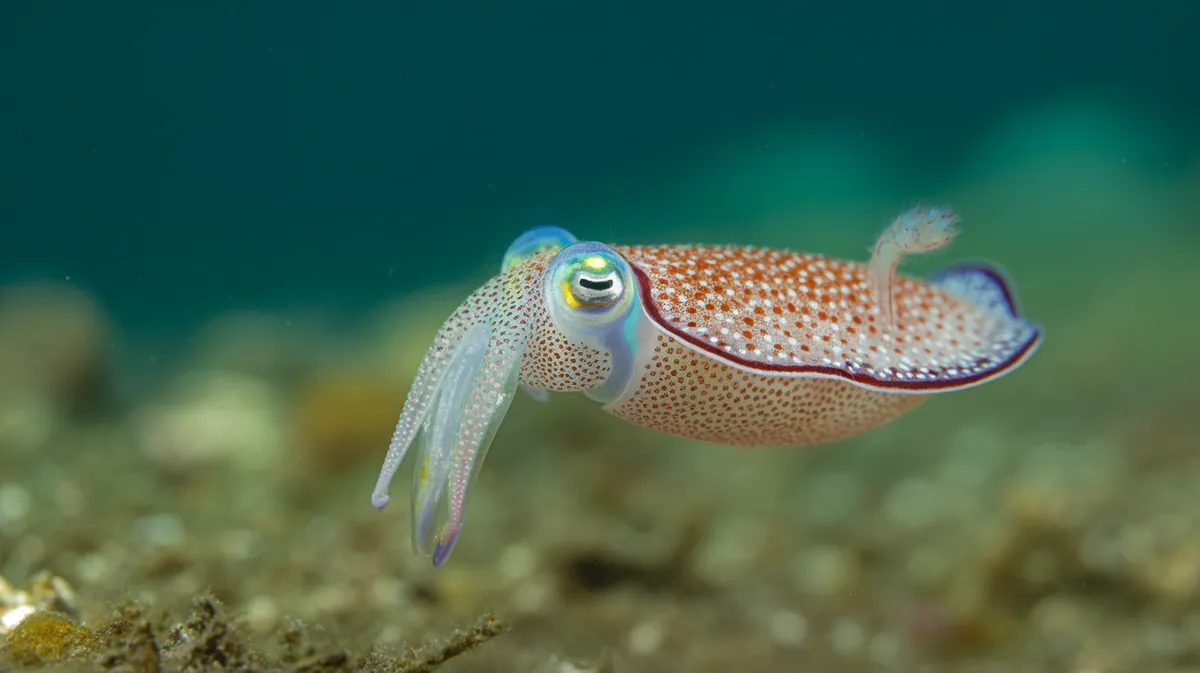
About the Hawaiian bobtail squid
Euprymna scolopes, a thumb-sized squid that hunts in Hawaiian shallows at night, is the most important animal in the study of how animals and bacteria form partnerships. It hatches sterile, with an empty light organ, and within hours must recruit a single species of luminous bacterium, Vibrio fischeri, from seawater where that species is vanishingly rare. The squid's light organ is a filtering gauntlet: ciliated fields sweep bacteria in, mucus traps them, and a series of chemical and physical checkpoints - including an oxidative burst and narrow ducts - eliminate everything except the right partner. Once inside, the bacteria multiply, switch on their luminescence via quorum sensing, and the squid uses that light for counter-illumination, projecting downward glow that erases its silhouette against moonlit water, with a reflective tissue and an ink-sac shutter that let it tune the brightness to the moon. Every dawn the squid vents about 95 percent of its bacterial colony into the sea and lets the remainder regrow through the day. Margaret McFall-Ngai and Edward Ruby's work on this system defined much of what we understand about how a host selects one microbe out of thousands - the foundational model for research on animal microbiomes.
Fascinating facts
Bioluminescent Partner
The squid houses Vibrio fischeri bacteria in a specialized light organ, enabling it to glow and blend in with moonlight or starlight at night.
Tiny Cephalopod
Despite being a squid, adults grow only up to 3 centimeters in length, making them one of the smallest cephalopods.
Model Organism
Scientists use the Hawaiian bobtail squid to study animal-microbe relationships, providing valuable insights into symbiosis.
Detailed description
The Hawaiian bobtail squid (Euprymna scolopes) is a small cephalopod, typically measuring 2–3 cm in mantle length, with a maximum recorded length of about 3.5 cm. Its body is rounded and compact, with a short, broad mantle and eight arms lined with suckers, as well as two slightly longer tentacles used for prey capture. The skin is embedded with specialized pigment cells called chromatophores, iridophores, and leucophores, allowing rapid color and texture changes for camouflage. This species is nocturnal, spending daylight hours buried in sandy substrates and emerging at night to hunt. A defining feature is its light organ, located in the mantle cavity, which houses symbiotic bioluminescent bacteria (Vibrio fischeri). This organ enables the squid to emit light that matches the intensity and color of downwelling moonlight or starlight, effectively erasing its silhouette from predators below—a phenomenon known as counter-illumination. The Hawaiian bobtail squid is solitary, with individuals maintaining territories. It is a benthic species, preferring shallow coastal habitats with sandy or muddy bottoms, typically at depths of 2–30 meters. Its lifespan is short, generally less than one year, and it exhibits rapid growth and early sexual maturity.
Did you know?
This squid can regulate the amount of light it emits by controlling the population of its symbiotic bacteria daily.
Research & sources
Wikipedia summary
Euprymna scolopes, also known as the Hawaiian bobtail squid, is a species of bobtail squid in the family Sepiolidae native to the central Pacific Ocean, where it occurs in shallow coastal waters off the Hawaiian Islands and Midway Island. The type specimen was collected off the Hawaiian Islands and is located at the National Museum of Natural History in Washington, D.C.
Behaviour & social structure
Euprymna scolopes is primarily nocturnal, emerging from its daytime burrows in the sand at dusk to forage. It exhibits ambush predation, lying in wait for small crustaceans, polychaete worms, and juvenile fish, which it captures with a rapid extension of its tentacles. The squid uses its chromatophores for dynamic camouflage, blending with the substrate or displaying disruptive patterns to confuse predators and prey. Social interactions are minimal outside of mating, as individuals are generally solitary and territorial. The squid is known for its meticulous sand-burying behavior, using jet propulsion and arm movements to cover itself completely except for its eyes. Daily routines include expelling most of the symbiotic Vibrio fischeri bacteria from the light organ at dawn, followed by reacquisition and regrowth of the bacterial population throughout the day, a process tightly regulated by both host and symbiont.
Reproduction & life cycle
Reproduction in E. scolopes involves internal fertilization. Mating typically occurs at night, with males transferring spermatophores to the female's mantle cavity using a specialized arm called the hectocotylus. Females lay clusters of 20–100 eggs, attaching them to the underside of rocks or within crevices in the substrate. The eggs are encased in a gelatinous capsule and incubate for approximately 20–30 days, depending on water temperature. There is no parental care after egg-laying; hatchlings are planktonic and immediately begin the search for Vibrio fischeri in the environment to colonize their light organs. Breeding may occur year-round in the stable tropical waters of Hawaii, but peak reproductive activity is often observed during warmer months.
Adaptations & survival
The Hawaiian bobtail squid exhibits several remarkable adaptations. Its symbiotic relationship with Vibrio fischeri is a prime example of mutualism, providing camouflage through bioluminescence while offering the bacteria a nutrient-rich habitat. Chromatophores, iridophores, and leucophores in the skin enable rapid changes in coloration and reflectivity, facilitating both camouflage and communication. The squid's ability to bury itself in sand is an effective anti-predator strategy. Its short life cycle and rapid maturation are evolutionary responses to high predation pressure. The light organ is structurally complex, with reflectors and lenses that control the direction and intensity of emitted light, finely tuned to match environmental conditions.
Cultural significance
While not a major figure in traditional Hawaiian mythology, the Hawaiian bobtail squid has gained cultural and scientific significance as a model organism in microbiology and symbiosis research. Its unique partnership with Vibrio fischeri has made it a symbol of beneficial animal-microbe relationships, frequently featured in educational materials and outreach programs. The squid is sometimes referenced in local ecotourism and marine education efforts, highlighting the biodiversity of Hawaiian coastal ecosystems.
Recent research
Euprymna scolopes is a cornerstone model for studying animal-bacterial symbiosis, particularly the molecular and genetic mechanisms underlying host-microbe interactions. Recent research has focused on the squid's immune system and its role in selecting and maintaining the Vibrio fischeri symbiont. Studies have elucidated the daily rhythm of bacterial expulsion and regrowth, revealing intricate host control over symbiont populations. Genomic sequencing of both the squid and the bacteria has provided insights into co-evolution and mutual adaptation. The squid's light organ development and the influence of microbiota on host tissue differentiation are active areas of investigation. Additionally, E. scolopes is used to explore cephalopod neural development, camouflage, and behavioral ecology.
Videos
Habitat
Shallow coastal waters

Conservation
The Hawaiian bobtail squid is currently classified as Least Concern on the IUCN Red List.
Threats & challenges
Currently, E. scolopes is listed as Data Deficient by the IUCN, reflecting a lack of comprehensive population data. However, its restricted range makes it potentially vulnerable to habitat degradation, coastal development, pollution, and climate change impacts such as ocean acidification. Light pollution may interfere with its nocturnal behaviors and bioluminescent camouflage. Collection for scientific research, while not currently a major threat, could impact local populations if not managed sustainably. There are no known large-scale fisheries targeting this species.
Taxonomy
Scientific name
Euprymna scolopes
- Kingdom
- Animalia
- Phylum
- Mollusca
- Class
- Cephalopoda
- Order
- Sepiolida
- Family
- Sepiolidae
- Genus
- Euprymna
- Species
- scolopes
Community notes
Share your observations about the Hawaiian bobtail squid.
No community notes yet. Be the first!
Discover more wildlife
More fascinating animals from the encyclopedia.