
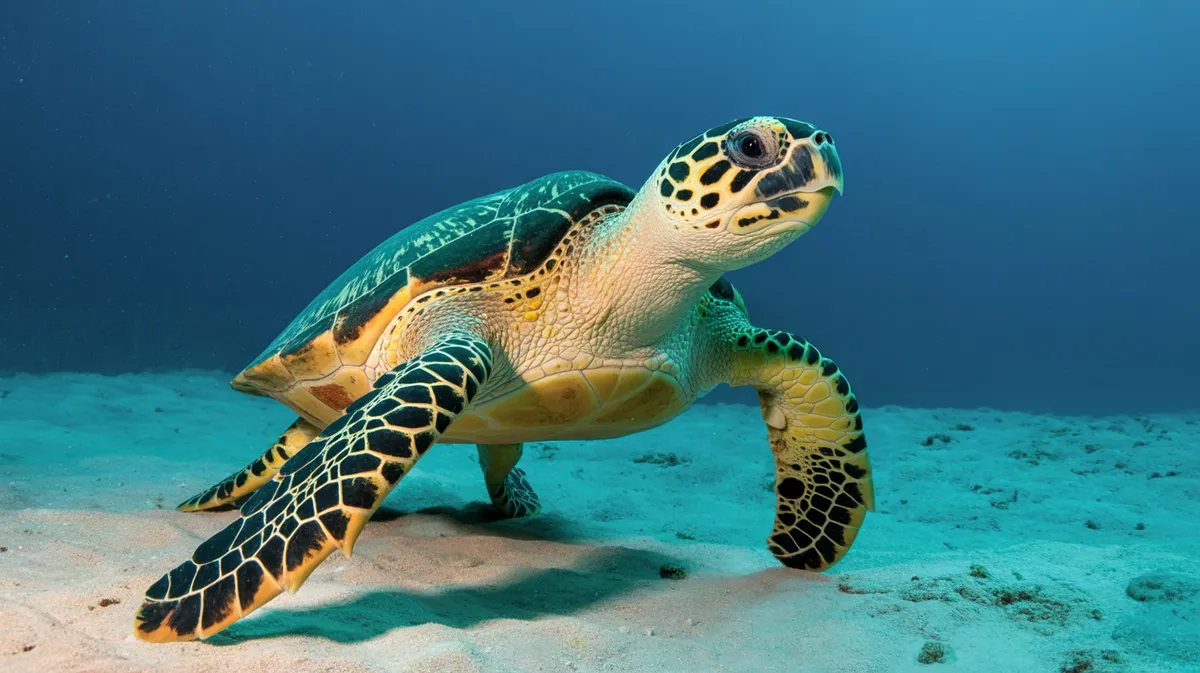
About the Hawksbill Sea Turtle
Eretmochelys imbricata is the only sea turtle whose scutes overlap like roof tiles, and that shell is the reason it is Critically Endangered. Polished, it becomes "tortoiseshell" - bekko in Japan - and for centuries it was worked into combs, spectacle frames, boxes and inlay; Japan alone imported the shells of an estimated two million hawksbills in the twentieth century before ending legal trade in the 1990s. The turtle's ecological role is unusual: it is a sponge specialist, and it eats sponges that are chemically defended and full of glass-like silica spicules that would shred most gut linings. By cropping fast-growing sponges off the reef it opens space for slow-growing corals, so hawksbill loss is directly linked to reef degradation. Their narrow, raptor-like beak is built to reach into crevices, and they will also take the venomous hydrozoan fire coral and stinging jellyfish, apparently unbothered. In 2015 researchers documented that hawksbills are biofluorescent, glowing red and green under blue light, the first reptile shown to do so, though how much of the effect is the turtle and how much is encrusting algae is still debated. They can accumulate sponge toxins in their flesh, making hawksbill meat sometimes lethally poisonous to humans.
Fascinating facts
Unique Shell
The hawksbill's shell, with its overlapping scutes, is highly valued for decorative purposes but has led to the species' dramatic population decline.
Sponge Specialist
Their primary diet consists of sponges, some of which are toxic to other species, helping maintain coral reef health.
Wide Distribution
Hawksbill Sea Turtles are found throughout tropical waters of the Atlantic, Pacific, and Indian Oceans, especially near coral reefs and rocky coastlines.
Detailed description
The hawksbill sea turtle (Eretmochelys imbricata) is a medium-sized marine reptile, typically measuring 60–90 cm (24–35 in) in carapace length and weighing between 45–70 kg (99–154 lbs) as adults. Its carapace is heart-shaped in juveniles, becoming more elongated with age, and is distinguished by thick, overlapping (imbricated) scutes with a striking pattern of amber, brown, and gold. The turtle’s narrow, pointed beak—resembling a bird’s bill—enables it to reach into crevices of coral reefs to extract prey. The plastron is pale yellow, and the limbs are paddle-shaped with two visible claws on each flipper. Hawksbills are primarily solitary, coming together only for mating or at feeding grounds with abundant resources. They are diurnal, actively foraging during daylight hours and resting in reef crevices or under ledges at night. Their diet is highly specialized, with sponges comprising up to 95% of their intake, but they also consume tunicates, jellyfish, sea anemones, and algae. This species exhibits natal homing, with females returning to the beaches where they were born to nest. Hawksbills are long-lived, with lifespans estimated at 30–50 years or more, and reach sexual maturity at 20–35 years. Their ecological role is vital, as their selective feeding on sponges helps maintain coral reef diversity and health.
Did you know?
Hawksbill Sea Turtles can nest as many as six times in a single season, laying up to 200 eggs per nest.
Research & sources
Wikipedia summary
The hawksbill sea turtle is a critically endangered sea turtle belonging to the family Cheloniidae. It is the only extant species in the genus Eretmochelys. The species has a global distribution that is largely limited to tropical and subtropical marine and estuary ecosystems.
Behaviour & social structure
Hawksbill sea turtles are generally solitary, except during the breeding season or when aggregating at rich feeding sites. They are strong swimmers, capable of covering large distances between feeding and nesting grounds. Foraging is primarily diurnal; individuals use their sharp, curved beaks to extract sponges and other invertebrates from tight reef crevices, displaying both dexterity and selectivity. They have been observed using their forelimbs to steady themselves or manipulate prey. Hawksbills are territorial at feeding sites, sometimes displaying aggressive behaviors such as biting or ramming to defend prime foraging areas. Rest periods are spent wedged into reef crevices or under ledges, providing protection from predators. Juveniles are more pelagic, drifting in ocean currents until they reach a size suitable for settling in coastal habitats.
Reproduction & life cycle
Breeding occurs every 2–4 years, with females migrating hundreds or even thousands of kilometers to return to their natal beaches. Mating takes place in shallow waters off nesting beaches, often involving multiple males competing for a single female. Females lay 2–5 clutches per season, each containing 100–140 eggs, with intervals of 14–16 days between clutches. Nesting typically occurs at night, with the female excavating a nest chamber above the high tide line. Incubation lasts 50–70 days, depending on sand temperature, which also determines the sex of hatchlings (warmer sands produce more females). There is no parental care after egg-laying; hatchlings emerge en masse and orient toward the brightest horizon, usually the sea. Only a small fraction survive to adulthood due to predation and environmental hazards.
Adaptations & survival
Hawksbills possess a uniquely narrow, hooked beak adapted for extracting sponges and invertebrates from complex reef structures, a specialization unmatched among sea turtles. Their overlapping scutes provide both protection and camouflage among corals. They are highly resistant to toxins found in many sponges and cnidarians, allowing them to exploit food sources unavailable to most predators. Their strong, paddle-like forelimbs enable efficient long-distance swimming and precise maneuvering in reef environments. Natal homing ensures reproductive success by returning females to proven nesting sites. Their cryptic coloration and nocturnal nesting behavior reduce predation risk.
Cultural significance
Hawksbill turtles have been highly valued for their ornate shells for millennia, particularly in Asia and the Mediterranean, where 'tortoiseshell' was crafted into combs, jewelry, and decorative objects. In some cultures, hawksbills are featured in folklore and mythology as symbols of longevity, wisdom, or the sea. Traditional use of their shells persists illegally in some regions despite international bans. Conservation efforts now highlight their ecological importance and promote their image as flagship species for coral reef protection.
Recent research
Recent genetic studies have clarified hawksbill population structure, revealing distinct regional management units critical for conservation planning. Satellite telemetry has documented extensive migratory routes, emphasizing the need for international cooperation in protection. Research into their diet has shown that hawksbills play a unique ecological role in controlling sponge populations, which can otherwise outcompete corals. Studies on climate change impacts highlight the vulnerability of nesting sites to sea level rise and temperature-driven sex ratio shifts. Ongoing projects include the use of artificial intelligence for nest monitoring and the development of community-based conservation initiatives in key range countries.
Videos
Habitat
Tropical coral reefs and coastal lagoons

Conservation
The Hawksbill Sea Turtle is currently classified as Critically Endangered on the IUCN Red List.
Threats & challenges
The hawksbill sea turtle faces severe threats from illegal trade in 'tortoiseshell' (bekko), used for jewelry and ornaments, leading to drastic population declines. Habitat loss from coastal development, coral reef degradation, and climate change further threaten nesting and foraging grounds. Accidental capture (bycatch) in fisheries, especially in trawl and gillnet operations, remains a significant mortality factor. Egg poaching and predation by introduced mammals on nesting beaches reduce recruitment. Rising sand temperatures due to climate change may skew sex ratios, threatening future population viability. Global populations have declined by more than 80% over the last century, with some regional populations functionally extinct.
Taxonomy
Scientific name
Eretmochelys imbricata
- Kingdom
- Animalia
- Phylum
- Chordata
- Class
- Reptilia
- Order
- Testudines
- Family
- Cheloniidae
- Genus
- Eretmochelys
- Species
- imbricata
Where to see a hawksbill sea turtle
1 zoo and aquarium in 1 country are recorded as keeping this species.

Community notes
Share your observations about the Hawksbill Sea Turtle.
No community notes yet. Be the first!
Discover more wildlife
More fascinating animals from the encyclopedia.