
About the Hellbender
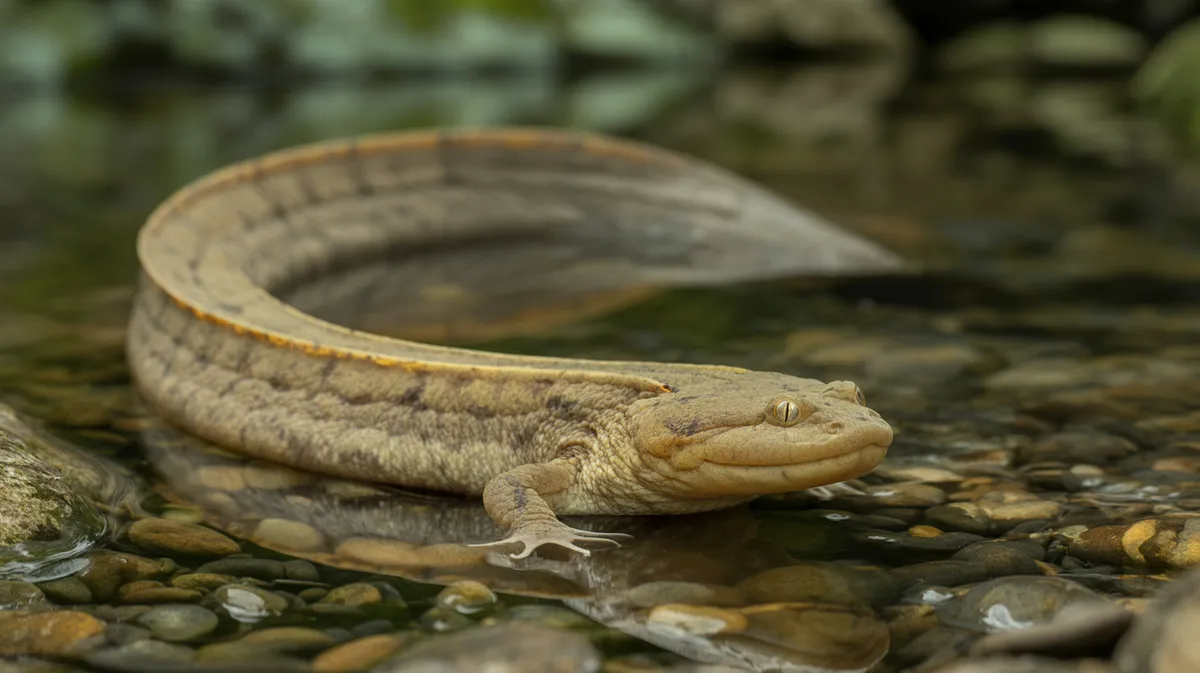
Cryptobranchus alleganiensis is North America's largest amphibian, reaching 74 cm, and it lives its whole life under a single large flat rock in a cold, fast Appalachian or Ozark stream. It has lungs but barely uses them for gas exchange; instead it absorbs oxygen through skin thrown into loose, wrinkled lateral folds that dramatically increase surface area, and it rocks its body side to side to keep fresh water flowing across them. Those folds mean it can only survive in water that is cold, turbulent and highly oxygenated, which makes it a strict indicator species: a silted stream suffocates hellbenders long before it visibly harms anything else. Males, not females, choose and defend the nest rock, excavate a cavity under it, court females in, and then guard the eggs for months, fanning them and eating any that fungus. The near-universal beliefs that hellbenders are venomous, that they poison trout streams, or that they can bite through a fishing line are all false; they are harmless, eat mostly crayfish, and anglers who kill them on sight have been a significant source of mortality. Populations have crashed across most of the range from siltation, dams and disease, and the Ozark subspecies is federally endangered.
Fascinating facts
Aquatic Specialist
Hellbenders are fully aquatic and rarely leave the water, spending nearly all their lives hidden under large rocks in streams.
Unusual Respiration
Adult hellbenders lack true gills and instead absorb oxygen directly through their wrinkled skin.
Parental Care
Male hellbenders guard the nest and protect the eggs after the female lays them, a rare trait among amphibians.
Detailed description
The hellbender (Cryptobranchus alleganiensis) is a fully aquatic salamander, reaching adult lengths of 30–74 cm (12–29 in), with some individuals exceeding 60 cm, making it the largest salamander in North America. Its dorsoventrally flattened body and broad, flattened head are complemented by loose, frilled skin folds along the sides, which dramatically increase surface area for cutaneous respiration. The skin is typically mottled brown or gray, providing camouflage among riverbed rocks. Hellbenders possess small, lidless eyes positioned dorsally, adapted for low-light environments. Limbs are short but robust, with four toes on the forelimbs and five on the hindlimbs. They have a laterally compressed tail used for propulsion in swift currents. Lacking external gills as adults, hellbenders rely almost entirely on gas exchange through their skin, which must remain moist and is highly sensitive to water quality. Their sensory system includes a lateral line, similar to fishes, allowing detection of vibrations and movement in the water. Hellbenders are primarily nocturnal and secretive, spending daylight hours concealed beneath large, flat rocks. Lifespans in the wild can exceed 25–30 years, with some individuals in captivity living over 30 years.
Did you know?
Hellbenders can live up to 30 years in the wild, making them one of the longest-lived amphibians in North America.
Research & sources
Wikipedia summary
The hellbender, also known as the hellbender salamander, is a species of aquatic giant salamander endemic to the eastern and central United States. It is the largest salamander in North America. A member of the family Cryptobranchidae, the hellbender is the only extant member of the genus Cryptobranchus. Other closely related salamanders in the same family are in the genus Andrias, which contains the Japanese and Chinese giant salamanders. The hellbender is much larger than any other salamander in its geographic range, and employs an unusual adaption for respiration through cutaneous gas exchange via capillaries found in its lateral skin folds. It fills a particular niche—both as a predator and prey—in its ecosystem, which either it or its ancestors have occupied for around 65 million years. The species is listed as Vulnerable on the IUCN Red List of Threatened Species due to the impacts of disease and widespread habitat loss and degradation throughout much of its range.
Behaviour & social structure
Hellbenders are solitary and highly territorial, especially outside the breeding season. They are predominantly nocturnal, emerging at night to hunt for prey such as crayfish, small fish, insects, and other aquatic invertebrates. Their hunting strategy is largely ambush-based; they remain motionless under rocks or debris, lunging quickly to capture passing prey with a rapid suction created by opening their large mouths. Hellbenders are not strong swimmers and prefer to crawl along the substrate. During the day, they remain hidden to avoid predation and desiccation. Aggressive encounters may occur between individuals competing for optimal shelter sites. They exhibit site fidelity, often returning to the same shelter for extended periods. Communication is primarily through tactile and chemical cues, as vocalizations are absent.
Reproduction & life cycle
Breeding occurs in late summer to early autumn (typically August–September), varying by latitude and water temperature. Males establish and defend nesting sites beneath large, flat rocks or submerged logs, excavating a cavity in the substrate. Females are attracted to these nests and may lay between 150 and 400 eggs in a single clutch, which are fertilized externally by the male. The male then guards the eggs for 45–75 days, fanning them with his tail to ensure adequate oxygenation and prevent fungal growth. No further parental care is provided after hatching. Larvae are fully aquatic, possess external gills, and remain hidden in gravel or under rocks, feeding on small invertebrates. Metamorphosis is gradual, with external gills being lost after 1–2 years, and sexual maturity is typically reached at 5–8 years of age.
Adaptations & survival
Hellbenders exhibit several remarkable adaptations for their aquatic lifestyle. Their loose, wrinkled skin folds maximize surface area for cutaneous respiration, a necessity in well-oxygenated, fast-flowing streams. The lateral line system enables detection of water movement and prey in turbid or dark environments. Their flattened bodies and broad heads allow them to squeeze into narrow crevices and resist strong currents. Cryptic coloration provides camouflage from both predators and prey. The absence of lungs in adults reduces buoyancy, aiding in remaining submerged and stationary on the streambed. Behavioral adaptations include nocturnality to avoid diurnal predators and reduce competition, as well as strong site fidelity to optimal shelter locations.
Cultural significance
The hellbender has been the subject of local folklore and regional names, including 'snot otter,' 'devil dog,' and 'Allegheny alligator.' While not widely featured in mainstream mythology, its unusual appearance and size have inspired both fascination and fear, sometimes leading to persecution. In recent years, it has become a symbol of clean water advocacy, with conservation groups using the hellbender as a flagship species for river and stream protection efforts. The hellbender was named the official state amphibian of Pennsylvania in 2019, reflecting its ecological and cultural importance in the region.
Recent research
Recent research has focused on the impacts of environmental stressors on hellbender health, including studies on the effects of water quality, disease prevalence, and genetic diversity. Conservation genetics has revealed significant population fragmentation, especially in the Ozark subspecies, prompting captive breeding and reintroduction programs. Advances in environmental DNA (eDNA) techniques have improved detection and monitoring of wild populations. Studies on cutaneous microbiomes are exploring potential resistance to chytrid fungus. Ongoing research also investigates the species' physiological responses to temperature and oxygen fluctuations, informing habitat management strategies. The hellbender serves as an indicator species for freshwater ecosystem health, making it a focal point for broader conservation initiatives.
Videos
Habitat
Clean, fast-flowing, rocky streams and rivers
 Elevated Terrain
Mountain
High-altitude environments with varying climates and specialized wildlife adapted to rugged terrain and thin air.
 Global
Forest
Wooded areas with significant tree cover and diverse plant and animal communities.
 Global
Freshwater
Lakes, rivers, and wetlands with diverse aquatic ecosystems.
Conservation
The Hellbender is currently classified as Near Threatened on the IUCN Red List.
Threats & challenges
Hellbender populations have declined sharply across their range due to a combination of threats. Habitat loss and degradation, primarily from sedimentation, dam construction, and pollution, reduce water quality and eliminate suitable nesting and shelter sites. Siltation clogs the interstitial spaces between rocks, suffocating eggs and larvae. Agricultural runoff, mining, and urbanization introduce contaminants and reduce dissolved oxygen levels. Emerging infectious diseases, such as chytridiomycosis (caused by Batrachochytrium dendrobatidis) and ranavirus, have further impacted populations. Illegal collection for the pet trade and bait use, as well as persecution due to mistaken beliefs about their danger, also contribute to declines. Climate change poses additional risks by altering stream flow regimes and water temperatures. The IUCN currently lists the species as Vulnerable, with some populations, such as the Ozark hellbender (C. a. bishopi), considered Endangered.
Taxonomy
Scientific name
Cryptobranchus alleganiensis
- Kingdom
- Animalia
- Phylum
- Chordata
- Class
- Amphibia
- Order
- Urodela
- Family
- Cryptobranchidae
- Genus
- Cryptobranchus
- Species
- alleganiensis
Where to see a hellbender
5 zoos and aquariums in 1 country are recorded as keeping this species.
 National Zoological Park🇺🇸 Washington, United States
 Turtle Back Zoo🇺🇸 West Orange, United States
- 🦁The Maryland Zoo in Baltimore🇺🇸 Baltimore, United States
 Louisville Zoo🇺🇸 United States
- 🦁Nashville Zoo at Grassmere🇺🇸 United States
Community notes
Share your observations about the Hellbender.
No community notes yet. Be the first!
Discover more wildlife
More fascinating animals from the encyclopedia.