
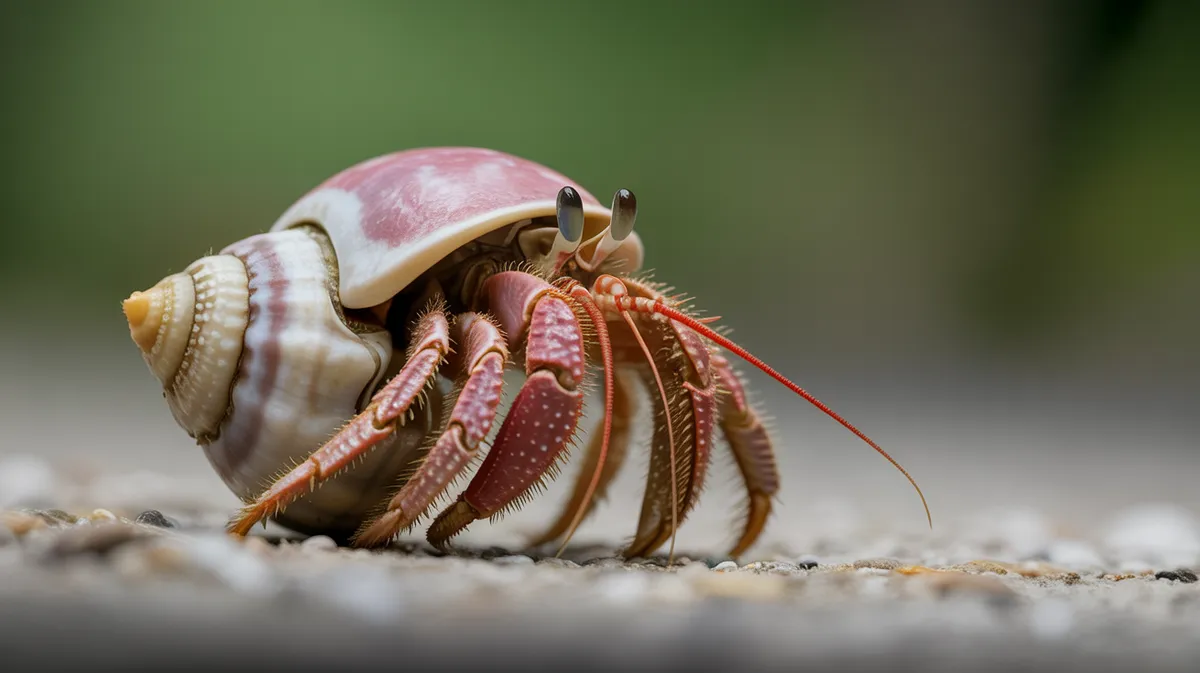
About the Hermit Crab
Hermit crabs are decapods that traded a hard abdomen for a soft, spirally curved one that fits inside an empty gastropod shell, held in place by a hooked tail and modified rear legs that grip the shell's inner column. Because they cannot make shells, the entire life of a hermit crab is limited by a resource they must scavenge, and this has produced one of the most cited pieces of animal economics: the vacancy chain. When a large new shell washes up, crabs gather and queue by size, and the moment the biggest crab moves in, the next-largest takes the shell it left, and so on down the line - a single new shell can rehouse a dozen animals in a matter of seconds. Terrestrial species will also form "gregarious" queues around a crab that looks close to moulting. Crabs fight over shells by rapping their own shell against an occupant's in a stereotyped rhythm until the loser evicts. Some marine species carry sea anemones on the shell for defence and deliberately transfer them when they move house. Land hermit crabs must still return to the sea to release larvae, and they need standing pools of both fresh and salt water to keep their gill chambers functioning.
Fascinating facts
Shell Swappers
Hermit crabs must find and move into larger shells as they grow, sometimes lining up in 'vacancy chains' to exchange shells with others.
Not True Crabs
Despite their name, hermit crabs are not considered true crabs because of their unique body structure and evolutionary lineage.
Diverse Habitats
Hermit crabs inhabit a wide range of environments, from shallow coral reefs and seagrass beds to sandy beaches and even tropical forests.
Detailed description
Hermit crabs (superfamily Paguroidea) are a diverse group of anomuran decapod crustaceans, comprising over 800 described species distributed across marine, brackish, and terrestrial environments worldwide. Unlike true crabs, hermit crabs possess a soft, spirally curved abdomen that is highly vulnerable to predation and desiccation, necessitating the occupation of empty gastropod shells or, in some species, alternative shelters such as hollow wood or coral. Their bodies are markedly asymmetrical, with the abdomen coiling to the right to fit the spiral of most mollusk shells, and the right chela (claw) often being larger and used as a protective operculum. Hermit crabs exhibit complex social behaviors, including group living, shell selection hierarchies, and even organized 'shell exchange chains' where multiple individuals swap shells in sequence. They are omnivorous scavengers, feeding on detritus, algae, carrion, and small invertebrates, and play a crucial role in nutrient cycling within their ecosystems. Many species possess specialized gills adapted for either aquatic or terrestrial respiration, and some terrestrial species (family Coenobitidae) have evolved lungs for breathing air. Reproduction typically involves external fertilization, with females carrying fertilized eggs on their pleopods until hatching. Larvae are planktonic and undergo several zoeal and megalopa stages before settling and acquiring their first shell. Hermit crabs are notable for their behavioral plasticity, adaptability to diverse habitats, and intricate mutualistic relationships with other organisms, such as sea anemones and polychaete worms that attach to their shells for mutual protection.
Did you know?
Hermit crabs are not true crabs; their closest relatives are actually squat lobsters and porcelain crabs.
Research & sources
Wikipedia summary
Hermit crabs are anomuran decapod crustaceans of the superfamily Paguroidea that have adapted to occupy empty scavenged mollusc shells to protect their fragile exoskeletons. There are over 800 species of hermit crab, most of which possess an asymmetric abdomen concealed by a snug-fitting shell. Hermit crabs' soft (non-calcified) abdominal exoskeleton means they must occupy shelter produced by other organisms or risk being defenseless.
Behaviour & social structure
Hermit crabs are primarily nocturnal, engaging in foraging and social interactions during the night to avoid diurnal predators and reduce desiccation risk. Their feeding behavior is opportunistic; they scavenge on dead animals, decaying plant matter, and algae, but some species actively hunt small invertebrates. Social interactions are highly developed, especially regarding shell acquisition. Hermit crabs assess potential shells by tactile and chemical cues, and when a desirable shell is found, they may engage in 'shell fights' or form queues where several individuals line up by size to exchange shells in a rapid sequence. Communication involves a combination of tactile, chemical, and sometimes auditory signals, such as stridulation (rubbing body parts to produce sound) during shell disputes. In terrestrial species, group living provides increased humidity and protection, while in marine species, aggregations may form around food sources or during larval release events.
Reproduction & life cycle
Hermit crab reproduction is generally sexual, with separate male and female individuals. Mating typically occurs after the female has molted, when her exoskeleton is soft. Males use their modified first pair of pleopods (gonopods) to transfer spermatophores to the female, often after an elaborate courtship involving tactile and chemical signaling. Females carry fertilized eggs attached to their pleopods under the abdomen for periods ranging from several weeks to over a month, depending on species and environmental conditions. Egg counts can range from a few hundred to over 50,000 per brood in larger species. Upon hatching, larvae are released into the water column (even by terrestrial species, which must return to the sea for this stage), where they undergo several planktonic zoeal stages followed by a megalopa stage. The megalopa settles to the substrate and seeks out a suitable shell before metamorphosing into the juvenile crab. Parental care is limited to egg brooding; no post-hatching care is provided.
Adaptations & survival
Hermit crabs exhibit a range of morphological and behavioral adaptations for survival. The most distinctive is their use of scavenged shells for protection, which has driven the evolution of their asymmetrical, flexible abdomen and specialized appendages for gripping the shell interior. Some species have developed symbiotic relationships with sea anemones or hydroids, which attach to the shell and provide additional defense via stinging cells, while benefiting from food scraps. Terrestrial hermit crabs have evolved modified gills and branchiostegal lungs to facilitate gas exchange in air, and behavioral adaptations such as burrowing and group clustering to maintain humidity. Their chelae are often unequal, with the larger claw used for defense and sealing the shell aperture, and the smaller for feeding. Sensory adaptations include well-developed antennae for chemoreception and mechanoreception, aiding in food detection and social communication.
Cultural significance
Hermit crabs have featured in various human cultures, often symbolizing adaptability, resourcefulness, and home. In some Pacific Island traditions, they are associated with creation myths or used as minor food sources. In modern times, hermit crabs are popular in the pet trade, especially terrestrial species like Coenobita clypeatus, though this has raised ethical and conservation concerns. Their unique lifestyle and behaviors have made them subjects of educational programs, children's literature, and ecological studies. In Japan, the marine hermit crab (Pagurus spp.) is sometimes kept in aquariums for its scavenging abilities.
Recent research
Recent research has focused on the cognitive abilities of hermit crabs, revealing advanced problem-solving skills and social learning, particularly in shell selection and exchange. Studies using RFID tagging and video monitoring have documented complex shell vacancy chains and negotiation behaviors. Molecular phylogenetics has clarified the evolutionary relationships within Paguroidea, revealing multiple independent transitions to terrestriality. Ecological research has highlighted the role of hermit crabs in nutrient cycling and as ecosystem engineers, influencing community structure in both marine and terrestrial habitats. Ongoing studies are investigating the impacts of microplastic pollution and climate change on shell availability and larval development, as well as the microbiomes associated with hermit crab shells.
Videos
Habitat
Coastal regions, intertidal zones, and tropical beaches


Conservation
The Hermit Crab is currently classified as Least Concern on the IUCN Red List.
Threats & challenges
While most hermit crab species are classified as Least Concern, they face several threats, particularly in coastal and island ecosystems. Habitat loss due to coastal development, pollution (especially microplastics, which can be ingested or used as substitute shells), and over-collection for the pet trade are significant concerns. The availability of suitable shells is a limiting factor for many populations; overharvesting of gastropods and shell collecting by humans can lead to shell shortages, resulting in increased mortality and reduced reproductive success. Climate change impacts, such as ocean acidification, may affect shell availability and larval development. Some terrestrial species are particularly vulnerable to habitat fragmentation and invasive species. Population trends are generally stable for widespread species, but localized declines have been documented in areas with intense human activity.
Taxonomy
Scientific name
Paguroidea
- Kingdom
- Animalia
- Phylum
- Arthropoda
- Class
- Malacostraca
- Order
- Decapoda
- Family
- Paguridae
- Genus
- Various (e.g., Coenobita, Pagurus)
- Species
- Paguroidea
Community notes
Share your observations about the Hermit Crab.
No community notes yet. Be the first!
Discover more wildlife
More fascinating animals from the encyclopedia.