
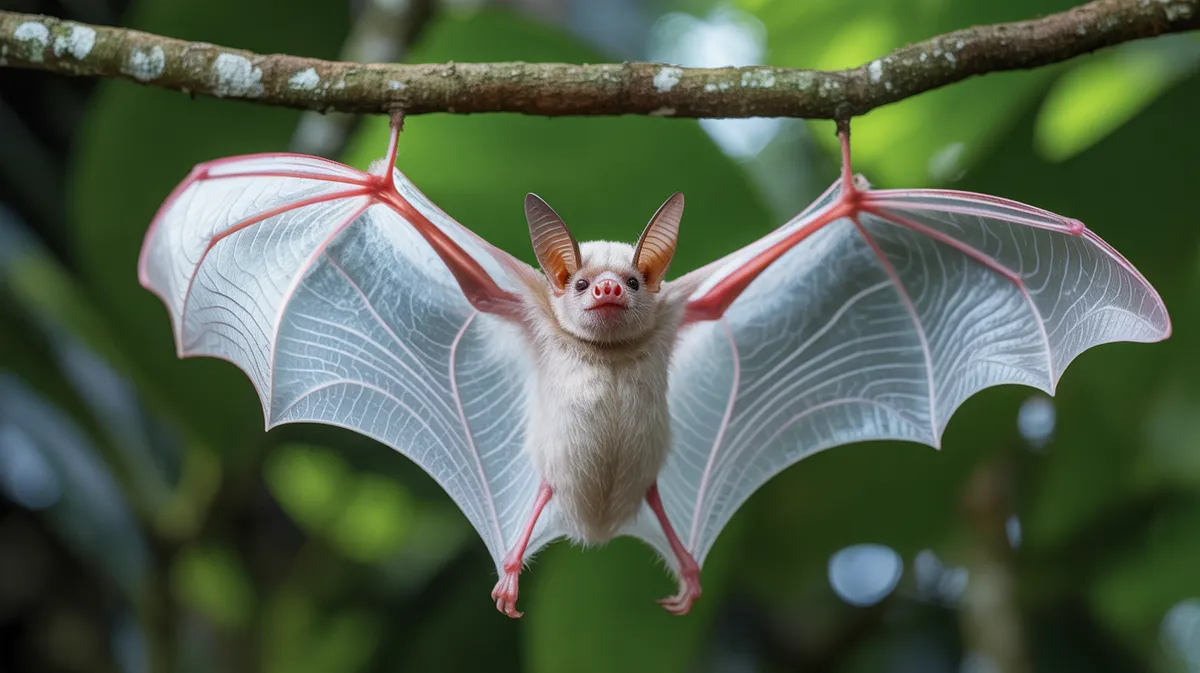
About the Honduran white bat
Ectophylla alba is a tiny snow-white bat, around 4 cm long, that lives in the lowland rainforests of Honduras, Nicaragua, Costa Rica and Panama, and it builds itself a house. Small groups bite along either side of the midrib of a large Heliconia leaf, severing the side veins so the leaf collapses into an inverted V, and then roost inside this green tent, clinging to the underside of the fold. The tent shelters them from rain and from the eyes of predators looking down. Sunlight filtering through the leaf bathes the roost in green light, and the bats' white fur takes on that cast, so a group of white bats in a green tent is effectively invisible from below. The white fur itself is unusual - fewer than a handful of bat species are white - and the bright yellow nose-leaf and ears get their colour from carotenoids, which the bat concentrates from the figs it eats; Ectophylla was the first mammal ever shown to deposit large amounts of dietary carotenoid directly into skin, published in 2016. Colonies are small, usually under a dozen, and both males and non-mother females help care for young. It is Near Threatened and tied directly to the survival of Heliconia understorey.
Fascinating facts
Leaf Tent Architects
Honduran white bats are one of the few bat species that modify their environment by crafting tents from Heliconia leaves for shelter.
Unique Coloration
Their pure white fur and bright yellow nose and ears are extremely rare among bats, providing both camouflage and UV protection.
Fruit-Only Diet
They feed almost exclusively on fruit, especially figs, making them important seed dispersers in their rainforest habitats.
Detailed description
The Honduran white bat (Ectophylla alba) is a diminutive phyllostomid bat, measuring just 3.7–4.7 cm (1.5–1.9 in) in body length and weighing approximately 5.0–6.0 grams. Its most striking feature is its velvety, snow-white fur, which covers the entire body except for its leaf-shaped noseleaf and large, rounded ears—both of which are a vivid yellow due to carotenoid pigmentation, a rare trait among mammals. The wings are translucent and pale, aiding in camouflage among filtered sunlight. The species possesses a short, broad skull with specialized dentition adapted for soft fruit consumption. Ectophylla alba is renowned for its tent-making behavior: using its teeth, it cuts the parallel veins of large leaves (primarily Heliconia and Calathea species), causing the leaf to fold into a tent-like shelter. Colonies are small, typically comprising 1–6 individuals, often with a single adult male and several females and juveniles, suggesting a harem-like social structure. These bats are strictly nocturnal, leaving their tents at dusk to forage and returning before dawn. Their diet is highly specialized, consisting almost exclusively of ripe figs (notably Ficus colubrinae), and they play a significant role in seed dispersal within their ecosystem. Females exhibit synchronized birthing, and reproductive activity is believed to be biannual, with a single pup born per litter. The species is found in lowland rainforests from Honduras through Nicaragua, Costa Rica, and western Panama, at elevations up to 700 meters. Their unique coloration and roosting strategy provide both camouflage from predators and protection from rain, making them a fascinating example of evolutionary adaptation.
Did you know?
Unlike most bats, the Honduran white bat's colonies almost always consist of just one male and several females, forming a small, close-knit social group.
Research & sources
Wikipedia summary
The Honduran white bat, also called the Caribbean white tent-making bat, is a species of bat in the family Phyllostomatidae. It is the only member of the genus Ectophylla. The genus and the species were both scientifically described for the first time in 1892. It has distinctive, entirely white fur, which is only found in six of the roughly 1,300 known species of bat. It constructs "tents" out of understory plant leaves by strategically cutting the leaf ribs with its teeth; it roosts in these tents during the day. It is a specialist frugivore, consuming almost exclusively the fruits of one species of fig. Females can likely become pregnant twice per year, giving birth to one offspring at a time.
Behaviour & social structure
Honduran white bats exhibit a highly specialized roosting behavior, constructing tents by carefully slicing the midribs of large understory leaves, which then collapse into a protective shelter. These tents are typically located 1–2 meters above the ground and are used for both day roosting and social interactions. The bats are strictly frugivorous, foraging at night for figs, and are known to travel short distances (usually less than 1 km) from their roosts to feeding sites. Foraging is solitary, but individuals return to the same tent, maintaining stable social groups. Social grooming and close huddling are common, likely serving thermoregulatory and social bonding functions. The bats are sensitive to disturbance and will abandon tents if repeatedly approached. Their daily routine involves leaving the tent at dusk, foraging for several hours, and returning before sunrise. Predation pressure from birds, snakes, and mammals is mitigated by their cryptic coloration and the concealment provided by their tents.
Reproduction & life cycle
Reproductive activity in Ectophylla alba is believed to occur twice annually, coinciding with peaks in fruit availability. Females are polyestrous and can become pregnant two times per year. The gestation period is estimated at 5–6 weeks, after which a single pup is born. Births are often synchronized within a colony, possibly as a predator avoidance strategy. Neonates are altricial, with mothers providing extensive care, including nursing and grooming. Juveniles remain in the tent with the colony and are weaned at approximately 3–4 weeks of age. Males are thought to maintain small harems, defending tents and associated females during the breeding season. Dispersal of young likely occurs after weaning, though detailed studies on juvenile dispersal are lacking.
Adaptations & survival
Ectophylla alba displays several remarkable adaptations. Its white fur, rare among bats, reflects dappled sunlight filtering through leaves, providing camouflage from aerial and terrestrial predators. The yellow pigmentation of the ears and noseleaf is derived from dietary carotenoids, a unique adaptation among mammals, and may play a role in mate selection or species recognition. The bat’s dental morphology is specialized for soft fruit consumption, with reduced molars and robust incisors for piercing figs. Tent-making behavior is a behavioral adaptation that offers protection from rain, sun, and predators, and may also reduce ectoparasite load compared to traditional roosts. Their small size and low body mass facilitate maneuverability within dense understory vegetation.
Cultural significance
While the Honduran white bat does not have a prominent role in indigenous folklore or mythology, its striking appearance and unique tent-making behavior have made it a symbol of rainforest biodiversity and a flagship species for conservation education in Central America. It is frequently featured in ecotourism literature and is a subject of fascination among naturalists and wildlife photographers. The species has been used to highlight the importance of preserving tropical understory habitats and the intricate ecological relationships within rainforests.
Recent research
Recent research has focused on the genetic basis of carotenoid deposition in the skin and fur, revealing unique metabolic pathways for pigment utilization. Studies on tent architecture have demonstrated that tent selection is influenced by microclimate, predator avoidance, and social factors. Ongoing ecological research is examining the bat’s role in fig seed dispersal and its impact on forest regeneration. Population genetics studies suggest limited gene flow between isolated populations, raising concerns about long-term viability. The species’ sensitivity to habitat disturbance is being investigated to inform conservation strategies. Advances in acoustic monitoring are improving detection and population assessment in dense forest environments.
Videos
Habitat
Lowland tropical rainforest
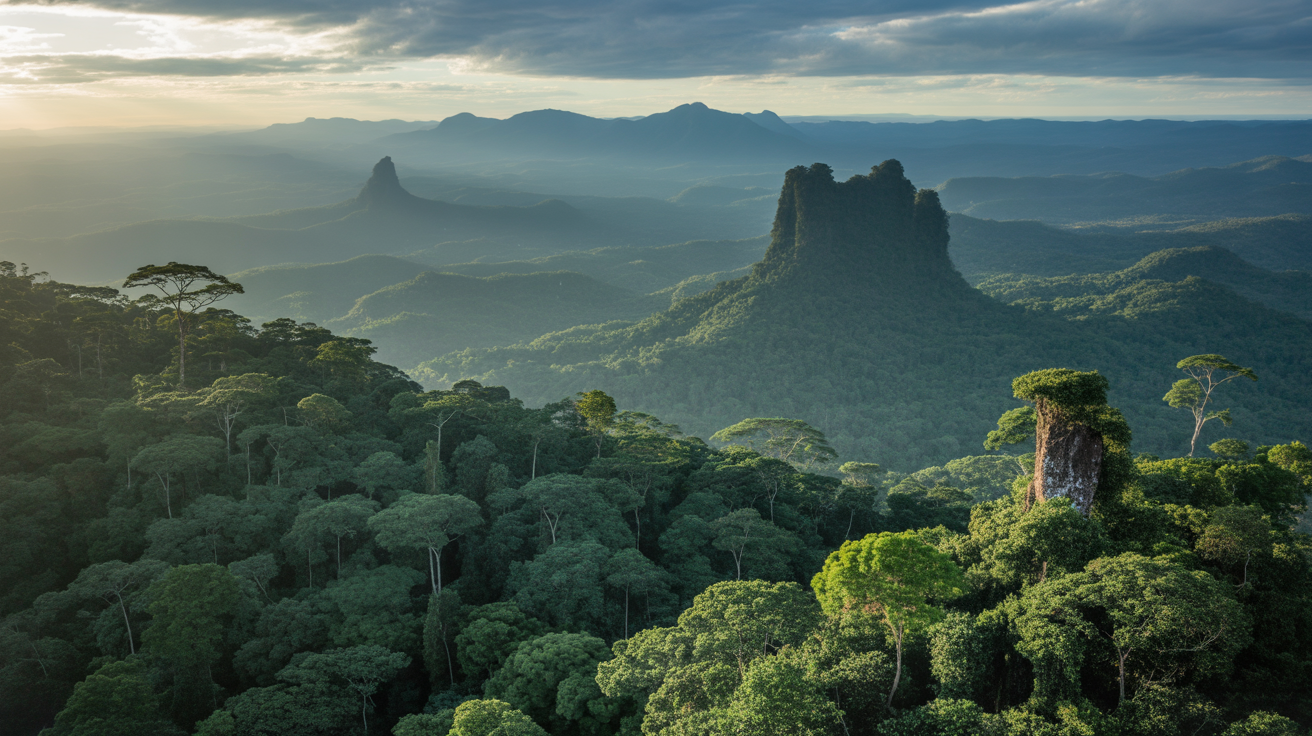

Conservation
The Honduran white bat is currently classified as Near Threatened on the IUCN Red List.
Threats & challenges
The primary threats to the Honduran white bat are habitat loss and fragmentation due to deforestation for agriculture, cattle ranching, and urban development. The species’ reliance on specific understory plants for tent construction makes it particularly vulnerable to changes in forest structure and plant community composition. Pesticide use and climate change may also impact food availability and roost site quality. Although currently listed as Near Threatened by the IUCN, population trends are believed to be declining, and local extinctions have occurred in heavily deforested areas. Conservation challenges include protecting lowland rainforest habitats, maintaining plant diversity, and mitigating human disturbance.
Taxonomy
Scientific name
Ectophylla alba
- Kingdom
- Animalia
- Phylum
- Chordata
- Class
- Mammalia
- Order
- Chiroptera
- Family
- Phyllostomidae
- Genus
- Ectophylla
- Species
- alba
Community notes
Share your observations about the Honduran white bat.
No community notes yet. Be the first!
Discover more wildlife
More fascinating animals from the encyclopedia.