
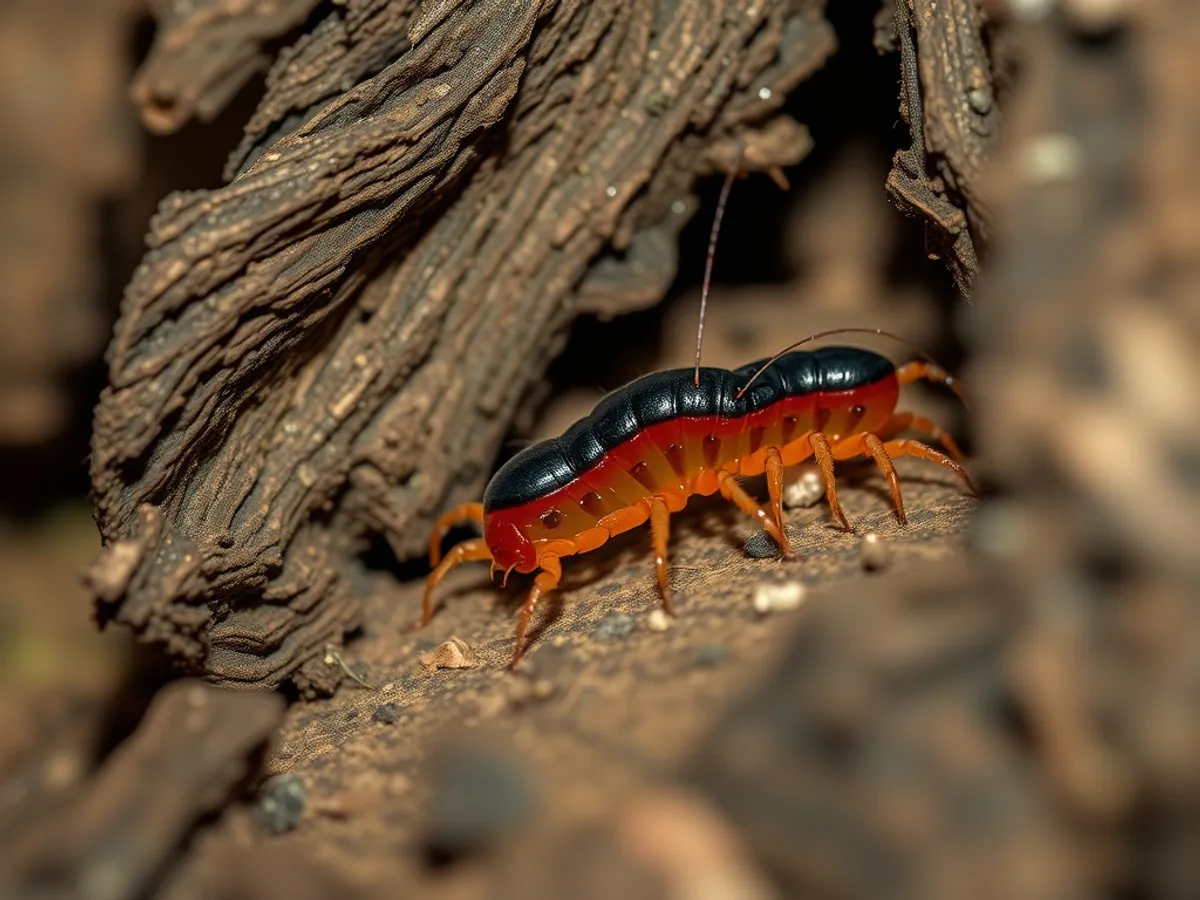
About the House Centipede
Scutigera coleoptrata is the fast, leggy horror that sprints across bathroom floors, and it is worth appreciating rather than crushing: it is a specialist predator of exactly the things people do not want indoors - cockroaches, silverfish, bed bugs, moth larvae, spiders and flies. Unlike most centipedes, which are blind, blundering soil-dwellers, the house centipede has large faceted compound eyes, an evolutionary rarity in the group, and it hunts by sight as well as touch. It has 15 pairs of legs, each pair longer than the one in front, an arrangement that keeps the legs from tangling at speed - and it is genuinely fast, clocked at around 0.4 m per second, which for its size is comparable to a sprinting human. The rearmost pair are long and antenna-like, so a startled centipede often looks as if it has two heads, buying it a moment when a predator grabs the wrong end. Its legs shed easily, an autotomy defence, and it can regrow them. The venomous forcipules - modified front legs, not true jaws - are usually too small to break human skin, and a rare bite is comparable to a bee sting. It also lassoes prey, whipping its long legs around an insect to pin it.
Fascinating facts
Indoor Resident
House centipedes are often found living indoors, especially in damp places like bathrooms and basements.
Compound Eyes
Unlike most centipedes, Scutigera coleoptrata has well-developed compound eyes, which provide better vision for hunting.
Speedy Predator
With 15 pairs of long legs, house centipedes can dash rapidly to chase down insects and escape predators.
Detailed description
Scutigera coleoptrata, commonly known as the house centipede, is a small to medium-sized arthropod typically measuring 25–35 mm in body length, with its long, delicate legs extending its total span to up to 100 mm. The body is dorsoventrally flattened and consists of 15 distinct segments, each bearing a pair of elongated, banded legs, giving the centipede a feather-like appearance. Its coloration is generally yellowish-grey with three longitudinal dark stripes running along the dorsal surface. The head is equipped with large, well-developed compound eyes—unusual among centipedes—providing acute vision for nocturnal hunting. Antennae are long and highly sensitive, aiding in navigation and prey detection. The house centipede possesses forcipules (modified front legs) that inject venom into prey, allowing it to subdue a wide variety of arthropods. Its exoskeleton is thin and flexible, facilitating rapid movement and the ability to squeeze into narrow crevices. Scutigera coleoptrata is primarily nocturnal, emerging at night to hunt, and is capable of running at speeds up to 0.4 m/s. Unlike many centipedes, it is well adapted to indoor environments, thriving in damp, sheltered areas of human dwellings. Its unique locomotion, alternating leg pairs in a wave-like motion, allows for agile movement across walls and ceilings.
Did you know?
Despite their alarming appearance, house centipedes are actually beneficial in homes because they prey on pests like cockroaches, termites, and spiders.
Research & sources
Wikipedia summary
A number of different centipede species in the family Scutigeridae are known as the house centipede, including:Scutigera coleoptrata, originally from the Mediterranean region, but now found almost worldwide Allothereua maculata, endemic to Australia
Behaviour & social structure
House centipedes are solitary and highly territorial, spending daylight hours hidden in cracks, under debris, or within wall voids. They are active hunters rather than ambush predators, using their speed and agility to chase down prey such as cockroaches, termites, silverfish, ants, and spiders. Upon detecting prey, they use their antennae to precisely locate and then rapidly immobilize it with venomous forcipules. Feeding is typically done in seclusion, and centipedes may consume multiple prey items in a single night. They exhibit thigmotactic behavior, preferring close contact with surfaces, which aids in navigation and protection. House centipedes are sensitive to vibrations and light, quickly retreating from disturbances. They do not form colonies or exhibit social cooperation, and encounters between individuals can result in aggressive displays or cannibalism, especially in resource-scarce environments.
Reproduction & life cycle
Reproduction in Scutigera coleoptrata involves indirect sperm transfer. Males deposit a spermatophore on the substrate, which the female collects with her genital opening. Courtship involves tactile and chemical cues, with the male and female engaging in a brief antennal interaction. Females lay between 35 and 150 eggs in moist, protected locations, such as soil crevices or beneath debris. Eggs hatch after several weeks, depending on temperature and humidity. Juveniles, known as nymphs, resemble adults but have fewer leg pairs (typically four at hatching) and acquire additional pairs with each successive molt, reaching the full complement of 15 pairs after 5–7 molts. There is no parental care; offspring are independent from hatching. Breeding can occur year-round in stable indoor environments, but may be seasonally restricted in temperate climates.
Adaptations & survival
The house centipede exhibits several key adaptations for survival in human habitats. Its elongated legs, each with specialized tarsal segments, enable rapid, multidirectional movement and the ability to scale vertical surfaces and ceilings. The thin, flexible exoskeleton allows entry into narrow crevices for shelter and hunting. Large compound eyes provide superior vision compared to most centipedes, enhancing nocturnal predation. The antennae are highly sensitive to chemical and mechanical stimuli, crucial for detecting prey and navigating dark environments. Venomous forcipules allow efficient subjugation of a wide range of arthropod prey. Behavioral adaptations include nocturnality, thigmotaxis, and the ability to autotomize (shed) legs to escape predators. Their tolerance for low-light, high-humidity microhabitats enables them to exploit indoor niches unavailable to many other predatory arthropods.
Cultural significance
The house centipede has a mixed reputation in human culture. In many societies, its sudden appearance indoors and unusual appearance evoke fear or disgust, often leading to its persecution. However, it is also recognized as a beneficial predator, controlling populations of household pests such as cockroaches and termites. In folklore, centipedes are sometimes associated with bad omens or supernatural abilities, but Scutigera coleoptrata is less prominent in mythology than larger tropical centipedes. There are no known traditional uses of this species in medicine or cuisine. In recent years, public perception has shifted somewhat, with increased appreciation for its ecological role as a natural pest controller.
Recent research
Recent research has focused on the biomechanics of Scutigera coleoptrata's locomotion, revealing unique gait patterns and leg coordination that enable high-speed movement and rapid changes in direction. Studies on its visual system have highlighted the evolutionary significance of its large compound eyes among centipedes, suggesting adaptation to active predation in low-light environments. Molecular analyses have traced its global dispersal patterns, confirming its Mediterranean origin and subsequent spread via human trade and travel. Ongoing research explores its venom composition, which contains a complex mixture of enzymes and neurotoxins effective against a wide range of arthropods but largely harmless to humans. Behavioral studies continue to investigate its sensory ecology, reproductive strategies, and interactions with other synanthropic species.
Sources
Videos
Habitat
Human dwellings, basements, and other damp indoor environments


Conservation
The House Centipede is currently classified as Least Concern on the IUCN Red List.
Threats & challenges
Scutigera coleoptrata faces few significant threats in its introduced range due to its adaptability and synanthropic lifestyle. Natural predators include spiders, larger centipedes, and some small mammals. Human impact is largely indirect, with populations occasionally reduced by pesticide use or habitat modification (e.g., reducing indoor humidity). However, their ability to recolonize and reproduce rapidly mitigates these pressures. There are no major conservation concerns; the species is classified as Least Concern and is expanding its range globally. In some regions, local populations may be affected by competition with other synanthropic arthropods or extreme environmental changes, but overall population trends are stable or increasing.
Taxonomy
Scientific name
Scutigera coleoptrata
- Kingdom
- Animalia
- Phylum
- Arthropoda
- Class
- Chilopoda
- Order
- Scutigeromorpha
- Family
- Scutigeridae
- Genus
- Scutigera
- Species
- coleoptrata
Community notes
Share your observations about the House Centipede.
No community notes yet. Be the first!
Discover more wildlife
More fascinating animals from the encyclopedia.