
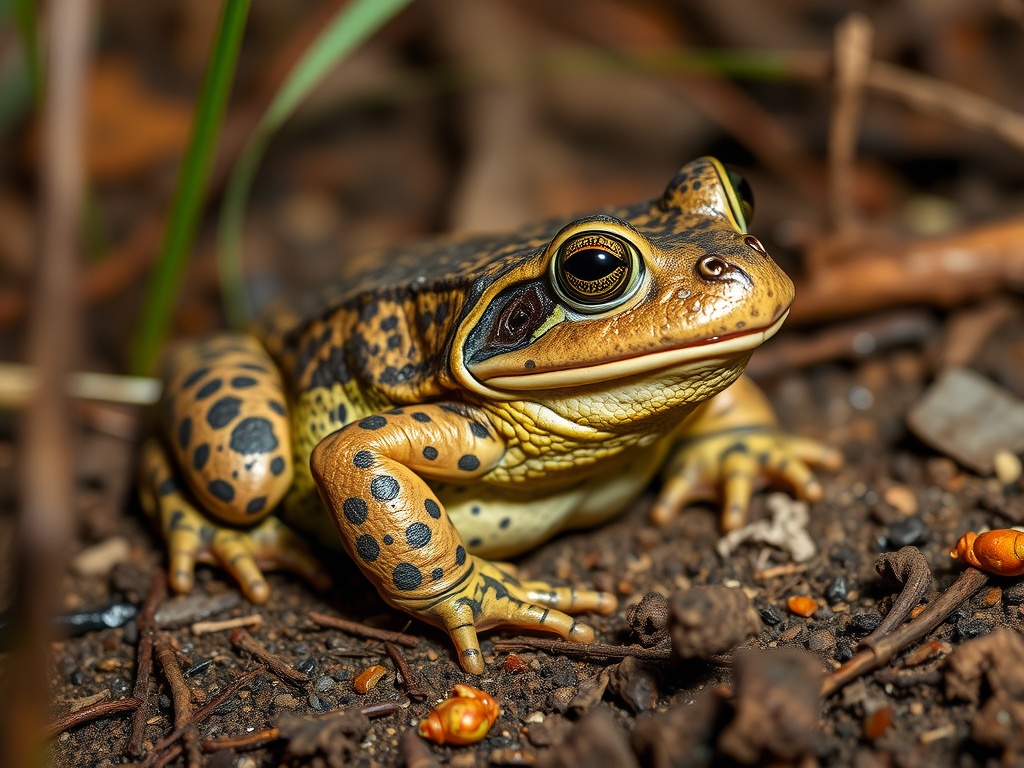
About the Houston Toad
The Houston toad is a small, rare amphibian native to the sandy soils and pine forests of east-central Texas, USA. Characterized by its brownish, warty skin and dark spots, it measures about 2 to 3.5 inches in length. This nocturnal species is most active after rains, breeding in shallow, temporary pools. Due to habitat loss, drought, and invasive species, its populations have declined drastically, making it one of the most endangered amphibians in North America.
Fascinating facts
Unique Vocalization
Male Houston toads produce a long, high-pitched trill that can last up to 14 seconds to attract females during the breeding season.
Habitat Specialist
This species depends on specific sandy soils in pine and oak woodlands, making it highly sensitive to habitat changes.
Conservation Efforts
Intensive management, including captive breeding and habitat restoration, is underway to try and save the Houston toad from extinction.
Detailed description
The Houston toad (Anaxyrus houstonensis) is a small, terrestrial amphibian, notable for its robust, squat body and granular, warty skin, which is typically brown to grayish with irregular dark blotches and a pale, often bluish, ventral surface. Adults range from 5 to 9 cm (2 to 3.5 inches) in snout-vent length, with males generally smaller and more slender than females. A distinguishing feature is the presence of a prominent cranial crest and a parotoid gland behind each eye, which secretes toxins as a defense mechanism. The species has relatively short limbs and unwebbed fingers, adapted for burrowing in sandy soils. Houston toads are primarily nocturnal and secretive, spending much of the year underground to avoid desiccation and extreme temperatures. Their activity peaks during the breeding season, when males emerge to call from temporary ponds. The call is a high-pitched, musical trill lasting up to 14 seconds, audible over considerable distances. The Houston toad is solitary outside the breeding season and is highly sensitive to environmental changes, relying on specific microhabitats with deep sandy soils and native vegetation for survival. Its skin is permeable, making it particularly vulnerable to pollutants and changes in soil moisture.
Did you know?
Despite being named after Houston, this toad is now extinct in the city itself due to urban development.
Research & sources
Wikipedia summary
The Houston toad, formerly Bufo houstonensis, is an endangered species of amphibian that is endemic to Texas in the United States. This toad was discovered in the late 1940s and named in 1953. It was among the first amphibians added to the United States List of Endangered Native Fish and Wildlife and is currently protected by the Endangered Species Act of 1973 as an endangered species. The Houston toad was placed as "endangered" on the IUCN Red List of Threatened Species from 1986 to 2022, and has worsened to "critically endangered" since then, with fewer than 250 mature individuals believed to remain in the wild as of 2021. Their kind is threatened every day as they continue to suffer from a loss of habitat and extreme drought. Their typical life expectancy is at least 3 years but it may exceed this number.
Behaviour & social structure
Houston toads are primarily nocturnal, emerging from burrows or under cover objects at dusk to forage. Their diet consists mainly of small invertebrates, including ants, beetles, spiders, and caterpillars, which they capture using a sticky, protrusible tongue. Foraging is opportunistic, with activity increasing after rainfall when prey is abundant. Outside of the breeding season, individuals are solitary and exhibit strong site fidelity, often returning to the same burrow or shelter. During the breeding season, males congregate at ephemeral ponds and call to attract females, establishing loose choruses. Aggressive interactions are rare, but males may compete for optimal calling sites. The species is highly sensitive to dehydration and temperature extremes, spending hot or dry periods underground in self-dug burrows or natural cavities. Predation risk is mitigated by cryptic coloration and the secretion of mild toxins from the parotoid glands.
Reproduction & life cycle
Breeding occurs from January to June, with peak activity typically in February and March, triggered by warm, rainy nights. Males arrive at shallow, temporary ponds and produce a distinctive, long trill to attract females. Amplexus (mating embrace) is axillary, with the male grasping the female behind the forelimbs. Females lay between 1,500 and 8,000 eggs in long gelatinous strings, which are fertilized externally. Eggs hatch within 3 to 6 days, depending on water temperature, and tadpoles undergo metamorphosis in 30 to 60 days. There is no parental care after egg deposition. Juvenile toads disperse from breeding sites soon after metamorphosis, seeking suitable terrestrial habitats. Breeding success is highly dependent on the availability and persistence of suitable aquatic sites, which are increasingly rare due to habitat alteration and drought.
Adaptations & survival
The Houston toad exhibits several adaptations to its sandy woodland habitat. Its burrowing behavior and short, robust limbs allow it to escape extreme temperatures and desiccation by retreating underground. The permeable skin facilitates cutaneous respiration but also requires the toad to remain in moist microhabitats. The parotoid glands secrete bufotoxins, deterring some predators. Cryptic coloration and irregular dorsal patterning provide camouflage against sandy and leaf-littered substrates. The species' reproductive strategy—explosive breeding in ephemeral ponds—reduces predation risk to eggs and larvae by avoiding permanent water bodies where predators are common. The long, musical advertisement call is adapted for transmission over open, sandy landscapes, maximizing mate attraction.
Cultural significance
The Houston toad has become a symbol of conservation efforts in Texas, representing the challenges faced by endemic species in rapidly developing regions. It is featured in local educational programs and conservation campaigns, particularly in the Bastrop County area. While there is no evidence of significant traditional or mythological roles, its plight has raised public awareness about amphibian declines and the importance of habitat preservation. The species has also been used as a case study in environmental law and policy discussions, especially regarding the Endangered Species Act.
Recent research
Recent research has focused on habitat requirements, population genetics, and the impacts of drought and fire on Houston toad populations. Studies using environmental DNA (eDNA) have improved detection of the species in fragmented habitats. Captive breeding and head-starting programs, led by organizations such as the Houston Zoo, have released thousands of juvenile toads into restored habitats, with ongoing monitoring of survival and reproduction. Genetic studies have highlighted low diversity and inbreeding concerns, prompting efforts to maximize genetic variability in captive populations. Research into the effects of prescribed fire and habitat restoration has shown that maintaining open, sandy woodlands with native vegetation is critical for long-term survival. The Houston toad is also monitored as an indicator species for ecosystem health in the Lost Pines region.
Sources
Videos
Habitat
Sandy woodlands and pine forests
 Various Continental Regions
Grassland
Open areas dominated by grasses rather than trees, supporting numerous herbivores and their predators.
 Global
Forest
Wooded areas with significant tree cover and diverse plant and animal communities.
 Global
Freshwater
Lakes, rivers, and wetlands with diverse aquatic ecosystems.
Conservation
The Houston Toad is currently classified as Critically Endangered on the IUCN Red List.
Threats & challenges
The Houston toad faces severe threats from habitat loss, fragmentation, and degradation, primarily due to urbanization, agriculture, and fire suppression, which alter the sandy woodland ecosystems it depends on. Prolonged droughts, exacerbated by climate change, reduce the availability of breeding ponds and increase mortality. Invasive species, such as fire ants (Solenopsis invicta), prey on eggs and tadpoles and compete for resources. Pesticide use and pollution further threaten the species by contaminating breeding sites and affecting sensitive skin. Genetic bottlenecks and small population sizes increase vulnerability to disease and reduce adaptive potential. As of 2021, fewer than 250 mature individuals are estimated to remain in the wild, with populations highly fragmented and isolated, making recovery efforts challenging.
Taxonomy
Scientific name
Anaxyrus houstonensis
- Kingdom
- Animalia
- Phylum
- Chordata
- Class
- Amphibia
- Order
- Anura
- Family
- Bufonidae
- Genus
- Anaxyrus
- Species
- houstonensis
Community notes
Share your observations about the Houston Toad.
No community notes yet. Be the first!
Discover more wildlife
More fascinating animals from the encyclopedia.